IMAGE IN CARDIOLOGY

DOI: 10.4244/EIJV10I12A258

Percutaneous closure of ruptured sinus of Valsalva aneurysms using a retrograde approach without formation of an arteriovenous loop

William Wilson, MBBS, FRACP; Yaso Emmanuel, MBChB, DPhil, MRCP; Neal Uren, MD, FRCP; David Northridge*, MB, FRCP

A 37-year-old male presented with exertional dyspnoea (NYHA III) and cardiac imaging demonstrated a ruptured sinus of Valsalva aneurysm (right aortic sinus to right atrium) (Figure 1A). The defect measured 6 mm at the aorta and successful device occlusion was achieved using an 8 mm AMPLATZER™ Muscular VSD Occluder (St. Jude Medical, St. Paul, MN, USA), delivered from the aorta without formation of an arteriovenous (AV) loop (Figure 1B). An immediate increase in the aortic diastolic pressure was noted after successful device deployment. The procedure was uncomplicated and the patient remains well at two-year clinical follow-up.
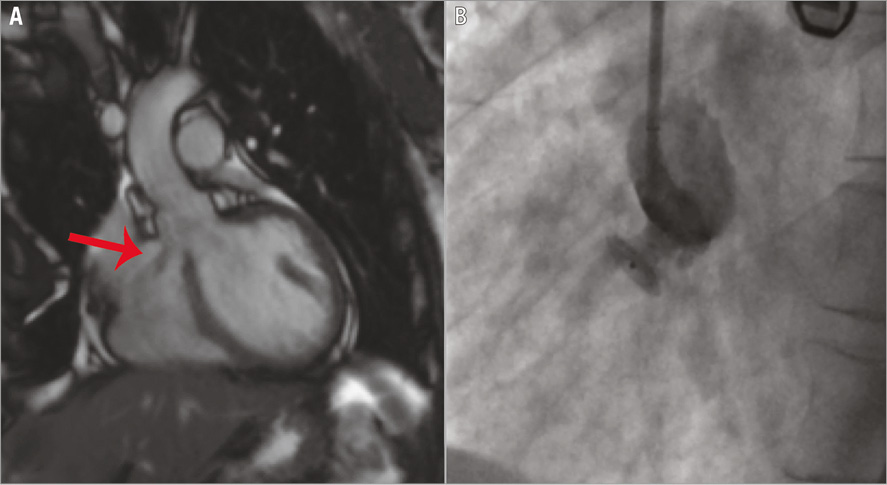
Figure 1. Imaging pre and during transcatheter closure. A) MRI with red arrow indicating fistula to right atrium. B) Cine angiography showing device in situ with cusp injection.

Ruptured sinus of Valsalva aneurysms carry significant morbidity. Surgery is the standard treatment, but transcatheter closure, which was initially explored out of need in high-risk surgical patients, has emerged as an alternative. Most previous reports of transcatheter closure describe delivery of a device (most commonly an AMPLATZER™ Duct Occluder; St. Jude Medical) from the venous side after formation of an AV loop. We have achieved successful closure in four cases through delivery of a “bileaflet” device in a retrograde fashion from the aorta without formation of an AV loop in a similar manner to the case described.

Conflict of interest statement

The authors have no conflicts of interest to declare.
Volume 10 Number 12
Apr 20, 2015
Volume 10 Number 12
View full issue


Key metrics

Suggested by Cory

CLINICAL RESEARCH

10.4244/EIJV10I4A87 Aug 19, 2014
Percutaneous closure of ruptured sinus of Valsalva aneurysm: results from a multicentre experience
Liu S et al
free

CLINICAL RESEARCH

10.4244/EIJ-D-18-00294 Dec 20, 2018
Safety and efficacy of percutaneous closure of ruptured sinus of Valsalva aneurysm
Yang K et al
free

Image – Interventional flashlight

10.4244/EIJ-D-18-01171 May 20, 2019
Percutaneous management of an embolised MANTA large bore arteriotomy closure device
Wong Y-H et al
free

Image – Interventional flashlight

10.4244/EIJ-D-19-00198 Jun 12, 2020
Percutaneous closure of atrial fistula after ascending aortic aneurysm surgery using cardiac fusion imaging
Cruz-González I et al
free

INTERVENTIONAL FLASHLIGHT

10.4244/EIJ-D-17-00647 Jan 19, 2018
Percutaneous closure of subannular rupture following transcatheter aortic valve implantation
Shah S et al
free

Image – Interventional flashlight

10.4244/EIJ-D-19-01122 Oct 9, 2020
The retro-antegrade approach to paravalvular leak closure after transcatheter aortic valve replacement
So C et al
free

IMAGE IN CARDIOLOGY

10.4244/EIJV12I8A165 Oct 10, 2016
Percutaneous closure of an iatrogenic aortocoronary venous fistula after coronary bypass graft surgery
Sandhu K et al
free
Trending articles
87.2

State-of-the-Art

10.4244/EIJ-D-25-00266 Jan 19, 2026
Lesion stratification with intracoronary imaging
McGarvey M et al
free
47.45

NEW INNOVATION

10.4244/EIJ-D-15-00467 Feb 20, 2018
Design and principle of operation of the HeartMate PHP (percutaneous heart pump)
Van Mieghem NM et al
free
34.8

Original Research

10.4244/EIJ-D-25-01006 Mar 16, 2026
Clinical outcomes and haemodynamic response after blinded stress assessment of moderate aortic stenosis
Eerdekens R et al
22.2

Viewpoint

10.4244/EIJ-D-25-01066 May 4, 2026
Intracoronary imaging guidance for de novo coronary lesion treatment with drug-coated balloons
Amabile N et al
free
20.75

Flashlight

10.4244/EIJ-D-25-01014 Apr 6, 2026
Stent retriever-assisted coronary thrombectomy with continuous aspiration
Liabot Q et al
open access
19.5

Original Research

10.4244/EIJ-D-26-00032 May 15, 2026
Glucocorticoids to reduce permanent pacemaker implantation after TAVI: the GLUCO-TAVI randomised trial
Fuertes-Kenneally L et al
17.8

Expert Review

10.4244/EIJ-D-25-01316 Apr 20, 2026
Electrosurgical laceration and stabilisation of tricuspid edge-to-edge repair: the ELASTA-T technique
Alvarez-Covarrubias H et al
free
X

PCR
Impact factor: 9.5
2024 Journal Citation Reports®
Science Edition (Clarivate Analytics, 2025)
Online ISSN 1969-6213 - Print ISSN 1774-024X
© 2005-2026 Europa Group - All rights reserved