Original Research

DOI: 10.4244/EIJ-D-26-00409

P2Y12 inhibitor monotherapy versus dual antiplatelet therapy after complex percutaneous coronary intervention in patients with acute coronary syndromes: a NEO-MINDSET trial substudy

Guy F.A. Prado1,2, MD; Pedro Beraldo de Andrade3, MD, PhD; Stefano Garzon Dias Lemos1,2, MD; Marcelo Franken1, MD, PhD; Patricia Oliveira Guimaraes1, MD, PhD; Caio de Assis Moura Tavares1,4, MD, PhD; Fabio Grunspun Pitta1,4, MD, PhD; Felipe Mateus Teixeira Bezerra1, MD; Willterson Carlos Bandeira1, MD; Maria Sanali5, MD, PhD; Silvia Regina Lamas Assis1, MSc; Frederico Monfardini1, MSc; Lailah Cristina de Carvalho Abrão1, MSc, PhD; Rosana Coura Rocha1, BSN; Fernanda Mangione6, MD; Vitor Arantes Pazolini7, MD; Adriadne Justi Bertolin4, MD, PhD; Murillo Antunes4,8, MD, PhD; Fabio Serra Silveira9, MD; Bruno Ramos Nascimento10, MD, PhD; Louis N. Ohe11, MD; Esmeralci Ferreira12, MD, PhD; Fernanda B.A. Sampaio13, MD; Rogerio Sarmento-Leite14, MD, PhD; Marco V. Wainstein15, MD, PhD; Cristiano Guedes Bezerra16, MD, PhD; Jose Airton Arruda7, MD, PhD; Breno Oliveira Almeida1, MD, PhD; Valeria Paradies17, MD, MSc; Jose Mariani Junior1, MD, PhD; Pedro Alves Lemos Neto1,18, MD, PhD

Abstract

Background: Whether the anatomical complexity of percutaneous coronary intervention (PCI) in patients with acute coronary syndromes (ACS) influences the effects of antiplatelet therapy remains unknown.

Aims: We aimed to evaluate the impact of coronary anatomical complexity on clinical outcomes in patients receiving potent P2Y12 inhibitor monotherapy or dual antiplatelet therapy (DAPT).

Methods: In the NEO-MINDSET trial, patients with ACS were randomised after successful PCI to 12-month ticagrelor- or prasugrel-based monotherapy or DAPT, initiated within the first 4 days of hospitalisation. The co-primary endpoints were (i) a composite of death, myocardial infarction, urgent target vessel revascularisation, or stroke; and (ii) Bleeding Academic Research Consortium (BARC) Type 2, 3, or 5 bleeding. Complex PCI was defined by one or more of the following criteria: three-vessel PCI, ≥3 treated lesions, ≥3 stents implanted, total stent length >60 mm, two-stent bifurcation, or stenting in the left main coronary artery, in a bypass graft, or in a chronic total occlusion lesion.

Results: Of the 3,408 randomised patients with available procedural data, 791 (23.2%) underwent complex PCI. Compared with the non-complex PCI group, patients in the complex PCI group were older (mean age 60.63±10.52 years vs 59.33±10.83 years; p=0.005) and had a higher prevalence of hypertension (67.9% vs 62.9%; p=0.010). Among patients undergoing complex PCI, 1, 2, or ≥3 complexity criteria were present in 45.5% (n=360), 22.5% (n=178), and 32.0% (n=253), respectively. PCI complexity did not significantly modify the treatment effects of monotherapy versus DAPT on the ischaemic co-primary endpoint (p-interaction=0.68). Likewise, PCI complexity did not have an effect on the comparative risk of BARC Type 2, 3, or 5 bleeding between monotherapy versus DAPT.

Conclusions: In this post hoc analysis of the NEO-MINDSET trial, PCI complexity did not significantly modify the treatment effects of potent P2Y12 inhibitor monotherapy versus DAPT on the co-primary ischaemic or bleeding outcomes. ClinicalTrials.gov: NCT04360720

Sign in to read
the full article

Forgot your password?
No account yet?
Sign up for free!

Create my pcr account

Join us for free and access thousands of articles from EuroIntervention, as well as presentations, videos, cases from PCRonline.com
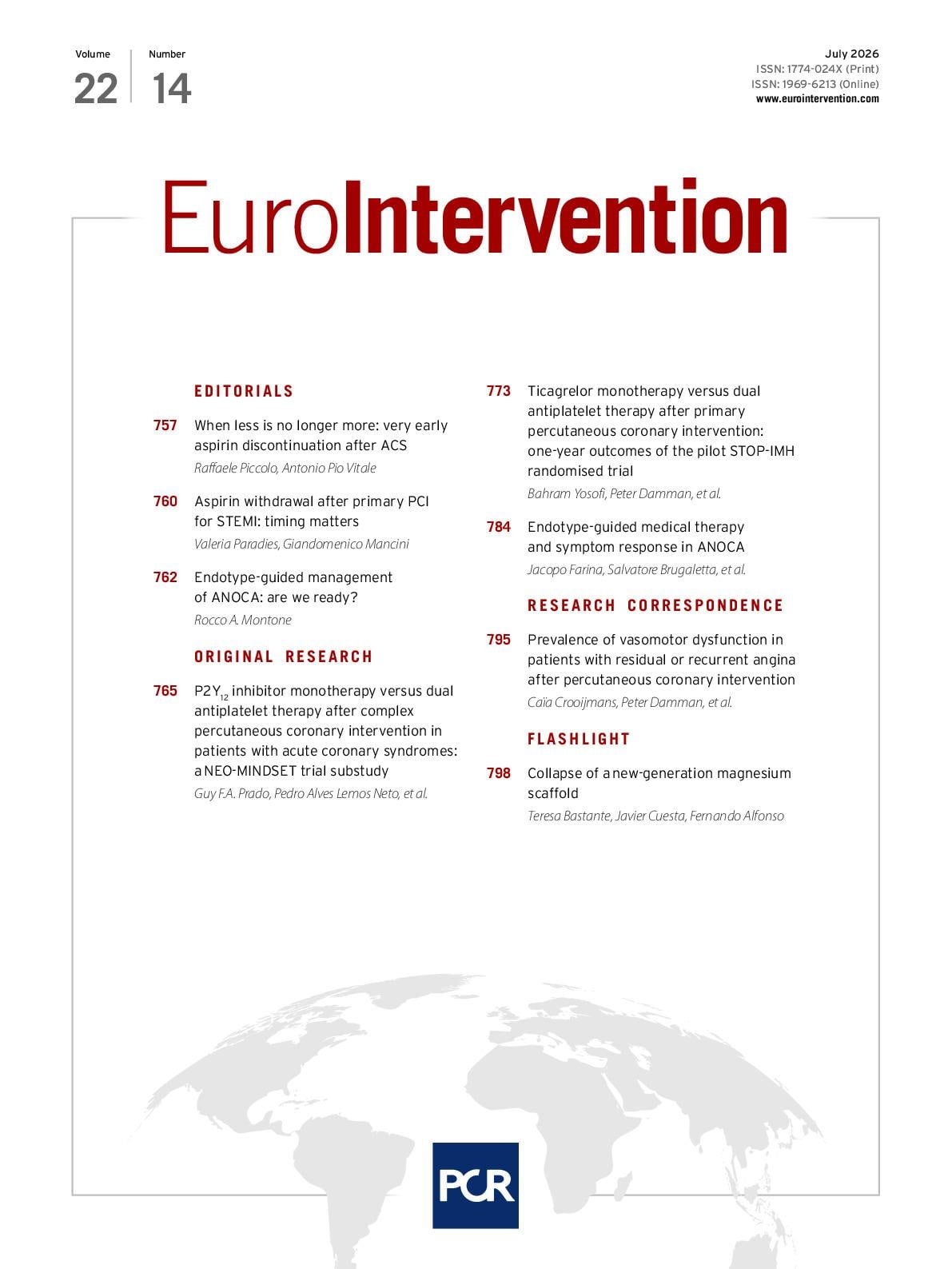
Volume 22 Number 14
Jul 20, 2026
Volume 22 Number 14
View full issue


Key metrics

Suggested by Cory

10.4244/EIJV15I11A174 Dec 6, 2019
Antiplatelet strategies for complex PCI
Capodanno D
free

Editorial

10.4244/EIJ-D-26-00648 Jul 20, 2026
When less is no longer more: very early aspirin discontinuation after ACS
Piccolo R and Vitale A
free

Clinical research

10.4244/EIJ-D-20-00145 Oct 23, 2020
Ticagrelor alone or conventional dual antiplatelet therapy in patients with stable or acute coronary syndromes
Franzone A et al
free

State-of-the-Art

10.4244/EIJ-D-24-00992 Sep 15, 2025
Antithrombotic therapy in complex percutaneous coronary intervention
Castiello D et al
free

Editorial

10.4244/EIJ-E-25-00023 Jul 21, 2025
DAPT de-escalation post-ACS: a new rule or just a new option? Lessons from the 4D-ACS trial
Cuisset T and Cayla G
free
Trending articles
335.05

State-of-the-Art Review

10.4244/EIJ-D-21-00904 Apr 1, 2022
Antiplatelet therapy after percutaneous coronary intervention
Angiolillo D et al
free
84.05

State-of-the-Art

10.4244/EIJ-D-23-00840 Sep 2, 2024
Aortic regurgitation: from mechanisms to management
Baumbach A et al
free
49.35

State-of-the-Art

10.4244/EIJ-D-25-00874 Jun 1, 2026
TAVI and coronary interventions: indications, technical considerations, and clinical scenarios
Aquino Bruno H et al
free
45.5

State-of-the-Art

10.4244/EIJ-D-25-01346 May 4, 2026
Slow flow and no reflow after percutaneous coronary intervention
Brugaletta S et al
free
38.2

State-of-the-Art

10.4244/EIJ-D-24-00195 Apr 7, 2025
Percutaneous coronary intervention for calcified and resistant lesions
Pesarini G et al
free
33.15

Original Research

10.4244/EIJ-D-26-00032 May 15, 2026
Glucocorticoids to reduce permanent pacemaker implantation after TAVI: the GLUCO-TAVI randomised trial
Fuertes-Kenneally L et al
X

PCR
Impact factor: 9.2
2025 Journal Citation Reports®
Science Edition (Clarivate Analytics, 2026)
Online ISSN 1969-6213 - Print ISSN 1774-024X
© 2005-2026 Europa Group - All rights reserved