Editorial

DOI: 10.4244/EIJ-D-26-00648

When less is no longer more: very early aspirin discontinuation after ACS

Raffaele Piccolo1, MD, PhD; Antonio Pio Vitale1, MD

In patients with acute coronary syndrome (ACS) undergoing percutaneous coronary intervention (PCI), the management of antiplatelet therapy poses two equally important challenges: preventing recurrent ischaemic complications and avoiding bleeding. Importantly, both events can have a similar impact on patients’ prognosis.1 Refinements in stent technology and the adoption of potent P2Y12 receptor inhibitors (P2Y12i) have fostered an unprecedented research effort exploring a wide range of antithrombotic strategies, with de-escalation from dual antiplatelet therapy (DAPT) to P2Y12i monotherapy being the most extensively studied intervention. Collectively, randomised evidence shows that withdrawing aspirin after 1-3 months following PCI is safe in terms of bleeding without a trade-off in ischaemic events.2 Nevertheless, only the NEO-MINDSET trial has evaluated aspirin discontinuation as early as within the first 4 days of hospitalisation for ACS in an adequately powered study. Although P2Y12i monotherapy decreased the risk of bleeding, it failed to meet non-inferiority to DAPT for ischaemic outcomes and was associated with an excess of stent thrombosis.3 This issue may become particularly relevant in patients undergoing complex PCI, in whom the likelihood of ischaemic manifestation...

Sign in to read
the full article

Forgot your password?
No account yet?
Sign up for free!

Create my pcr account

Join us for free and access thousands of articles from EuroIntervention, as well as presentations, videos, cases from PCRonline.com
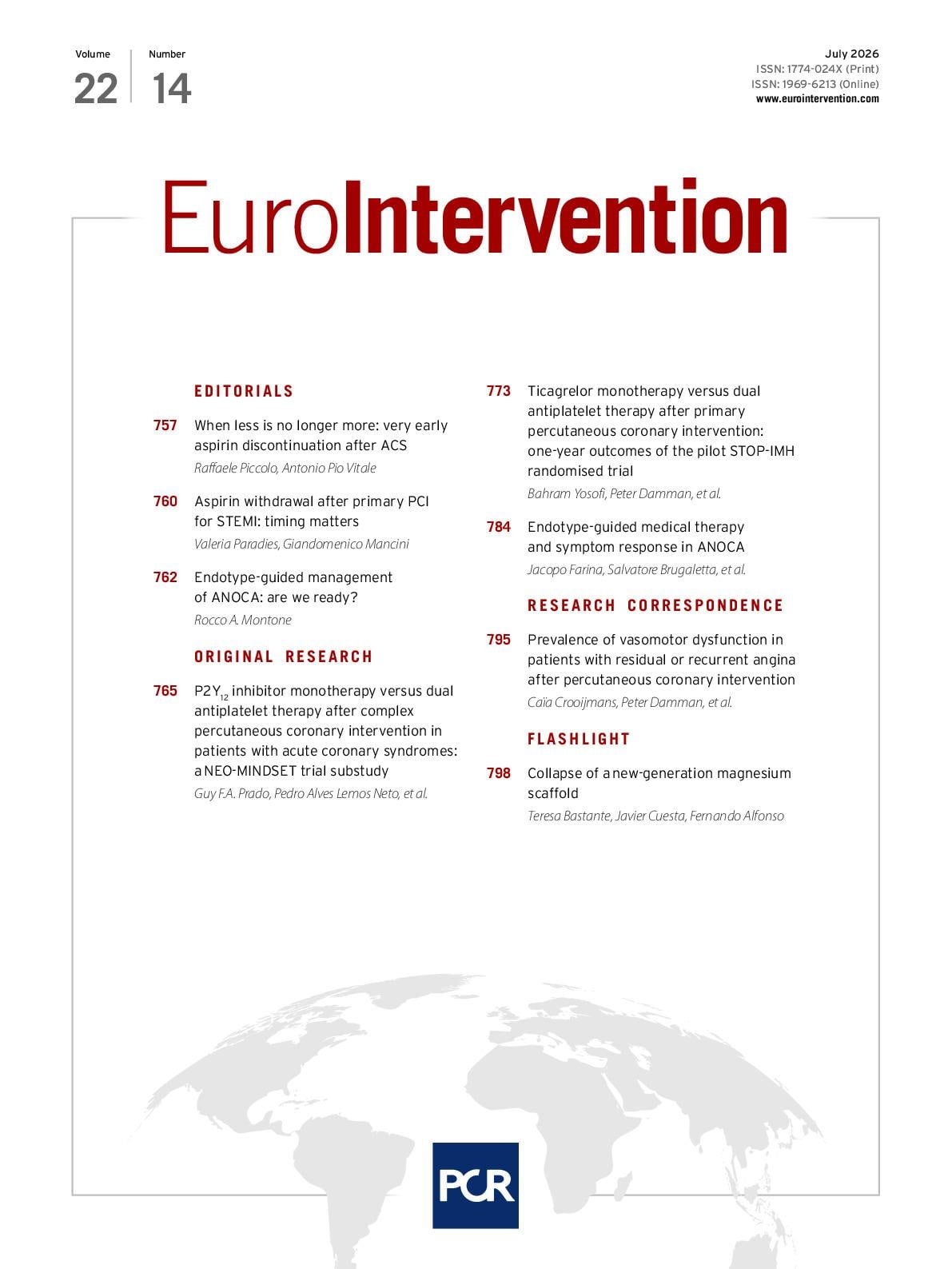
Volume 22 Number 14
Jul 20, 2026
Volume 22 Number 14
View full issue


Key metrics

Suggested by Cory

10.4244/EIJV15I12A192 Dec 20, 2019
GLOBAL LEADERS: looking now at the bigger picture
Guedeney P and Montalescot G
free

State-of-the-Art Review

10.4244/EIJ-D-21-00904 Apr 1, 2022
Antiplatelet therapy after percutaneous coronary intervention
Angiolillo D et al
free

Perspective

10.4244/EIJ-E-23-00001 Apr 3, 2023
Aspirin should be stopped at day 0 after PCI: pros and cons
Gurbel P et al
free

State-of-the-Art

10.4244/EIJ-D-25-00896 Apr 6, 2026
Pretreatment with antiplatelet agents in patients undergoing coronary revascularisation
Kaur G et al
free

10.4244/EIJV15I11A174 Dec 6, 2019
Antiplatelet strategies for complex PCI
Capodanno D
free
Trending articles
335.05

State-of-the-Art Review

10.4244/EIJ-D-21-00904 Apr 1, 2022
Antiplatelet therapy after percutaneous coronary intervention
Angiolillo D et al
free
84.05

State-of-the-Art

10.4244/EIJ-D-23-00840 Sep 2, 2024
Aortic regurgitation: from mechanisms to management
Baumbach A et al
free
49.35

State-of-the-Art

10.4244/EIJ-D-25-00874 Jun 1, 2026
TAVI and coronary interventions: indications, technical considerations, and clinical scenarios
Aquino Bruno H et al
free
45.5

State-of-the-Art

10.4244/EIJ-D-25-01346 May 4, 2026
Slow flow and no reflow after percutaneous coronary intervention
Brugaletta S et al
free
38.2

State-of-the-Art

10.4244/EIJ-D-24-00195 Apr 7, 2025
Percutaneous coronary intervention for calcified and resistant lesions
Pesarini G et al
free
33.15

Original Research

10.4244/EIJ-D-26-00032 May 15, 2026
Glucocorticoids to reduce permanent pacemaker implantation after TAVI: the GLUCO-TAVI randomised trial
Fuertes-Kenneally L et al
X

PCR
Impact factor: 9.2
2025 Journal Citation Reports®
Science Edition (Clarivate Analytics, 2026)
Online ISSN 1969-6213 - Print ISSN 1774-024X
© 2005-2026 Europa Group - All rights reserved