The European Society of Cardiology (ESC)/ European Association of Percutaneous Cardiovascular Interventions (EAPCI) Atlas in Interventional Cardiology is a joint project between the EAPCI and the ESC1. The ESC/EAPCI Atlas is a unique compendium of cardiovascular statistics across ESC member countries, providing a resource for guideline and policy development and an audit tool for the implementation of their recommendations in participating countries.
In this short report, we focus on changes in interventional practice over time, highlighting inequalities between high- and middle-income ESC member countries in Europe.
This is the 2nd ESC/EAPCI Atlas survey, with participation of 35 ESC member countries, expanding upon the 16 countries that contributed to the previous survey1. The descriptive statistics, infrastructure and procedure volumes are summarised in Supplementary Table 1. Data collection and analysis are reported in Supplementary Appendix 1. We acknowledge the contributing working groups and national representatives in Supplementary Appendix 2.
Our survey showed wide national variation in the number of catheterisation laboratories per million population, ranging from 1.46 in Ukraine to 12.12 in Germany. Notable changes were seen in Egypt, with an increase, and Denmark, with a reduction, of catheterisation laboratories between 2016 and 2018. Similar heterogeneity was observed in numbers of interventional cardiologists and procedure volumes, with continuing differences across ESC member countries in the penetration of life-saving interventions such as primary percutaneous coronary intervention (PCI) (Supplementary Table 1). Novel structural interventional procedures are generally increasing, particularly in higher-income countries, where they far outnumber those performed in middle-income countries.
All countries with paired 2016 and 2018 data available reported an increase in transcatheter aortic valve implantation (TAVI) procedures, except for Turkey and Greece. The procedure rates were low in middle-income countries, where fewer than 50 TAVI procedures per million people were performed. We found a positive correlation between TAVI implantation and gross national income per capita (r=0.95; p<0.001) (Figure 1).
Detailed results are summarised and illustrated in Supplementary Appendix 3-Supplementary Appendix 4-Supplementary Appendix 5 and Supplementary Figure 1-Supplementary Figure 2-Supplementary Figure 3-Supplementary Figure 4-Supplementary Figure 5-Supplementary Figure 6-Supplementary Figure 7-Supplementary Figure 8-Supplementary Figure 9-Supplementary Figure 10-Supplementary Figure 11-Supplementary Figure 12-Supplementary Figure 13-Supplementary Figure 14-Supplementary Figure 15-Supplementary Figure 16-Supplementary Figure 17.
The results of this survey document an ongoing increase in valvular interventions prior to the 2020 pandemic. The rate of coronary intervention appears stable in most developed countries. The wider spectrum of valve procedures, as well as the use of adjunctive coronary procedures, are predominantly present in higher-income countries with a more developed interventional infrastructure. The data we present illustrate the significant penetration of PCI across ESC member countries and provide a benchmark for policymakers developing national interventional services.
Although every effort went into making the maximum data available, we cannot claim completeness of data for all countries, procedures or infrastructure parameters. Furthermore, differences in the national datasets can make direct comparison difficult. Changes in data acquisition methods in some countries between the first and second editions may lead to inaccuracies in direct comparisons.
This 2nd ESC/EAPCI Atlas survey reports data on infrastructure and procedures in interventional cardiology from 35 participating ESC member countries. This edition will serve as a comparator for the next update, the EAPCI/ESC Atlas 3, which will address the impact of the pandemic on patient access to procedures, as well as the limitations to reporting, during and after the COVID-19 years.
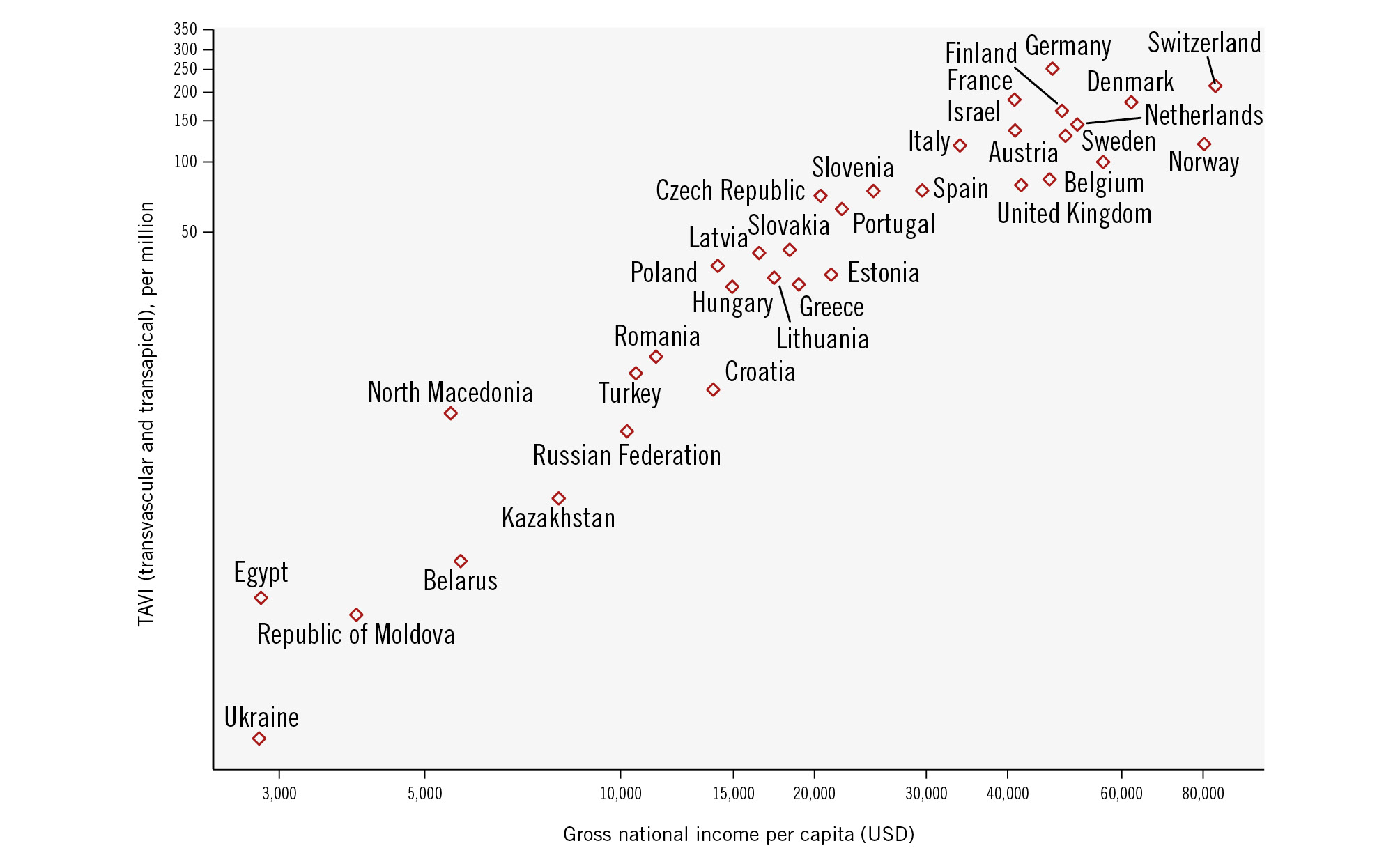
Figure 1. Transcatheter aortic valve implantation and gross national income across Europe in 2018 (log scale).
Funding
This project was funded by the European Society of Cardiology.
Conflict of interest statement
A. Baumbach reports personal fees from AstraZeneca, Sinomed, MicroPort, Medtronic, Faraday, Pi-Cardia, Biosensors, JenaValve, and Meril Life Sciences. E. Barbato reports personal fees from Insight Lifetech, Boston Scientific, and Abbott. P. Vardas reports personal fees from the ESC and Hygeia Hospitals Group. The other authors have no conflicts of interest to declare.
Supplementary data
To read the full content of this article, please download the PDF.