Original Research

DOI: 10.4244/EIJ-D-25-01352

Derivation and external validation of a deep learning model to predict changes in coronary plaque burden

Hector M. García-García1, MD; Carlos A. Bulant2,3, BSc; Gustavo A. Boroni2,3, BSc; Alejandro Clausse2,3, BSc; Thomas Engstrøm4, MD; Pedro A. Lemos5,6, MD; Nathan A. Lecaros Yap7, MD; Murat Cap7, MD; Juan F. Iglesias8, MD; Robert van Geuns9, MD; Irene M. Lang10, MD; David Spirk11,12, MD; Jonas D. Häner13, MD; Konstantinos C. Koskinas13, MD; Ryota Kakizaki13, MD; Yasushi Ueki13, MD; George C.M. Siontis13, MD; Cristos V. Bourantas7, MD; Pablo J. Blanco14, BSc; Lorenz Räber13, MD

Abstract

Background: Predicting the progression/regression of coronary plaque burden is challenging.

Aims: We aimed to develop a deep learning model to forecast changes in percent atheroma volume (ΔPAV) using intravascular ultrasound (IVUS).

Methods: We analysed data from IBIS-4 and PACMAN-AMI. Core lab measurements of plaque burden were available from IVUS pullbacks. Each model consists of a bidirectional Long Short-Term Memory (biLSTM) layer followed by two fully connected layers with one neuron each, resulting in both a classification for input progression/regression and an estimation of the ΔPAV.

Results: For the derivation and validation, a total of 1,960 regions of interest (ROIs) from the IBIS-4 dataset were used. The mean±standard deviation of the model accuracy was 0.85±0.02, the Matthews correlation coefficient was 0.70±0.04, and the F1 score was 0.85±0.02 for both progression and regression classes. In the testing (external validation) process with the PACMAN-AMI dataset, 5,283 ROIs were utilised. The mean ΔPAV was –0.31±5.63, for which 2,665 featured regression with a mean ΔPAV of –4.57±3.73, and 2,618 presented progression with a mean ΔPAV of 4.02±3.55, representing 49.6% of plaque progression prevalence. The predictive performance across the 100 trained models in the testing dataset showed an accuracy of 0.84, a Matthews correlation coefficient of 0.68, and an F1 score for the progression and regression classes of 0.84.

Conclusions: This is the first deep learning model capable of detecting changes in plaque progression by analysing the rate of plaque burden change between adjacent frames.

Sign in to read
the full article

Forgot your password?
No account yet?
Sign up for free!

Create my pcr account

Join us for free and access thousands of articles from EuroIntervention, as well as presentations, videos, cases from PCRonline.com
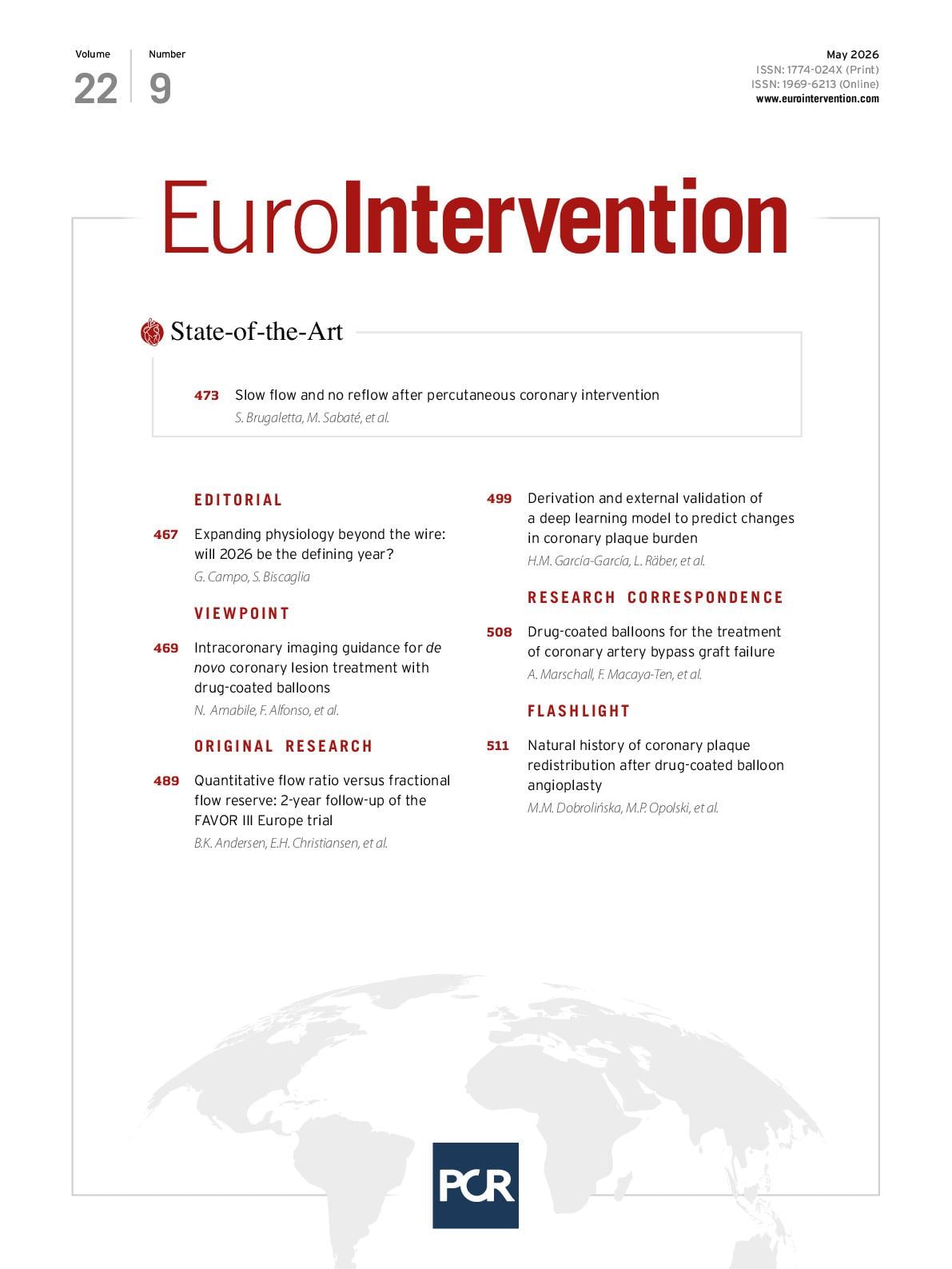
Volume 22 Number 9
May 4, 2026
Volume 22 Number 9
View full issue


Key metrics

Suggested by Cory

State-of-the-Art

10.4244/EIJ-D-24-00387 Jul 21, 2025
Advances in coronary imaging of atherosclerotic plaques
Garcia-Garcia H et al
free

Clinical research

10.4244/EIJ-D-20-00570 May 16, 2021
Training and validation of a deep learning architecture for the automatic analysis of coronary angiography
Du T et al
free
Trending articles
333.95

State-of-the-Art Review

10.4244/EIJ-D-21-00904 Apr 1, 2022
Antiplatelet therapy after percutaneous coronary intervention
Angiolillo D et al
free
202.75

State-of-the-Art

10.4244/EIJ-D-21-00089 Jun 11, 2021
Intracoronary optical coherence tomography: state of the art and future directions
Ali ZA et al
free
47.45

NEW INNOVATION

10.4244/EIJ-D-15-00467 Feb 20, 2018
Design and principle of operation of the HeartMate PHP (percutaneous heart pump)
Van Mieghem NM et al
free
42.15

State-of-the-Art

10.4244/EIJ-D-25-00896 Apr 6, 2026
Pretreatment with antiplatelet agents in patients undergoing coronary revascularisation
Kaur G et al
free
33.05

State-of-the-Art

10.4244/EIJ-D-25-00874 Jun 1, 2026
TAVI and coronary interventions: indications, technical considerations, and clinical scenarios
Aquino Bruno H et al
free
27.6

Original Research

10.4244/EIJ-D-25-01370 May 21, 2026
Prognostic value of early haemodynamic valve deterioration after TAVI
Trimaille A et al
27.6

Original Research

10.4244/EIJ-D-25-01370 Jun 1, 2026
Prognostic value of early haemodynamic valve deterioration after TAVI
Trimaille A et al
19.5

Original Research

10.4244/EIJ-D-26-00032 May 15, 2026
Glucocorticoids to reduce permanent pacemaker implantation after TAVI: the GLUCO-TAVI randomised trial
Fuertes-Kenneally L et al
X

PCR
Impact factor: 9.2
2025 Journal Citation Reports®
Science Edition (Clarivate Analytics, 2026)
Online ISSN 1969-6213 - Print ISSN 1774-024X
© 2005-2026 Europa Group - All rights reserved