Editorial

DOI: 10.4244/EIJ-E-26-00010

Aspirin withdrawal after primary PCI for STEMI: timing matters

Valeria Paradies1,2, MD, MSc; Giandomenico Mancini1,3, MD

Antithrombotic management in the early days after primary percutaneous coronary intervention (PCI) for ST-segment elevation myocardial infarction (STEMI) requires a careful balance between ischaemic protection and bleeding risk. Potent P2Y12 inhibitors, refined stent platforms, and shorter dual antiplatelet therapy (DAPT) regimens have collectively shifted the field towards strategies that minimise bleeding without compromising ischaemic protection.12 P2Y12 inhibitor monotherapy after a shorter period of DAPT is increasingly supported by trial data. Yet, when aspirin should be withdrawn – or whether it should be given beyond the loading dose at all – remains unsettled in STEMI.

In this issue of EuroIntervention, Yosofi and colleagues report the one-year outcomes of STOP-IMH,3 a multicentre open-label pilot randomised trial designed to compare ticagrelor plus aspirin as a DAPT strategy versus ticagrelor monotherapy after primary PCI for STEMI.

STOP-IMH enrolled 200 STEMI patients across five Dutch centres after successful primary PCI with drug-eluting stent implantation. All patients received aspirin and ticagrelor loading doses before PCI; they were then randomised to either ticagrelor monotherapy (n=99) or ticagrelor plus aspirin (n=101) and followed for 13 months. A...

Sign in to read
the full article

Forgot your password?
No account yet?
Sign up for free!

Create my pcr account

Join us for free and access thousands of articles from EuroIntervention, as well as presentations, videos, cases from PCRonline.com
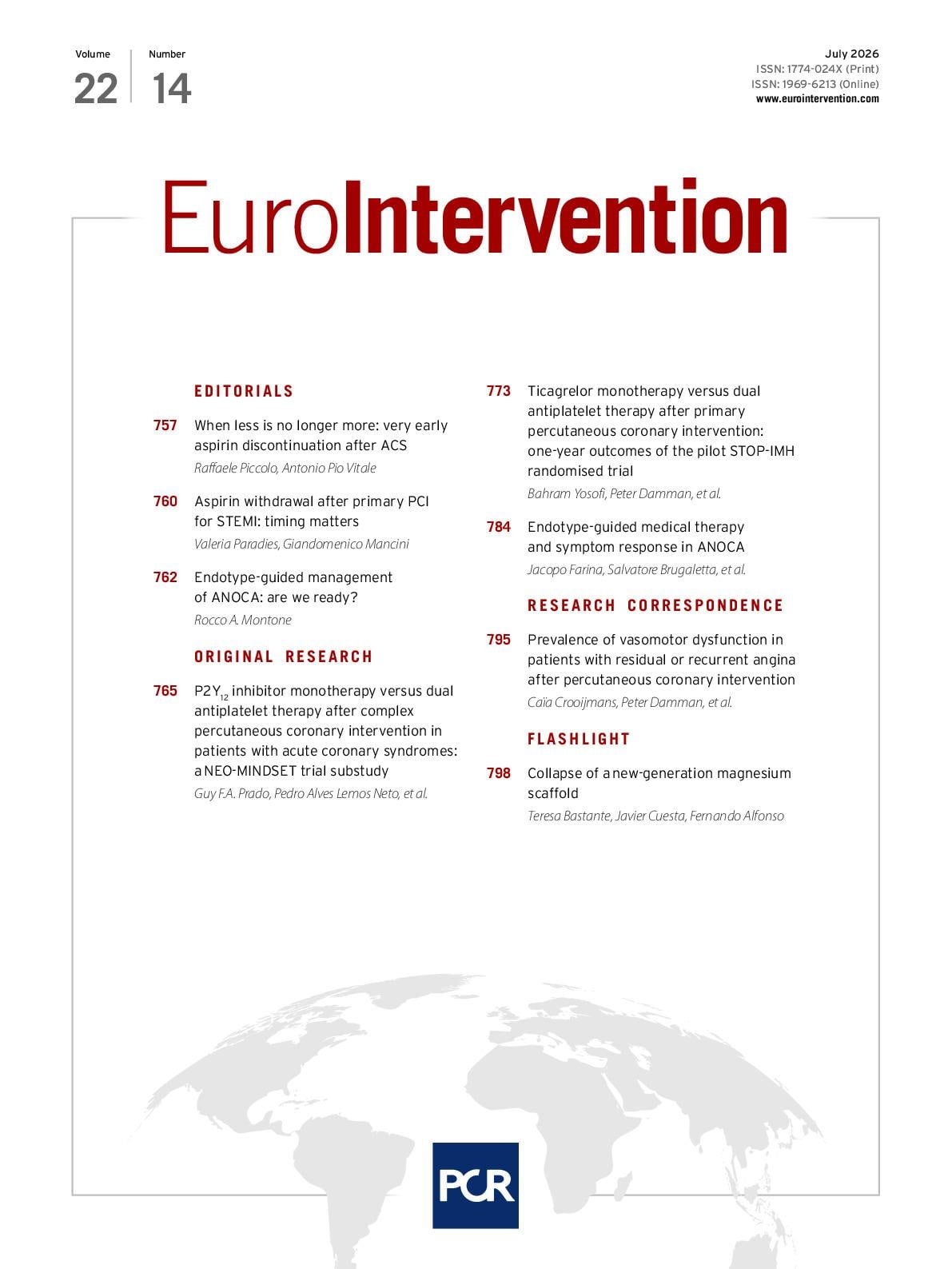
Volume 22 Number 14
Jul 20, 2026
Volume 22 Number 14
View full issue


Key metrics

Suggested by Cory

10.4244/EIJV10STA11 Aug 19, 2014
The conundrum of antithrombotic drugs before, during and after primary PCI
Cortese B et al
free

10.4244/EIJV15I12A192 Dec 20, 2019
GLOBAL LEADERS: looking now at the bigger picture
Guedeney P and Montalescot G
free

10.4244/EIJV14I1A3 May 20, 2018
P2Y12 inhibition in STEMI: early, strong or both?
Mangiacapra F and Di Sciascio G
free

Perspective

10.4244/EIJ-E-23-00001 Apr 3, 2023
Aspirin should be stopped at day 0 after PCI: pros and cons
Gurbel P et al
free

Editorial

10.4244/EIJ-D-26-00648 Jul 20, 2026
When less is no longer more: very early aspirin discontinuation after ACS
Piccolo R and Vitale A
free

State-of-the-Art Review

10.4244/EIJ-D-21-00904 Apr 1, 2022
Antiplatelet therapy after percutaneous coronary intervention
Angiolillo D et al
free
Trending articles
335.05

State-of-the-Art Review

10.4244/EIJ-D-21-00904 Apr 1, 2022
Antiplatelet therapy after percutaneous coronary intervention
Angiolillo D et al
free
84.05

State-of-the-Art

10.4244/EIJ-D-23-00840 Sep 2, 2024
Aortic regurgitation: from mechanisms to management
Baumbach A et al
free
49.35

State-of-the-Art

10.4244/EIJ-D-25-00874 Jun 1, 2026
TAVI and coronary interventions: indications, technical considerations, and clinical scenarios
Aquino Bruno H et al
free
45.5

State-of-the-Art

10.4244/EIJ-D-25-01346 May 4, 2026
Slow flow and no reflow after percutaneous coronary intervention
Brugaletta S et al
free
38.2

State-of-the-Art

10.4244/EIJ-D-24-00195 Apr 7, 2025
Percutaneous coronary intervention for calcified and resistant lesions
Pesarini G et al
free
33.15

Original Research

10.4244/EIJ-D-26-00032 May 15, 2026
Glucocorticoids to reduce permanent pacemaker implantation after TAVI: the GLUCO-TAVI randomised trial
Fuertes-Kenneally L et al
X

PCR
Impact factor: 9.2
2025 Journal Citation Reports®
Science Edition (Clarivate Analytics, 2026)
Online ISSN 1969-6213 - Print ISSN 1774-024X
© 2005-2026 Europa Group - All rights reserved