Original Research

DOI: 10.4244/EIJ-D-24-01065

Changes in non-culprit coronary lesions with PCSK9 inhibitors: the randomised, placebo-controlled FITTER trial

Frans B. Mensink1, MD; Jonathan Los1, MD; Mohamed M. Reda Morsy2, MD; Rohit M. Oemrawsingh3, MD, PhD; Clemens von Birgelen4, MD, PhD; Alexander J.J. Ijsselmuiden5,6, MD, PhD; Martijn Meuwissen5, MD, PhD; Jin M. Cheng3,5, MD, PhD; Diederik F. van Wijk7, MD, PhD; Pieter C. Smits8, MD, PhD; Valeria Paradies8, MD, PhD; Dirk J. van Wijk9, MD, PhD; Himanshu Rai10,11, PhD; Tim J.F. ten Cate1, MD, PhD; Cyril Camaro1, MD; Peter Damman1, MD, PhD; Lokien X. van Nunen1, MD, PhD; Aukelien C. Dimitriu-Leen1, MD, PhD; Marleen H. van Wely1, MD; Aysun Cetinyurek-Yavuz1, PhD; Robert A. Byrne10,11, MD, PhD; Niels van Royen1, MD, PhD; Robert-Jan M. van Geuns1, MD, PhD

Abstract

Background: Prolonged lipid-lowering therapy has demonstrated its ability to induce plaque regression and improve the plaque morphology of mild atherosclerotic lesions.

Aims: This trial aimed to assess the short-term effect of evolocumab in addition to high-intensity statin therapy (HIST) on relevant non-culprit coronary artery lesions using fractional flow reserve (FFR) measurements and multimodality intracoronary imaging.

Methods: Patients with an acute coronary syndrome (ACS) and relevant multivessel disease were randomised to receive either evolocumab or placebo for 12 weeks in addition to HIST. Patients underwent serial FFR and intravascular ultrasound (IVUS)-near-infrared spectroscopy imaging of a non-culprit vessel. The primary endpoints were the differences in the change in FFR and in the maximum lipid core burden index within any 4 mm segment (maxLCBI4mm). The secondary endpoints were the differences in the change in IVUS-derived atheroma volume parameters.

Results: Among 150 patients (mean age 64.2±8.5 years; 27 [18.0%] female) randomised to evolocumab (n=74) or placebo (n=76), 143 underwent follow-up coronary angiography. After 12 weeks of treatment, the adjusted mean change in FFR was 0.00 (95% confidence interval [CI]: −0.02 to 0.02) with evolocumab versus 0.01 (95% CI: −0.01 to 0.03) with placebo (adjusted mean difference: −0.01, 95% CI: −0.03 to 0.01; p=0.6). The adjusted mean change in the maxLCBI4mm was −27.8 (95% CI: −72.2 to 16.6) for evolocumab-treated patients versus −35.6 (95% CI: −82.5 to 11.4) for placebo-treated patients (adjusted mean difference: 7.8, 95% CI: −40.9 to 56.4; p=0.8). No between-group differences in any IVUS-derived parameter were found.

Conclusions: In patients with ACS and relevant non-culprit coronary artery lesions, the addition of evolocumab to HIST for 12 weeks, compared to placebo, did not result in improvement of FFR or maxLCBI4mm. (ClinicalTrials.gov: NCT04141579)

Sign in to read
the full article

Forgot your password?
No account yet?
Sign up for free!

Create my pcr account

Join us for free and access thousands of articles from EuroIntervention, as well as presentations, videos, cases from PCRonline.com
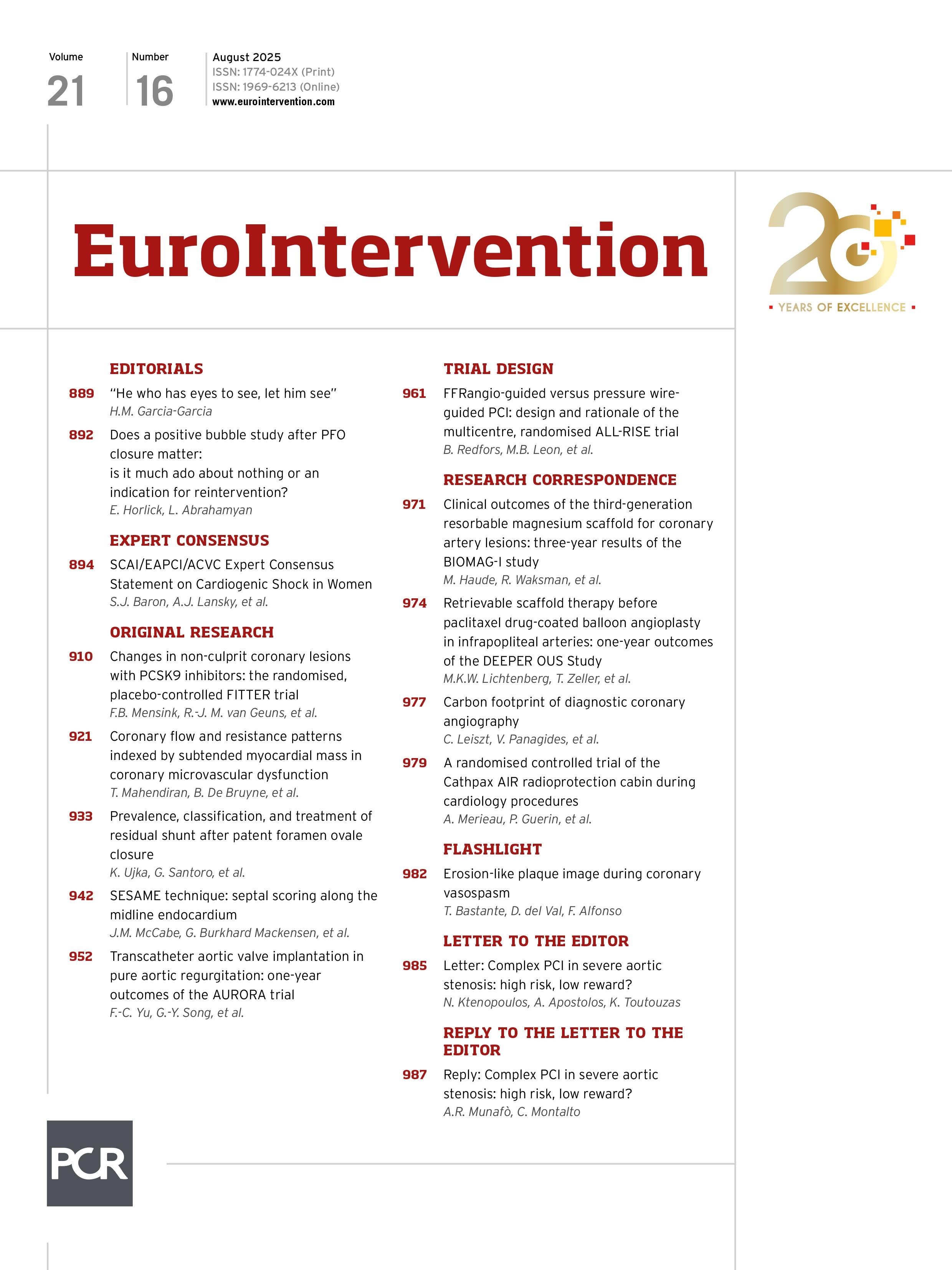
Volume 21 Number 16
Aug 18, 2025
Volume 21 Number 16
View full issue


Key metrics

Suggested by Cory

State-of-the-Art Review

10.4244/EIJ-D-20-00999 Apr 20, 2021
Lipid-lowering therapy and percutaneous coronary interventions
Koskinas K et al
free

Editorial

10.4244/EIJ-E-22-00032 Oct 7, 2022
In search of the pleiotropic effects of PCSK9 inhibitors
Räber L and Ueki Y
free

State-of-the-Art

10.4244/EIJ-D-24-00387 Jul 21, 2025
Advances in coronary imaging of atherosclerotic plaques
Garcia-Garcia H et al
free

Editorial

10.4244/EIJ-E-25-00036 Aug 18, 2025
“He who has eyes to see, let him see”
Garcia-Garcia H
free

Editorial

10.4244/EIJ-E-23-00005 Mar 20, 2023
Effects of PCSK9 inhibitors on platelet function
Räber L and Ueki Y
free

Debate

10.4244/EIJ-E-23-00014 Jul 17, 2023
In-hospital initiation of PCSK9 inhibitors in ACS: pros and cons
Krychtiuk KA et al
free
Trending articles
202.75

State-of-the-Art

10.4244/EIJ-D-21-00089 Jun 11, 2021
Intracoronary optical coherence tomography: state of the art and future directions
Ali ZA et al
free
87.2

State-of-the-Art

10.4244/EIJ-D-25-00266 Jan 19, 2026
Lesion stratification with intracoronary imaging
McGarvey M et al
free
47.45

NEW INNOVATION

10.4244/EIJ-D-15-00467 Feb 20, 2018
Design and principle of operation of the HeartMate PHP (percutaneous heart pump)
Van Mieghem NM et al
free
35.3

Original Research

10.4244/EIJ-D-25-01006 Mar 16, 2026
Clinical outcomes and haemodynamic response after blinded stress assessment of moderate aortic stenosis
Eerdekens R et al
26.25

Original Research

10.4244/EIJ-D-25-01370 May 21, 2026
Prognostic value of early haemodynamic valve deterioration after TAVI
Trimaille A et al
26.25

Original Research

10.4244/EIJ-D-25-01370 Jun 1, 2026
Prognostic value of early haemodynamic valve deterioration after TAVI
Trimaille A et al
23.2

State-of-the-Art

10.4244/EIJ-D-25-00874 Jun 1, 2026
TAVI and coronary interventions: indications, technical considerations, and clinical scenarios
Aquino Bruno H et al
free
22.2

Viewpoint

10.4244/EIJ-D-25-01066 May 4, 2026
Intracoronary imaging guidance for de novo coronary lesion treatment with drug-coated balloons
Amabile N et al
free
20.75

Flashlight

10.4244/EIJ-D-25-01014 Apr 6, 2026
Stent retriever-assisted coronary thrombectomy with continuous aspiration
Liabot Q et al
open access
X

PCR
Impact factor: 9.5
2024 Journal Citation Reports®
Science Edition (Clarivate Analytics, 2025)
Online ISSN 1969-6213 - Print ISSN 1774-024X
© 2005-2026 Europa Group - All rights reserved