Original Research

DOI: 10.4244/EIJ-D-25-00489

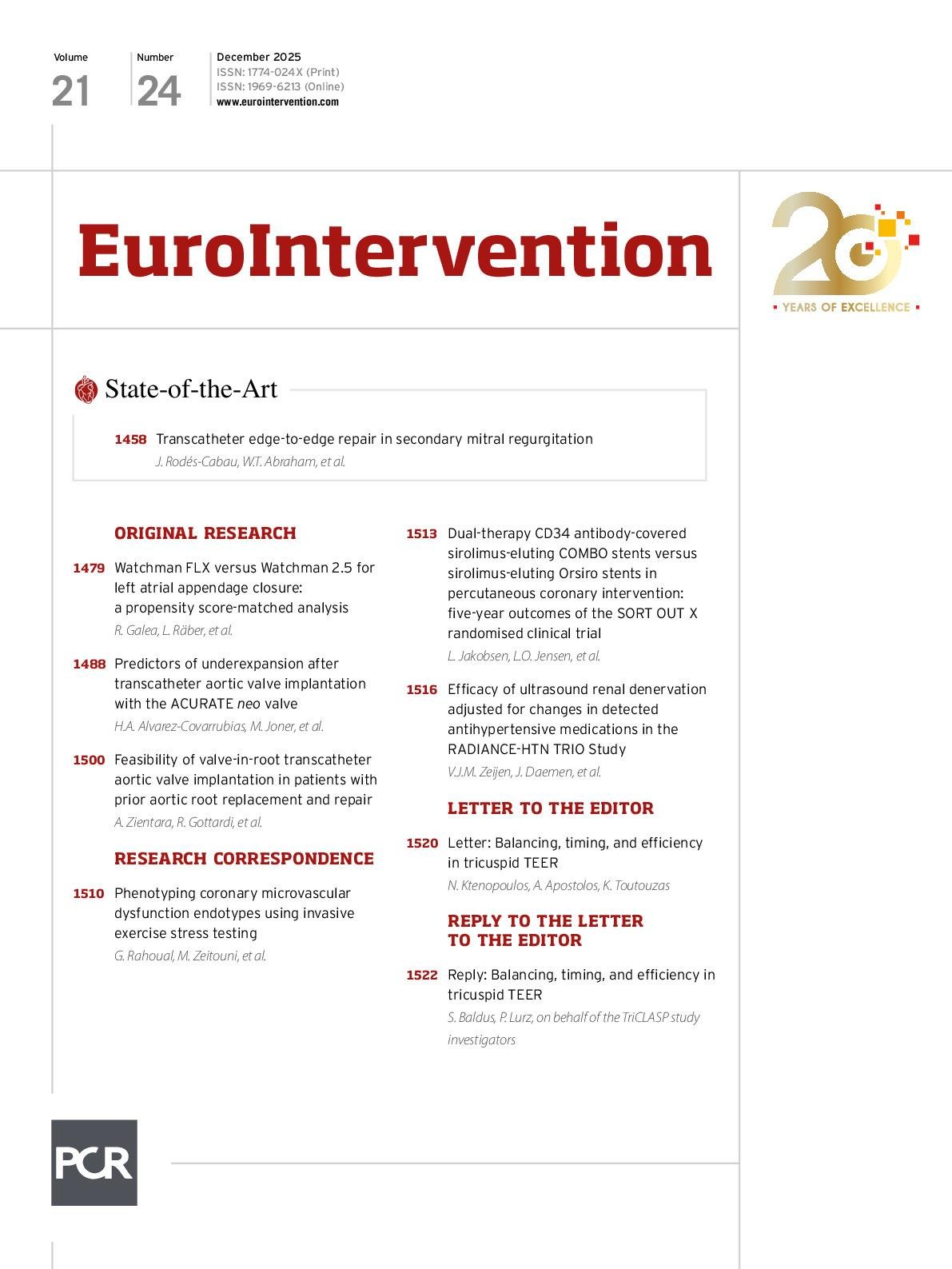
Predictors of underexpansion after transcatheter aortic valve implantation with the ACURATE neo valve

Hector A. Alvarez-Covarrubias1,2, MD, MSc, PhD; Yousuke Taniguchi1, MD; Martin Jurisic1, MD; Niklas Altaner1, MD; Finn Syryca1, MD; Edna Blum1, MD; Costanza Pellegrini1, MD; Charlotte Duesmann1, MD; N. Patrick Mayr3, MD; Tobias Rheude1, MD; Heribert Schunkert1,4, MD; Adnan Kastrati1,4, MD; Salvatore Cassese1,4, MD, PhD; Erion Xhepa1,4, MD, PhD; Michael Joner1,4, MD

Abstract

Background: Transcatheter heart valve (THV) deformation after transcatheter aortic valve implantation (TAVI) using the self-expanding ACURATE platform has been associated with impaired clinical outcomes in a randomised trial. Procedural factors associated with THV deformation remain incompletely understood.

Aims: We aimed to investigate procedural factors associated with valve underexpansion, mainly derived from preprocedural computed tomography angiography (CTA) imaging.

Methods: A single-centre, retrospective, observational study was carried out, including patients who underwent TAVI with an ACURATE THV between January 2014 and December 2022, with available CTA and procedural fluoroscopy. Aortic calcium volume was quantified using 3mensio software. Fluoroscopy was used to determine valve frame underexpansion.

Results: Of 3,027 patients, 480 were eligible (74 [15.4%] with an underexpanded and 406 [84.6%] with an expanded ACURATE THV). There were no differences regarding baseline clinical and procedural characteristics. Preprocedural CTA assessment showed more calcium at the annulus level in underexpanded versus expanded THVs (60.3 [interquartile range [IQR] 21.3; 135.2] mm3 vs 45.3 [IQR 15.8; 96.1] mm3, respectively; p=0.042), while post-dilatation was less frequently performed in underexpanded compared to expanded THVs (44.6% vs 64.8%, respectively; p=0.001). Multivariable regression analysis revealed that annulus calcium volume (odds ratio [OR] 2.333, 95% confidence interval [CI]: 1.331-4.089; p=0.003) and post-dilatation (OR 0.350, 95% CI: 0.203-0.602; p<0.001) were significantly associated with underexpanded THVs. Sensitivity analysis using annulus calcium volume as a dichotomised variable (>54 mm3) confirmed the significant association with valve frame underexpansion (OR 2.38, 95% CI: 1.37-4.19; p=0.002).

Conclusions: Annular calcium volume was shown to be associated with underexpanded ACURATE THVs, while post-dilatation may reduce valve deformation.

Sign in to read
the full article

Forgot your password?
No account yet?
Sign up for free!

Create my pcr account

Join us for free and access thousands of articles from EuroIntervention, as well as presentations, videos, cases from PCRonline.com
Volume 21 Number 24
Dec 15, 2025
Volume 21 Number 24
View full issue


Key metrics

Suggested by Cory

CLINICAL RESEARCH

10.4244/EIJ-D-17-00373 Oct 11, 2017
Subclinical leaflet thickening and stent frame geometry in self-expanding transcatheter heart valves
Fuchs A et al
free

Editorial

10.4244/EIJ-E-22-00034 Oct 21, 2022
Is transcatheter aortic valve implantation safe in patients with left ventricular outflow tract calcification?
Søndergaard L and Mylotte D
free

Clinical research

10.4244/EIJ-D-23-00011 Jul 17, 2023
Transcatheter aortic valve implantation in patients with extra-small aortic annuli
Tirado-Conte G et al
free

Original Research

10.4244/EIJ-D-24-00966 Jul 7, 2025
Intra- versus supra-annular self-expanding transcatheter heart valves in small aortic annuli
Yamamoto M et al
free

10.4244/EIJV10I6A116 Oct 20, 2014
Aortic regurgitation after TAVI: focus on calcium in the aortic valve and root
van Rosendael P and Delgado V
free
Trending articles
334.7

State-of-the-Art Review

10.4244/EIJ-D-21-00904 Apr 1, 2022
Antiplatelet therapy after percutaneous coronary intervention
Angiolillo D et al
free
84.05

State-of-the-Art

10.4244/EIJ-D-23-00840 Sep 2, 2024
Aortic regurgitation: from mechanisms to management
Baumbach A et al
free
45.75

State-of-the-Art

10.4244/EIJ-D-25-01346 May 4, 2026
Slow flow and no reflow after percutaneous coronary intervention
Brugaletta S et al
free
42.15

State-of-the-Art

10.4244/EIJ-D-25-00896 Apr 6, 2026
Pretreatment with antiplatelet agents in patients undergoing coronary revascularisation
Kaur G et al
free
38.2

State-of-the-Art

10.4244/EIJ-D-24-00195 Apr 7, 2025
Percutaneous coronary intervention for calcified and resistant lesions
Pesarini G et al
free
33.5

Original Research

10.4244/EIJ-D-26-00032 May 15, 2026
Glucocorticoids to reduce permanent pacemaker implantation after TAVI: the GLUCO-TAVI randomised trial
Fuertes-Kenneally L et al
32.2

State-of-the-Art

10.4244/EIJ-D-25-00874 Jun 1, 2026
TAVI and coronary interventions: indications, technical considerations, and clinical scenarios
Aquino Bruno H et al
free
29.2

Original Research

10.4244/EIJ-D-25-01370 May 21, 2026
Prognostic value of early haemodynamic valve deterioration after TAVI
Trimaille A et al
29.2

Original Research

10.4244/EIJ-D-25-01370 Jun 1, 2026
Prognostic value of early haemodynamic valve deterioration after TAVI
Trimaille A et al
X

PCR
Impact factor: 9.2
2025 Journal Citation Reports®
Science Edition (Clarivate Analytics, 2026)
Online ISSN 1969-6213 - Print ISSN 1774-024X
© 2005-2026 Europa Group - All rights reserved