Abstract
Background: Contemporary self-expanding transcatheter heart valves (THVs) differ in leaflet position and frame architecture. Comparative data between new-generation intra-annular (IA) and supra-annular (SA) platforms remain limited.
Aims: We sought to compare 30-day and 1-year clinical and haemodynamic outcomes between contemporary intra-annular and supra-annular self-expanding THVs in a large multicentre real-world cohort.
Methods: Consecutive patients undergoing transfemoral transcatheter aortic valve implantation with a Navitor/Navitor Vision (IA self-expanding valve [SEV]) or Evolut FX/FX+ (SA-SEV) between June 2021 and April 2025 were included. The primary endpoint was the composite of all-cause death, disabling stroke, or heart failure hospitalisation at 1 year. Propensity score matching (PSM) was performed to adjust for baseline differences.
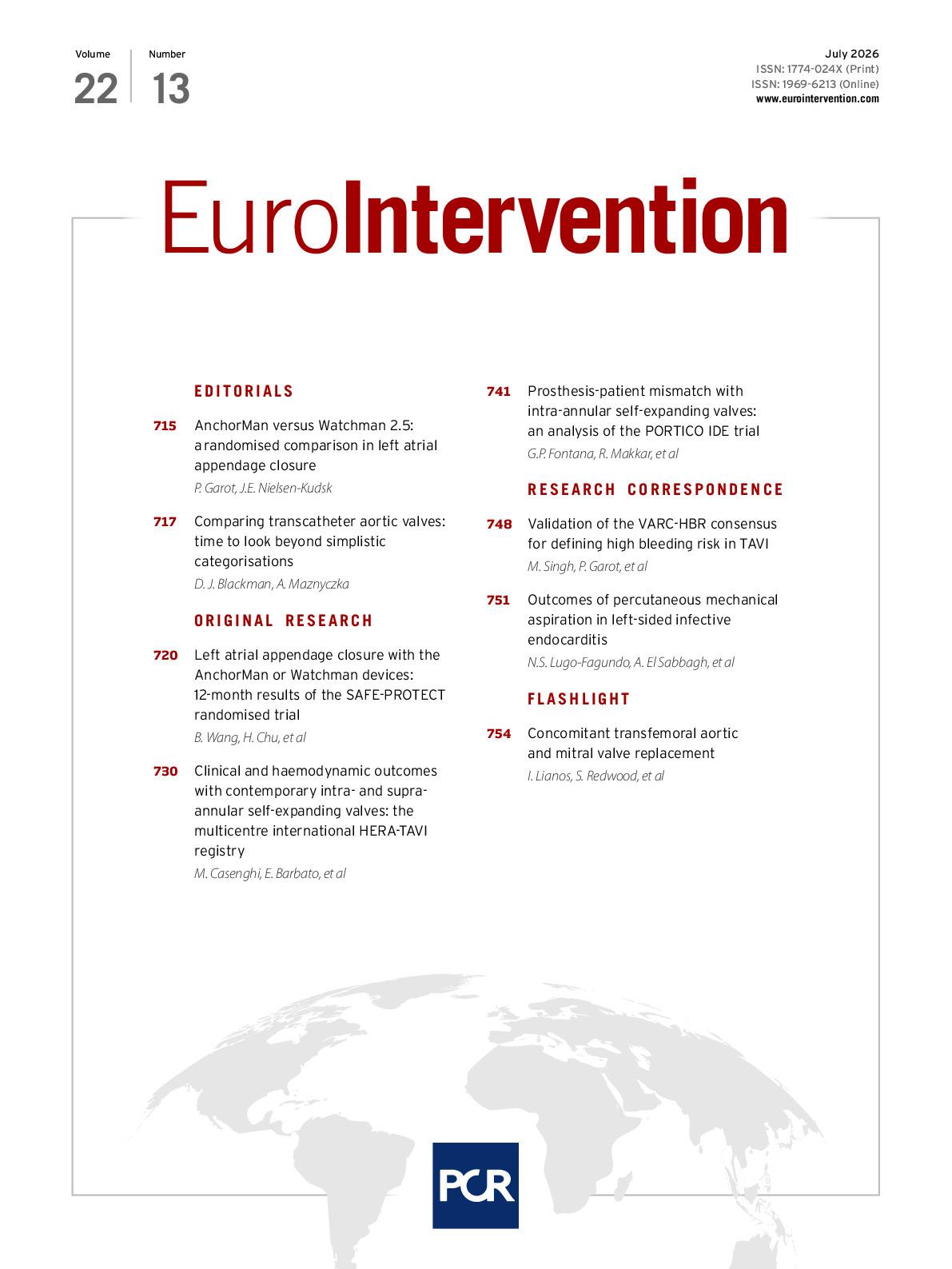
Results: Among 2,607 patients (IA-SEV: 1,604; SA-SEV: 1,003), PSM yielded 892 well-balanced pairs. Valve Academic Research Consortium 3 device success was achieved in 91.1% of IA-SEV patients and 90.9% of SA-SEV patients (p=0.868). Permanent pacemaker implantation was more frequent with IA-SEVs (22.1% vs 16.3%; p=0.007), whereas major or life-threatening bleeding was more common with SA-SEVs (4.2% vs 2.6%; p<0.001). At 1 year, the primary endpoint occurred in 12.6% of IA-SEV patients and 11.3% of SA-SEV patients (p=0.422) with no difference between groups in the time-to-event analysis (hazard ratio [HR] 1.01, 95% confidence interval [CI]: 0.77-1.33; p=0.916). The mean transvalvular gradients and rates of moderate or severe paravalvular leak remained low and similar between the two groups at 1 year. Findings were consistent in the unmatched cohort (HR 1.02, 95% CI: 0.81-1.31; p=0.835).
Conclusions: In this large real-world registry, contemporary IA-SEVs and SA-SEVs demonstrated overall similar clinical outcomes and sustained haemodynamic performance at 1-year follow-up, despite differences in procedure-related endpoints between the groups.
Sign up for free!
Join us for free and access thousands of articles from EuroIntervention, as well as presentations, videos, cases from PCRonline.com