Editorial

DOI: 10.4244/EIJ-D-26-00715

Endotype-guided management of ANOCA: are we ready?

Rocco A. Montone1, MD, PhD

Angina with non-obstructive coronary arteries (ANOCA) has emerged as one of the most challenging syndromes in contemporary cardiovascular medicine.1 Despite the absence of flow-limiting epicardial coronary stenoses, affected patients frequently experience persistent angina, recurrent healthcare resources utilisation, impaired quality of life, and a substantial psychological burden. Historically, ANOCA was often considered as “non-cardiac” chest pain or managed empirically, resulting in therapeutic uncertainty and poor symptom control. Increasing evidence now suggests that effective management of ANOCA patients depends fundamentally on accurate identification of the underlying ischaemic mechanism.123 Indeed, recent invasive physiological studies have demonstrated that ANOCA is not a single entity but rather a heterogeneous spectrum of distinct coronary disorders, with multiple identifiable endotypes.4

Contemporary guidelines now recommend invasive coronary functional testing (CFT) in persistently symptomatic patients,5 as landmark randomised trials such as CorMicA and ILIAS ANOCA have demonstrated that mechanism-guided therapy can improve angina-related quality of life.67

In this issue of EuroIntervention, the TRI-NOCA study by Farina and colleagues8 extends these observations by providing real-world multicentre evidence across a broader spectrum of haemodynamic...

Sign in to read
the full article

Forgot your password?
No account yet?
Sign up for free!

Create my pcr account

Join us for free and access thousands of articles from EuroIntervention, as well as presentations, videos, cases from PCRonline.com
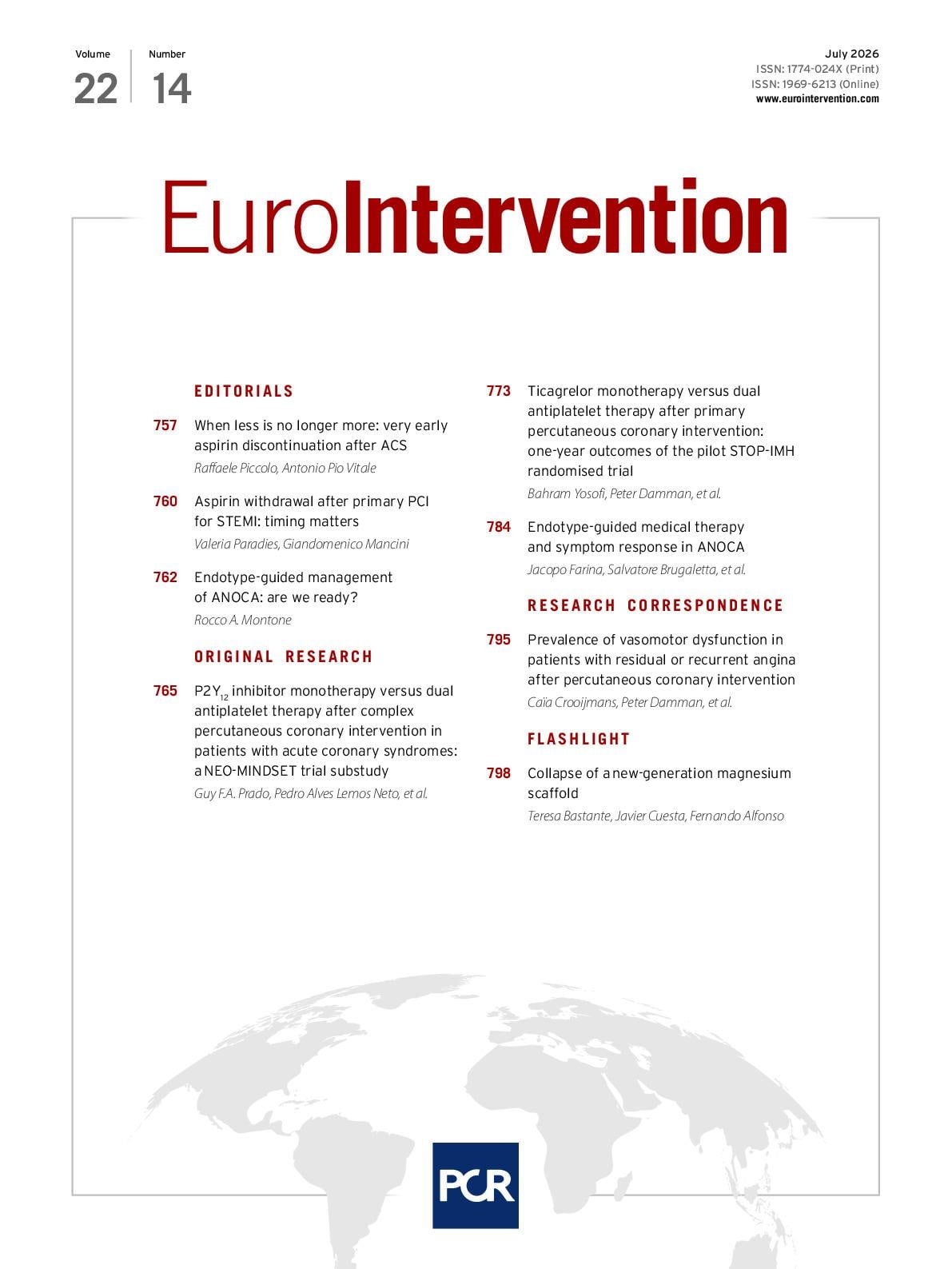
Volume 22 Number 14
Jul 20, 2026
Volume 22 Number 14
View full issue


Key metrics

Suggested by Cory

Debate

10.4244/EIJ-E-24-00072 Mar 17, 2025
Routine diagnosis of ANOCA/INOCA: pros and cons
Montone R et al
free

State-of-the-Art

10.4244/EIJ-D-23-00448 Jan 15, 2024
Coronary spasm and vasomotor dysfunction as a cause of MINOCA
Yaker ZS et al
free

Clinical Research

10.4244/EIJ-D-21-00875 Aug 5, 2022
Features of atherosclerosis in patients with angina and no obstructive coronary artery disease
Pellegrini D et al
free

Original Research

10.4244/EIJ-D-25-00277 Sep 1, 2025
Chest pain patterns and coronary microvascular function in non-obstructive coronary artery disease
Nogami K et al

Original Research

10.4244/EIJ-D-26-00148 Jul 20, 2026
Endotype-guided medical therapy and symptom response in ANOCA
Farina J et al

Original Research

10.4244/EIJ-D-24-00111 Oct 7, 2024
Absolute coronary blood flow across different endotypes of ANOCA
Paradies V et al
free

Editorial

10.4244/EIJ-E-25-00037 Sep 1, 2025
Angina and coronary microvascular dysfunction: unravelling the links
Berry C and Hanna R
free
Trending articles
335.05

State-of-the-Art Review

10.4244/EIJ-D-21-00904 Apr 1, 2022
Antiplatelet therapy after percutaneous coronary intervention
Angiolillo D et al
free
84.05

State-of-the-Art

10.4244/EIJ-D-23-00840 Sep 2, 2024
Aortic regurgitation: from mechanisms to management
Baumbach A et al
free
49.35

State-of-the-Art

10.4244/EIJ-D-25-00874 Jun 1, 2026
TAVI and coronary interventions: indications, technical considerations, and clinical scenarios
Aquino Bruno H et al
free
45.5

State-of-the-Art

10.4244/EIJ-D-25-01346 May 4, 2026
Slow flow and no reflow after percutaneous coronary intervention
Brugaletta S et al
free
38.2

State-of-the-Art

10.4244/EIJ-D-24-00195 Apr 7, 2025
Percutaneous coronary intervention for calcified and resistant lesions
Pesarini G et al
free
33.15

Original Research

10.4244/EIJ-D-26-00032 May 15, 2026
Glucocorticoids to reduce permanent pacemaker implantation after TAVI: the GLUCO-TAVI randomised trial
Fuertes-Kenneally L et al
X

PCR
Impact factor: 9.2
2025 Journal Citation Reports®
Science Edition (Clarivate Analytics, 2026)
Online ISSN 1969-6213 - Print ISSN 1774-024X
© 2005-2026 Europa Group - All rights reserved