Original Research

DOI: 10.4244/EIJ-D-26-00148

Endotype-guided medical therapy and symptom response in ANOCA

Jacopo Farina1, MD; Sant Kumar2, MD; Gianluca Campo1, MD; Simone Biscaglia1, MD; Alberto Sarti1, MD; Joan Llevadot-Sesmilo3, MD; Valeria Paradies4, MD, PhD; Gianluca Mincione5, MD; Brian Christopher Case6, MD; Antonio Maria Leone7, MD; Domenico Galante7, MD; Andrea Erriquez1, MD; Salvatore Brugaletta3,8,9, MD

Abstract

Background: Invasive coronary functional testing enables the classification of angina with non-obstructive coronary arteries (ANOCA) into distinct endotypes. However, real-world data linking endotype identification to subsequent pharmacological management and patient-reported symptom outcomes remain limited.

Aims: We sought to evaluate the association between coronary endotypes, post-testing pharmacological treatment patterns, and changes in angina-related quality of life in patients with ANOCA in a multicentre real-world registry.

Methods: Consecutive ANOCA patients undergoing invasive coronary functional testing were included. Patients were classified into six endotypes using adenosine- and acetylcholine-based testing. Pharmacological therapy was adjusted at the discretion of the treating physician based on the functional test results. The primary endpoint was a clinically meaningful improvement in angina-related health status, defined as a ≥5-point increase in the 7-item Seattle Angina Questionnaire (SAQ-7) summary score, assessed within each endotype.

Results: Among 525 patients, endotype distribution was as follows: normal physiology 10.5%, elevated resting coronary blood flow 8.8%, high resistance 13.9%, compensated high resistance 14.9%, epicardial spasm 33.3%, and microvascular spasm 18.7%. After testing, prescription patterns differed across the endotypes, with increased use of beta blockers, ranolazine, and renin-angiotensin-aldosterone system blockers in coronary microvascular dysfunction endotypes and greater use of non-dihydropyridine calcium channel blockers in vasospastic endotypes. At follow-up, a ΔSAQ-7 summary score ≥5 points was observed in elevated resting flow, high-resistance, compensated high-resistance, and epicardial spasm endotypes (all p<0.001) but not in microvascular spasm or normal physiology.

Conclusions: In this multicentre real-world registry, invasive coronary endotyping was associated with distinct pharmacological management patterns and differential changes in angina-related quality of life across ANOCA endotypes.

Sign in to read
the full article

Forgot your password?
No account yet?
Sign up for free!

Create my pcr account

Join us for free and access thousands of articles from EuroIntervention, as well as presentations, videos, cases from PCRonline.com
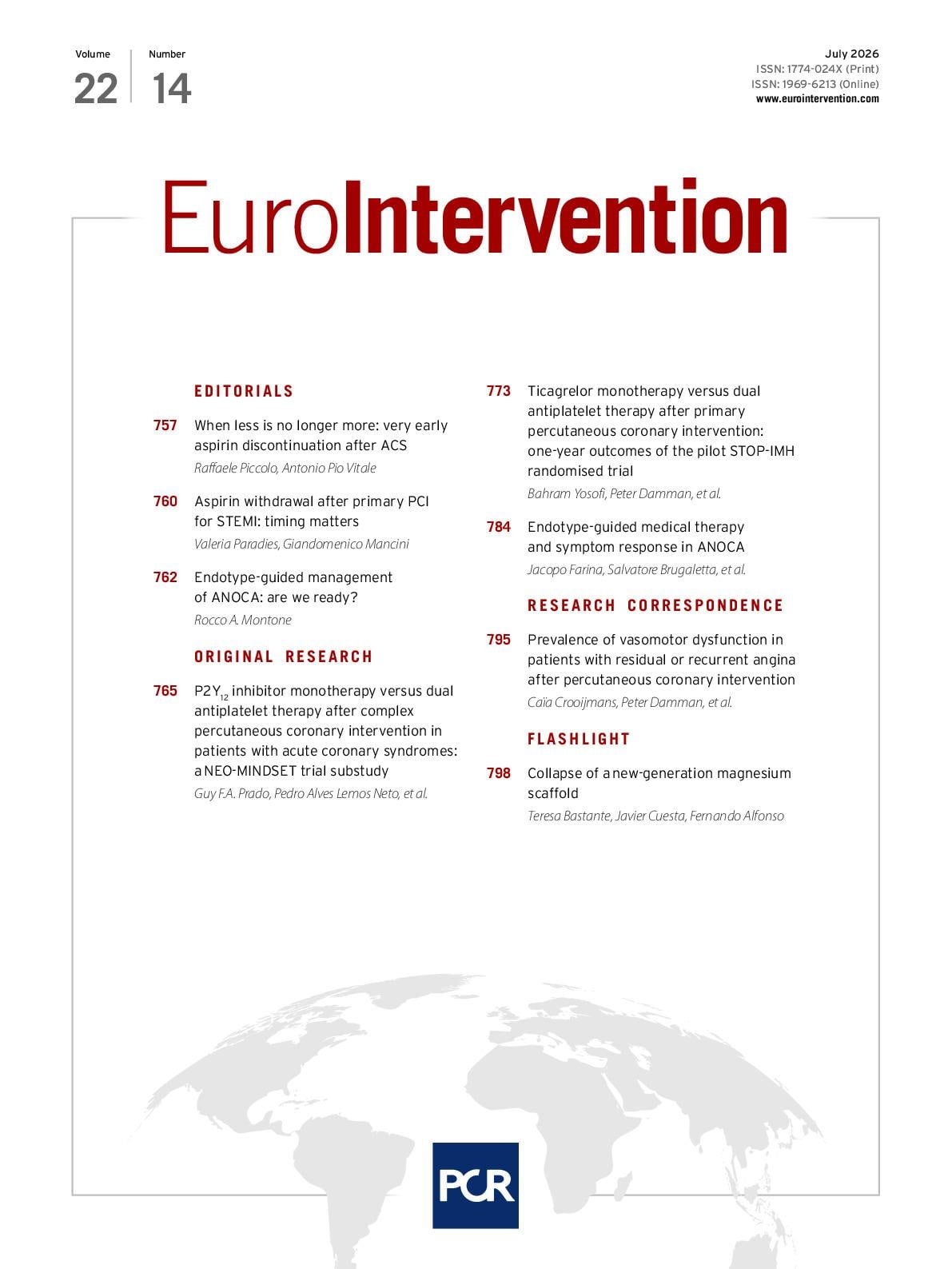
Volume 22 Number 14
Jul 20, 2026
Volume 22 Number 14
View full issue


Key metrics

Suggested by Cory

Editorial

10.4244/EIJ-D-26-00715 Jul 20, 2026
Endotype-guided management of ANOCA: are we ready?
Montone R
free

Debate

10.4244/EIJ-E-24-00072 Mar 17, 2025
Routine diagnosis of ANOCA/INOCA: pros and cons
Montone R et al
free

Original Research

10.4244/EIJ-D-24-00111 Oct 7, 2024
Absolute coronary blood flow across different endotypes of ANOCA
Paradies V et al
free

Editorial

10.4244/EIJ-E-25-00037 Sep 1, 2025
Angina and coronary microvascular dysfunction: unravelling the links
Berry C and Hanna R
free

Clinical Research

10.4244/EIJ-D-21-00402 Feb 18, 2022
Principles and pitfalls in coronary vasomotor function testing
Feenstra R et al
free

Original Research

10.4244/EIJ-D-25-00277 Sep 1, 2025
Chest pain patterns and coronary microvascular function in non-obstructive coronary artery disease
Nogami K et al
Trending articles
335.05

State-of-the-Art Review

10.4244/EIJ-D-21-00904 Apr 1, 2022
Antiplatelet therapy after percutaneous coronary intervention
Angiolillo D et al
free
84.05

State-of-the-Art

10.4244/EIJ-D-23-00840 Sep 2, 2024
Aortic regurgitation: from mechanisms to management
Baumbach A et al
free
49.35

State-of-the-Art

10.4244/EIJ-D-25-00874 Jun 1, 2026
TAVI and coronary interventions: indications, technical considerations, and clinical scenarios
Aquino Bruno H et al
free
45.5

State-of-the-Art

10.4244/EIJ-D-25-01346 May 4, 2026
Slow flow and no reflow after percutaneous coronary intervention
Brugaletta S et al
free
38.2

State-of-the-Art

10.4244/EIJ-D-24-00195 Apr 7, 2025
Percutaneous coronary intervention for calcified and resistant lesions
Pesarini G et al
free
33.15

Original Research

10.4244/EIJ-D-26-00032 May 15, 2026
Glucocorticoids to reduce permanent pacemaker implantation after TAVI: the GLUCO-TAVI randomised trial
Fuertes-Kenneally L et al
X

PCR
Impact factor: 9.2
2025 Journal Citation Reports®
Science Edition (Clarivate Analytics, 2026)
Online ISSN 1969-6213 - Print ISSN 1774-024X
© 2005-2026 Europa Group - All rights reserved