Original Research

DOI: 10.4244/EIJ-D-25-01308

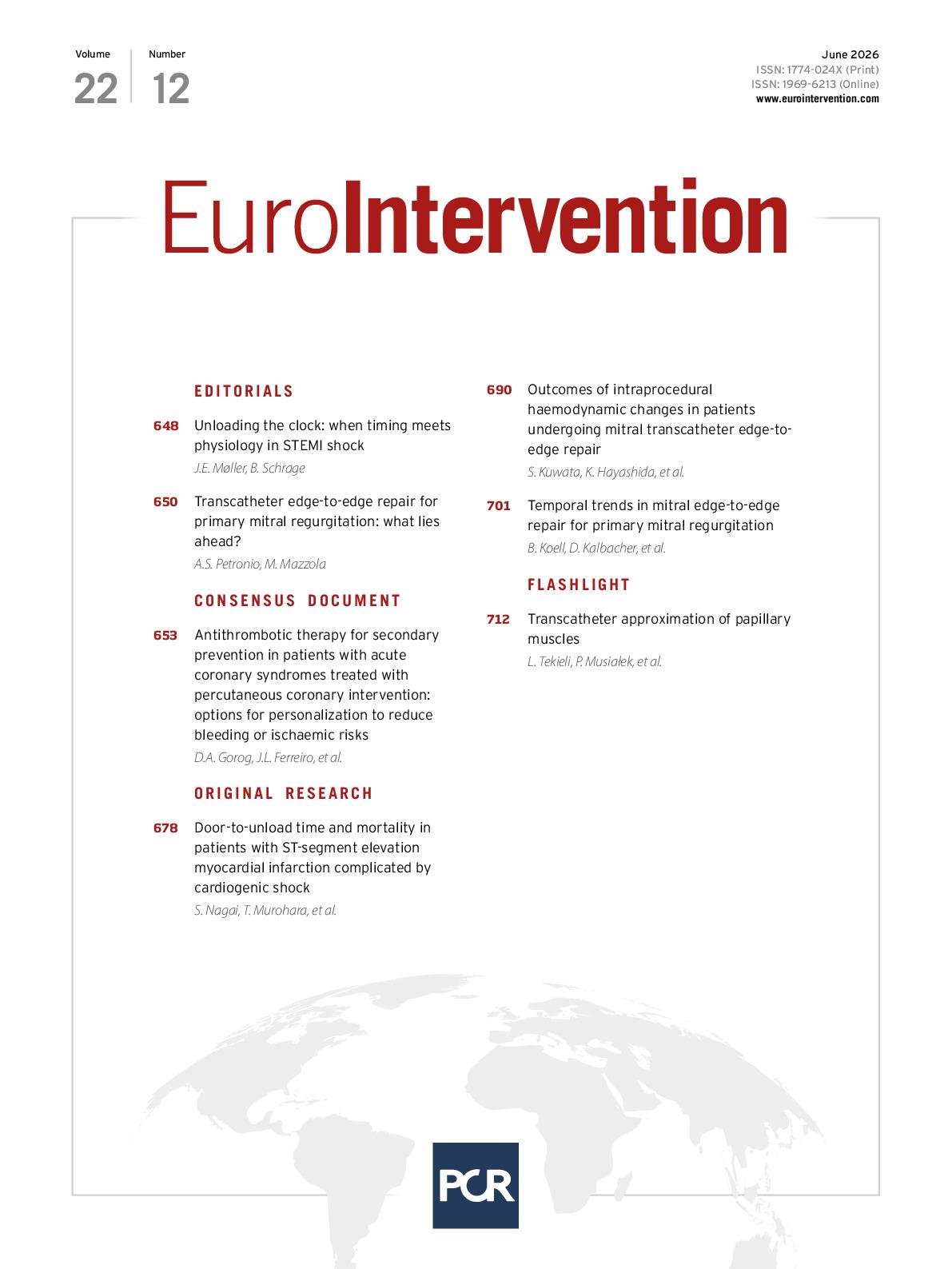
Temporal trends in mitral edge-to-edge repair for primary mitral regurgitation

Benedikt Koell1,2, MD; Sebastian Ludwig1,2, MD; Jessica Weimann1, MSc; Dhairya Patel3, MD; Lukas Stolz4,5, MD; Tetsu Tanaka6, MD; Teresa Trenkwalder7, MD; Felix Rudolph8, MD; Daryoush Samim9, MD; Philipp von Stein10, MD; Cristina Giannini11, MD; Julien Dreyfus12, MD; Andrea Scotti13, MD; Jean-Michel Paradis14, MD; Marianna Adamo15, MD; Nicole Karam16, MD; Yohann Bohbot17, MD; Anne Bernard18, MD; Bruno Melica19, MD; Yusuke Kobari20, MD; Yoan Lavie-Badie21, MD; Mirjam Kessler22, MD; Omar Chehab23, MD; Simon Redwood23, MD; Edith Lubos24, MD; Ole De Backer20, MD; Marco Metra15, MD; Azeem Latib13, MD; Chiara Primerano11, MD; Christos Iliadis10, MD; Fabien Praz9, MD; Muhammed Gerçek8, MD; Erion Xhepa7, MD; Marcel Weber6, MD; Raj Makkar3, MD; Juan Granada25, MD; Thomas Modine26, MD; Erwan Donal27, MD; Jörg Hausleiter4,5, MD; Augustin Coisne28, MD; Daniel Kalbacher1,2, MD; on behalf of the PRIME-MR investigators

Abstract

Background: The evolving landscape of mitral valve transcatheter edge-to-edge repair (M-TEER) for mitral regurgitation (MR) has seen continuous advancements, driving improvements in therapeutic efficacy. Particularly in primary MR (PMR), contemporary device iterations of M-TEER offer technical advantages for improved management of complex anatomies. However, data on temporal trends in M-TEER for PMR are limited.

Aims: The primary objective of our study was to analyse temporal trends in the safety, efficacy, and stability of M-TEER treatment.

Methods: The PRIME-MR registry, a retrospective multicentre study, enrolled consecutive patients undergoing M-TEER for PMR at 27 centres in Europe and North America. M-TEER procedures were categorised into four time periods (2009-2013, 2014-2016, 2017-2019, and 2020-2023), to align with major device updates.

Results: The analysis included 3,082 consecutive patients (median age 82 years [interquartile range 76.0-85.0], 45.1% female). Patients treated were highly symptomatic (New York Heart Association [NYHA] Class ≥III in 80.4%). Patient characteristics showed a decline in symptomatic severity (NYHA Class ≥III 85.9% in 2009-2013 vs 71.8% in 2020-2023), accompanied by lower mean Society of Thoracic Surgeons scores (5.6% [2009-2013] vs 4.6% [2020-2023]; p for trend<0.0001), and less severe MR. Over time, complication rates decreased (procedures with complications: 42.4% [2009-2013] vs 23.1% [2020-2023]; p for trend<0.0001), whereas technical efficacy increased (residual MR ≤1+: 54.0% [2009-2013] vs 68.4% [2020-2023]; p for trend<0.001). There was an increased occurrence of stable results without any deterioration at one-year follow-up (63.6% [2009-2013] vs 74.4% [2020-2023]; p for trend=0.03).

Conclusions: Findings from the PRIME-MR registry highlight substantial reductions in residual MR severity and complication rates over time in PMR patients undergoing M-TEER.

Sign in to read
the full article

Forgot your password?
No account yet?
Sign up for free!

Create my pcr account

Join us for free and access thousands of articles from EuroIntervention, as well as presentations, videos, cases from PCRonline.com
Volume 22 Number 12
Jun 15, 2026
Volume 22 Number 12
View full issue


Key metrics

Suggested by Cory

Editorial

10.4244/EIJ-E-25-00054 Jan 19, 2026
Randomised trials in mitral transcatheter edge-to-edge repair: taking yet another look
Besler C and Westermann D
free

Editorial

10.4244/EIJ-D-25-01374 Feb 2, 2026
Durability of transcatheter mitral valve replacement: another step forward
Adamo M and Pezzola E
free

Editorial

10.4244/EIJ-E-24-00047 Oct 21, 2024
Mitral valve edge-to-edge repair under scrutiny: what can we learn from transoesophageal echocardiographic follow-up?
Hausleiter J and Stolz L
free

Editorial

10.4244/EIJ-D-26-00394 Jun 15, 2026
Transcatheter edge-to-edge repair for primary mitral regurgitation: what lies ahead?
Petronio A and Mazzola M
free

Editorial

10.4244/EIJ-E-23-00071 Feb 19, 2024
One-year outcomes with a new mitral edge-to-edge repair device: is mitral TEER about to conquer the world?
Praz F and Samim D
free

Expert Review

10.4244/EIJ-D-23-00700 Feb 19, 2024
Evolving indications for transcatheter mitral edge-to-edge repair
Shuvy M and Maisano F
free

Research Correspondence

10.4244/EIJ-D-24-00392 Dec 16, 2024
Very long-term outcomes of mitral transcatheter edge-to-edge repair
Bargagna M et al
free

State-of-the-Art

10.4244/EIJ-D-22-00725 Jan 23, 2023
Mitral valve transcatheter edge-to-edge repair
Hausleiter J et al
free
Trending articles
334.7

State-of-the-Art Review

10.4244/EIJ-D-21-00904 Apr 1, 2022
Antiplatelet therapy after percutaneous coronary intervention
Angiolillo D et al
free
202.75

State-of-the-Art

10.4244/EIJ-D-21-00089 Jun 11, 2021
Intracoronary optical coherence tomography: state of the art and future directions
Ali ZA et al
free
83.8

State-of-the-Art

10.4244/EIJ-D-23-00840 Sep 2, 2024
Aortic regurgitation: from mechanisms to management
Baumbach A et al
free
47.45

NEW INNOVATION

10.4244/EIJ-D-15-00467 Feb 20, 2018
Design and principle of operation of the HeartMate PHP (percutaneous heart pump)
Van Mieghem NM et al
free
42.15

State-of-the-Art

10.4244/EIJ-D-25-00896 Apr 6, 2026
Pretreatment with antiplatelet agents in patients undergoing coronary revascularisation
Kaur G et al
free
33.05

State-of-the-Art

10.4244/EIJ-D-25-00874 Jun 1, 2026
TAVI and coronary interventions: indications, technical considerations, and clinical scenarios
Aquino Bruno H et al
free
27.6

Original Research

10.4244/EIJ-D-25-01370 May 21, 2026
Prognostic value of early haemodynamic valve deterioration after TAVI
Trimaille A et al
27.6

Original Research

10.4244/EIJ-D-25-01370 Jun 1, 2026
Prognostic value of early haemodynamic valve deterioration after TAVI
Trimaille A et al
X

PCR
Impact factor: 9.2
2025 Journal Citation Reports®
Science Edition (Clarivate Analytics, 2026)
Online ISSN 1969-6213 - Print ISSN 1774-024X
© 2005-2026 Europa Group - All rights reserved