Original Research

DOI: 10.4244/EIJ-D-25-00031

Transcatheter mitral repair in patients with symptomatic moderate functional mitral regurgitation: 1-year outcomes from the MiCLASP study

Philipp Lurz1, MD, PhD; Volker Rudolph2, MD; Tienush Rassaf3, MD; Peter Luedike3,4, MD; Thomas Schmitz5, MD; Tobias Kister6, MD; Tobias Geisler7, MD; Edith Lubos8, MD; Ingo Eitel9, MD, PhD; Ralph Stephan von Bardeleben1, MD, PhD; Nedy Brambilla10, MD; Sergio Berti11, MD; Axel Linke12, MD, PhD; Bernhard Unsöld13, MD; Christian Hengstenberg14, MD; Stephan Baldus15, MD; Konstantinos Spargias16, MD, PhD; Georg Nickenig17, MD; Paolo Denti18, MD; Helge Möllmann19, MD, PhD; Wolfgang Rottbauer20, MD, PhD; Fabien Praz21, MD; Christian Butter22, MD, PhD; Markus Reinthaler23, MD; Nicolas M. Van Mieghem24, MD, PhD; Frank Edelmann25, MD; Martin J. Swaans26, MD, PhD; Adam Witkowski27, MD; Mamta H. Buch28, MD, PhD; Tim Seidler29, MD; Andrés Iñiguez30, MD; Leo Marcoff31, MD; Konstantinos Koulogiannis31, MD; Jörg Hausleiter32, MD, PhD; on behalf of the MiCLASP study investigators

Abstract

Background: Current clinical guidelines do not recommend mitral transcatheter edge-to-edge repair (M-TEER) for patients with moderate functional mitral regurgitation (FMR), and the implications of M-TEER in this population are not well documented.

Aims: We aimed to assess M-TEER outcomes in patients with symptomatic moderate FMR compared to those with FMR ≥3+ who were treated with the PASCAL system in the MiCLASP study.

Methods: Patients were stratified by baseline FMR grade (2+ or ≥3+). The echocardiographic core laboratory-assessed mitral regurgitation (MR) reduction, clinical events committee-adjudicated major adverse events (MAE) rate and functional and quality-of-life outcomes were evaluated up to 1 year after M-TEER.

Results: Of the 544 (FMR=322; degenerative MR=163; mixed/other=59) enrolled patients, 101 had baseline FMR 2+ and 197 FMR ≥3+. Both groups achieved significant MR reduction at discharge, which was sustained up to 1 year, with 89.8% of patients achieving MR ≤1+ in the FMR 2+ group and 77.8% in the FMR ≥3+ group (all p<0.001 vs baseline). At 1 year, significant improvements (all p<0.001 vs baseline) in functional capacity (New York Heart Association Class I/II: 67.1% FMR 2+; 70.1% FMR ≥3+) and quality of life (change in the Kansas City Cardiomyopathy Questionnaire overall score: +13.9 points FMR 2+; +13.9 points FMR ≥3+) were achieved in both groups, with high survival (90.0% FMR 2+; 84.2% FMR ≥3+; p=0.176) and low MAE rates (13.9% FMR 2+; 18.3% FMR ≥3+; p=0.413).

Conclusions: In the MiCLASP study, patients with moderate FMR experienced significant MR reduction at 1 year, resulting in clinical and symptomatic benefits comparable to those with ≥moderate-severe FMR, suggesting that select patients with symptomatic moderate FMR can benefit from M-TEER.

Sign in to read
the full article

Forgot your password?
No account yet?
Sign up for free!

Create my pcr account

Join us for free and access thousands of articles from EuroIntervention, as well as presentations, videos, cases from PCRonline.com
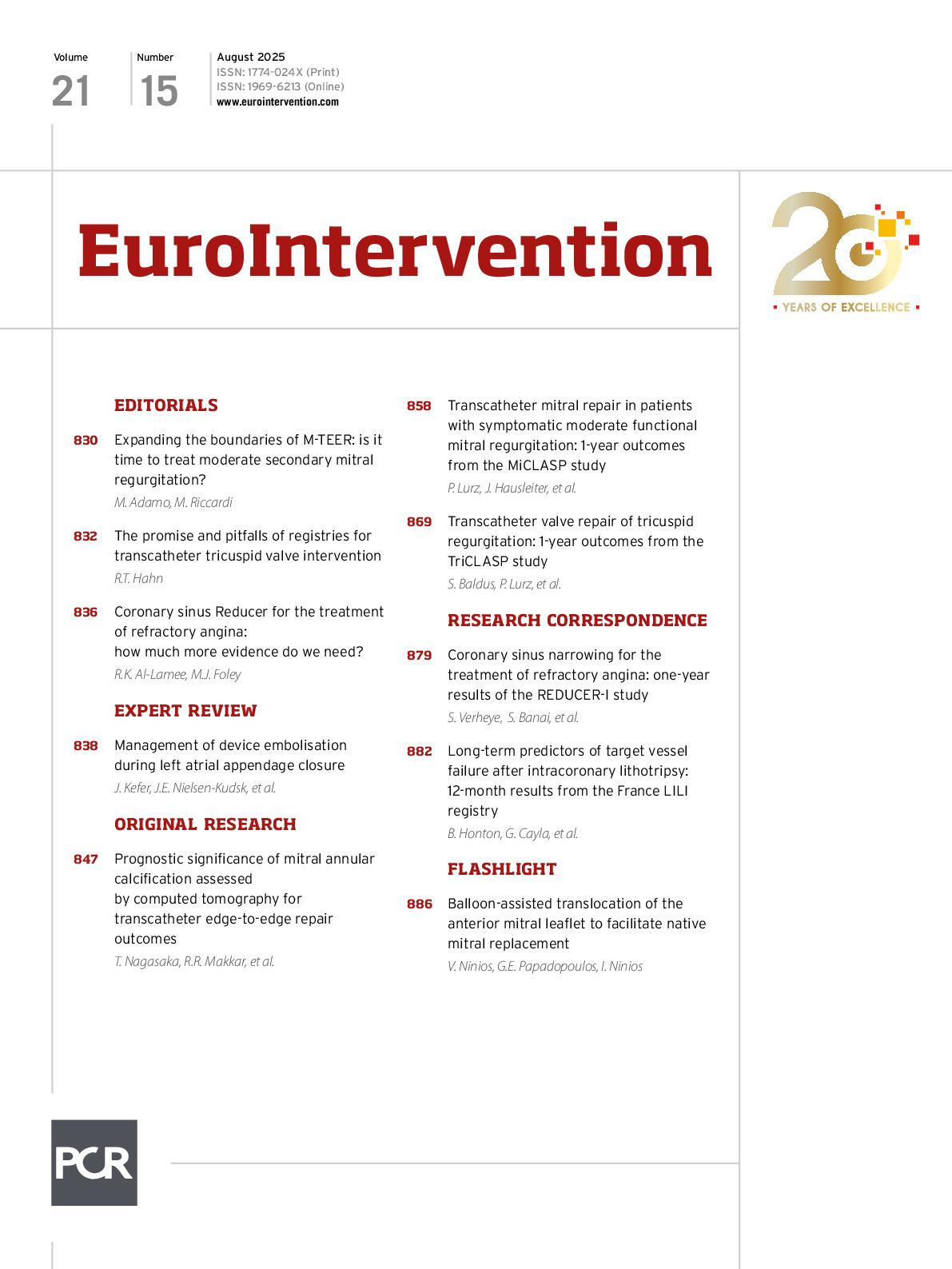
Volume 21 Number 15
Aug 4, 2025
Volume 21 Number 15
View full issue


Key metrics

Suggested by Cory

Original Research

10.4244/EIJ-D-25-01308 Jun 15, 2026
Temporal trends in mitral edge-to-edge repair for primary mitral regurgitation
Koell B et al

Original Research

10.4244/EIJ-D-23-00819 Nov 19, 2023
Outcomes of transcatheter edge-to-edge repair for atrial functional mitral regurgitation
Tanaka T et al
free

Original Research

10.4244/EIJ-D-23-00819 Feb 19, 2024
Outcomes of transcatheter edge-to-edge repair for atrial functional mitral regurgitation
Tanaka T et al
free

Editorial

10.4244/EIJ-E-25-00054 Jan 19, 2026
Randomised trials in mitral transcatheter edge-to-edge repair: taking yet another look
Besler C and Westermann D
free

Editorial

10.4244/EIJ-E-25-00030 Aug 4, 2025
Expanding the boundaries of M-TEER: is it time to treat moderate secondary mitral regurgitation?
Adamo M and Riccardi M
free

Editorial

10.4244/EIJ-D-25-01374 Feb 2, 2026
Durability of transcatheter mitral valve replacement: another step forward
Adamo M and Pezzola E
free

State-of-the-Art

10.4244/EIJ-D-22-00725 Jan 23, 2023
Mitral valve transcatheter edge-to-edge repair
Hausleiter J et al
free

Editorial

10.4244/EIJ-E-24-00047 Oct 21, 2024
Mitral valve edge-to-edge repair under scrutiny: what can we learn from transoesophageal echocardiographic follow-up?
Hausleiter J and Stolz L
free
Trending articles
202.75

State-of-the-Art

10.4244/EIJ-D-21-00089 Jun 11, 2021
Intracoronary optical coherence tomography: state of the art and future directions
Ali ZA et al
free
47.45

NEW INNOVATION

10.4244/EIJ-D-15-00467 Feb 20, 2018
Design and principle of operation of the HeartMate PHP (percutaneous heart pump)
Van Mieghem NM et al
free
42.15

State-of-the-Art

10.4244/EIJ-D-25-00896 Apr 6, 2026
Pretreatment with antiplatelet agents in patients undergoing coronary revascularisation
Kaur G et al
free
32.2

State-of-the-Art

10.4244/EIJ-D-25-00874 Jun 1, 2026
TAVI and coronary interventions: indications, technical considerations, and clinical scenarios
Aquino Bruno H et al
free
27.6

Original Research

10.4244/EIJ-D-25-01370 May 21, 2026
Prognostic value of early haemodynamic valve deterioration after TAVI
Trimaille A et al
27.6

Original Research

10.4244/EIJ-D-25-01370 Jun 1, 2026
Prognostic value of early haemodynamic valve deterioration after TAVI
Trimaille A et al
19.5

Original Research

10.4244/EIJ-D-26-00032 May 15, 2026
Glucocorticoids to reduce permanent pacemaker implantation after TAVI: the GLUCO-TAVI randomised trial
Fuertes-Kenneally L et al
X

PCR
Impact factor: 9.5
2024 Journal Citation Reports®
Science Edition (Clarivate Analytics, 2025)
Online ISSN 1969-6213 - Print ISSN 1774-024X
© 2005-2026 Europa Group - All rights reserved