Original Research

DOI: 10.4244/EIJ-D-25-00737

Transcatheter edge-to-edge repair plus guideline-directed medical therapy versus guideline-directed medical therapy alone for symptomatic functional mitral regurgitation: a comprehensive, up-to-date meta-analysis of randomised trials

Nicola Ammirabile1, MD, MSc; Daniele Giacoppo1, MD, MSc, PhD; Placido Maria Mazzone1, MD; Davide Landolina1,2, MD; Marco Spagnolo1, MD, MSc; Davide Capodanno1, MD, PhD

Abstract

Background: Transcatheter edge-to-edge repair (TEER) is among the treatments for functional mitral regurgitation (FMR), but its benefits over guideline-directed medical therapy (GDMT) alone are discordant. We conducted a meta-analysis of randomised trials comparing long-term outcomes between these treatment strategies.

Aims: We aimed to compare long-term clinical outcomes between TEER plus GDMT and GDMT alone in symptomatic moderate-to-severe FMR.

Methods: Major electronic databases were searched for randomised trials comparing TEER plus GDMT with GDMT alone in FMR. The primary outcome was death or first hospitalisation due to heart failure at 24 months. The key secondary outcome was first hospitalisation due to heart failure at 24 months. Summary hazard ratios (HRs) with 95% confidence intervals (CIs) were computed by mixed-effects Cox models based on reconstructed time-to-first event individual patient data and random-effects models based on study-level data.

Results: Three randomised trials (MITRA-FR, COAPT, and RESHAPE-HF2) were included, for a total of 1,422 patients assigned to TEER plus GDMT (n=703) or GDMT alone (n=719). The primary outcome was significantly lower in the TEER plus GDMT group compared with the GDMT-alone group by one-stage analysis (HR 0.72, 95% CI: 0.56-0.92; p=0.010). However, the two-stage analysis marginally failed to confirm this result (HR 0.72, 95% CI: 0.51-1.00; p=0.052) and showed substantial heterogeneity (I²=80.3%; p=0.006). Hospitalisation due to heart failure was significantly lower in the TEER plus GDMT group, regardless of the statistical method used (one-stage: HR 0.65, 95% CI: 0.48-0.88; p=0.006; two-stage: HR 0.66, 95% CI: 0.45-0.96; p=0.031). However, heterogeneity was substantial (I²=81.2%; p=0.005). All-cause death and cardiovascular death at 24 months were not significantly different between treatment groups but became significant after excluding MITRA-FR in the leave-one-out analysis.

Conclusions: In symptomatic moderate-to-severe FMR, TEER plus GDMT significantly reduces death or hospitalisation due to heart failure and hospitalisation due to heart failure at 24 months.

Sign in to read
the full article

Forgot your password?
No account yet?
Sign up for free!

Create my pcr account

Join us for free and access thousands of articles from EuroIntervention, as well as presentations, videos, cases from PCRonline.com
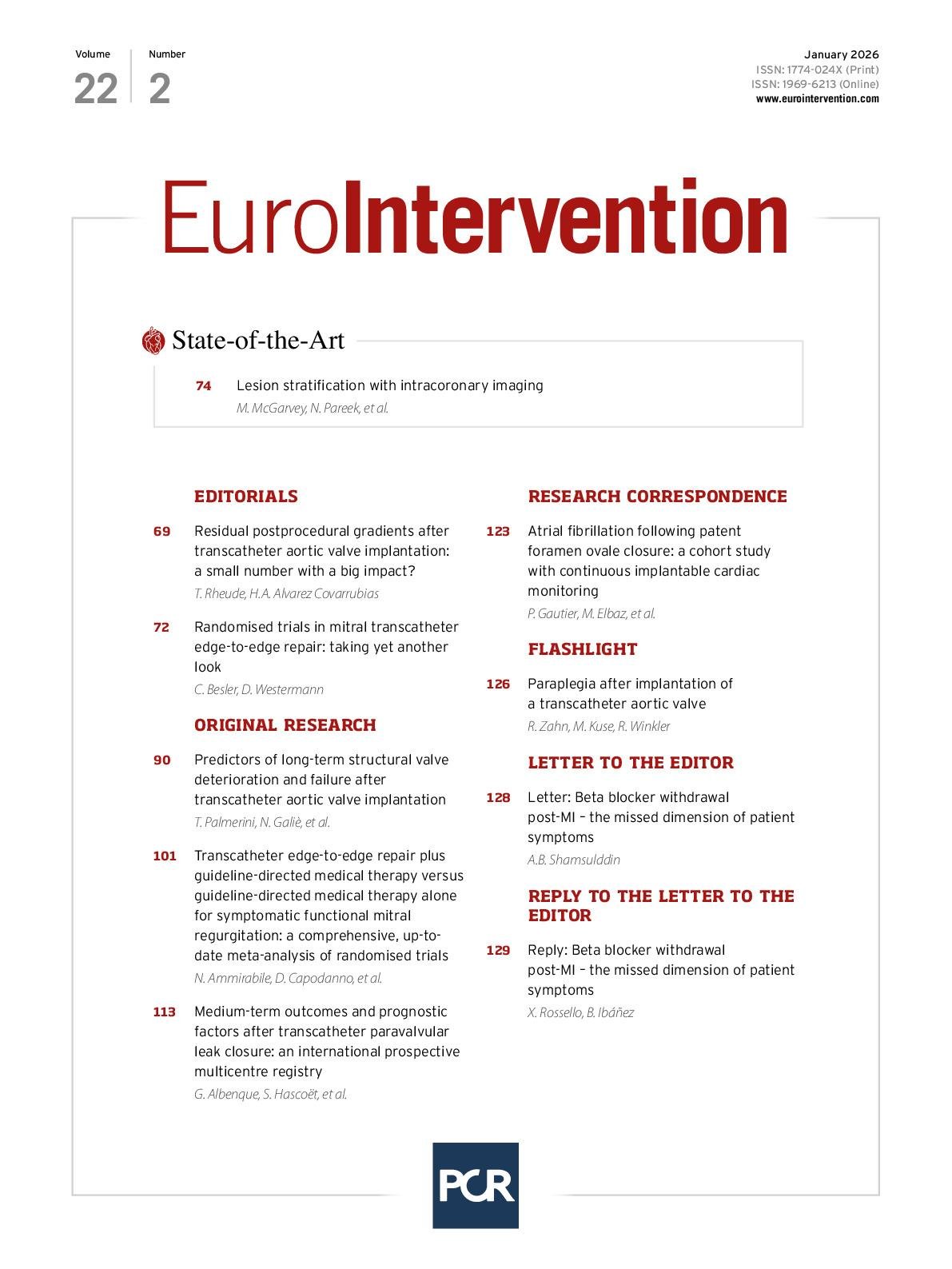
Volume 22 Number 2
Jan 19, 2026
Volume 22 Number 2
View full issue


Key metrics

Suggested by Cory

10.4244/EIJV15I16A251 Mar 20, 2020
Risk of stroke, atrial fibrillation, and major bleeding after mitral valve repair: the jury is still out
Giacoppo D and Tarantini G
free

Original Research

10.4244/EIJ-D-23-00819 Feb 19, 2024
Outcomes of transcatheter edge-to-edge repair for atrial functional mitral regurgitation
Tanaka T et al
free

Editorial

10.4244/EIJ-D-25-01374 Feb 2, 2026
Durability of transcatheter mitral valve replacement: another step forward
Adamo M and Pezzola E
free

Original Research

10.4244/EIJ-D-23-00819 Nov 19, 2023
Outcomes of transcatheter edge-to-edge repair for atrial functional mitral regurgitation
Tanaka T et al
free

Editorial

10.4244/EIJ-E-25-00030 Aug 4, 2025
Expanding the boundaries of M-TEER: is it time to treat moderate secondary mitral regurgitation?
Adamo M and Riccardi M
free

Editorial

10.4244/EIJ-E-25-00054 Jan 19, 2026
Randomised trials in mitral transcatheter edge-to-edge repair: taking yet another look
Besler C and Westermann D
free

CLINICAL RESEARCH

10.4244/EIJ-D-18-00874 Apr 16, 2019
Impact of mitral valve treatment choice on mortality according to aetiology
Kortlandt F et al
free

Original Research

10.4244/EIJ-D-25-01308 Jun 15, 2026
Temporal trends in mitral edge-to-edge repair for primary mitral regurgitation
Koell B et al
Trending articles
334.45

State-of-the-Art Review

10.4244/EIJ-D-21-00904 Apr 1, 2022
Antiplatelet therapy after percutaneous coronary intervention
Angiolillo D et al
free
84.05

State-of-the-Art

10.4244/EIJ-D-23-00840 Sep 2, 2024
Aortic regurgitation: from mechanisms to management
Baumbach A et al
free
45.4

State-of-the-Art

10.4244/EIJ-D-25-01346 May 4, 2026
Slow flow and no reflow after percutaneous coronary intervention
Brugaletta S et al
free
42.15

State-of-the-Art

10.4244/EIJ-D-25-00896 Apr 6, 2026
Pretreatment with antiplatelet agents in patients undergoing coronary revascularisation
Kaur G et al
free
38.2

State-of-the-Art

10.4244/EIJ-D-24-00195 Apr 7, 2025
Percutaneous coronary intervention for calcified and resistant lesions
Pesarini G et al
free
32.7

State-of-the-Art

10.4244/EIJ-D-25-00874 Jun 1, 2026
TAVI and coronary interventions: indications, technical considerations, and clinical scenarios
Aquino Bruno H et al
free
29.2

Original Research

10.4244/EIJ-D-25-01370 May 21, 2026
Prognostic value of early haemodynamic valve deterioration after TAVI
Trimaille A et al
29.2

Original Research

10.4244/EIJ-D-25-01370 Jun 1, 2026
Prognostic value of early haemodynamic valve deterioration after TAVI
Trimaille A et al
X

PCR
Impact factor: 9.2
2025 Journal Citation Reports®
Science Edition (Clarivate Analytics, 2026)
Online ISSN 1969-6213 - Print ISSN 1774-024X
© 2005-2026 Europa Group - All rights reserved