Flashlight

DOI: 10.4244/EIJ-D-25-01145

Natural history of coronary plaque redistribution after drug-coated balloon angioplasty

Magdalena M. Dobrolińska1,2, MD, PhD; Wojciech J. Skorupski2,3, MD, PhD; Mariusz Kruk4, MD, PhD; Damini Dey5, PhD; Maksymilian P. Opolski2, MD, PhD

While there is growing interest in a “leave nothing behind” percutaneous coronary intervention (PCI) strategy using drug‐coated balloons (DCB), accurate evaluation of DCB-treated lesions remains critical after PCI. The advent and continued evolution of advanced computed tomography (CT) technologies, including photon-counting CT (PCCT), with markedly improved temporal and spatial resolution, enable increasingly precise, non-invasive monitoring of patients following DCB PCI.1

We present three cases of de novo coronary chronic total occlusion patients undergoing PCI using a DCB-only strategy, with baseline and follow-up coronary CT angiography (CCTA), each employing a different generation of CT modalities. The first patient was scanned on conventional CT, the second patient was scanned using PCCT, and the third patient was scanned on PCCT in high-resolution mode (Supplementary Figure 1). Computed tomography acquisition and reconstruction parameters were unchanged pre- and post-PCI, and quantitative coronary plaque analysis was performed automatically (Autoplaque, version 3.0 [Cedars-Sinai]).2 In each case a paclitaxel-eluting balloon (SeQuent Please NEO [B. Braun]) was used (inflation time of 60-90 seconds each, balloon-to-vessel ratio of 0.92 to 1.0). The study complied with the Declaration...

Sign in to read
the full article

Forgot your password?
No account yet?
Sign up for free!

Create my pcr account

Join us for free and access thousands of articles from EuroIntervention, as well as presentations, videos, cases from PCRonline.com
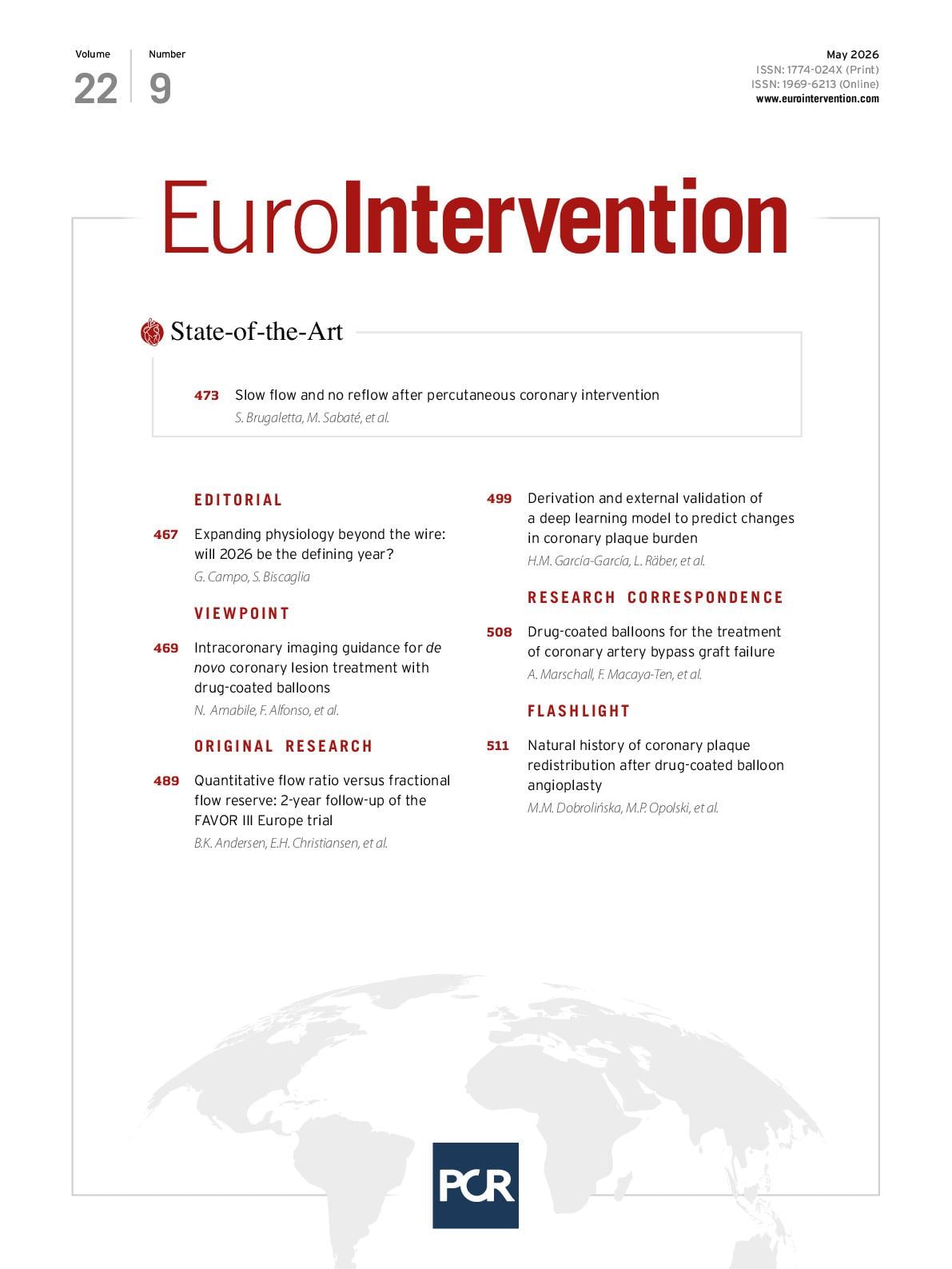
Volume 22 Number 9
May 4, 2026
Volume 22 Number 9
View full issue


Key metrics

Suggested by Cory

Viewpoint

10.4244/EIJ-D-25-01066 May 4, 2026
Intracoronary imaging guidance for de novo coronary lesion treatment with drug-coated balloons
Amabile N et al
free

Research Correspondence

10.4244/EIJ-D-23-01073 Jul 1, 2024
Paclitaxel-coated balloons for vulnerable lipid-rich plaques
van Veelen A et al
open access

Research Correspondence

10.4244/EIJ-D-24-01113 Jul 7, 2025
Restenosis patterns after percutaneous coronary intervention with drug-coated balloons for de novo coronary lesions
Matsuda K et al

Editorial

10.4244/EIJ-E-23-00043 Dec 18, 2023
The longest way round is the shortest way home: drug-coated balloons for long lesions in large coronary arteries
Gonzalo N and Shabbir A
free

Editorial

10.4244/EIJ-E-24-00053 Nov 4, 2024
The future of sirolimus-coated balloon use in percutaneous coronary intervention
Yeh R and Lalani C
free

Editorial

10.4244/EIJ-E-24-00035 Jul 1, 2024
Angioplasty with drug-coated balloon catheters: the coming tide?
Byrne R and Durand R
free

Debate

10.4244/EIJ-E-23-00034 Jan 15, 2024
Drug-coated balloons as a first choice for patients with de novo lesions: pros and cons
Colombo A et al
free
Trending articles
87.2

State-of-the-Art

10.4244/EIJ-D-25-00266 Jan 19, 2026
Lesion stratification with intracoronary imaging
McGarvey M et al
free
47.45

NEW INNOVATION

10.4244/EIJ-D-15-00467 Feb 20, 2018
Design and principle of operation of the HeartMate PHP (percutaneous heart pump)
Van Mieghem NM et al
free
34.8

Original Research

10.4244/EIJ-D-25-01006 Mar 16, 2026
Clinical outcomes and haemodynamic response after blinded stress assessment of moderate aortic stenosis
Eerdekens R et al
22.2

Viewpoint

10.4244/EIJ-D-25-01066 May 4, 2026
Intracoronary imaging guidance for de novo coronary lesion treatment with drug-coated balloons
Amabile N et al
free
20.75

Flashlight

10.4244/EIJ-D-25-01014 Apr 6, 2026
Stent retriever-assisted coronary thrombectomy with continuous aspiration
Liabot Q et al
open access
19.5

Original Research

10.4244/EIJ-D-26-00032 May 15, 2026
Glucocorticoids to reduce permanent pacemaker implantation after TAVI: the GLUCO-TAVI randomised trial
Fuertes-Kenneally L et al
17.8

Expert Review

10.4244/EIJ-D-25-01316 Apr 20, 2026
Electrosurgical laceration and stabilisation of tricuspid edge-to-edge repair: the ELASTA-T technique
Alvarez-Covarrubias H et al
free
X

PCR
Impact factor: 9.5
2024 Journal Citation Reports®
Science Edition (Clarivate Analytics, 2025)
Online ISSN 1969-6213 - Print ISSN 1774-024X
© 2005-2026 Europa Group - All rights reserved