Original Research

DOI: 10.4244/EIJ-D-26-00084

Outcomes of intraprocedural haemodynamic changes in patients undergoing mitral transcatheter edge-to-edge repair

Shingo Kuwata1, MD; Masaki Izumo1, MD; Tetsu Tanaka1, MD; Taishi Okuno1, MD; Yoshihiro J. Akashi1, MD; Masanori Yamamoto2, MD; Tetsuro Shimura3, MD; Atsushi Sugiura4, MD; Shunsuke Kubo5, MD; Mike Saji6,7, MD; Yuki Izumi6, MD; Yusuke Enta8, MD; Shinichi Shirai9, MD; Shingo Mizuno10, MD; Yusuke Watanabe11, MD; Makoto Amaki12, MD; Kazuhisa Kodama13, MD; Junichi Yamaguchi14, MD; Toru Naganuma15, MD; Hiroki Bota16, MD; Yohei Ohno17, MD; Masahiko Asami18, MD; Daisuke Hachinohe19, MD; Masahiro Yamawaki20, MD; Hiroshi Ueno21, MD; Gaku Nakazawa22, MD; Toshiaki Otsuka23, MD; Kentaro Hayashida24, MD; on behalf the OCEAN-Mitral investigators

Abstract

Background: While the mean left atrial pressure (mLAP) reduction during mitral transcatheter edge-to-edge repair (M-TEER) has been suggested as a potential prognostic marker, comprehensive evidence from large-scale, real-world cohorts is limited, especially with stratification by mitral regurgitation (MR) aetiology.

Aims: This study aimed to evaluate the prognostic significance of intraprocedural haemodynamic changes, particularly the mLAP reduction, during M-TEER for MR, using multicentre registry data.

Methods: From the OCEAN-Mitral registry, 2,629 patients undergoing M-TEER with intraprocedural direct mLAP measurements were included. A decrease in the mLAP was defined as follows: postprocedural mLAP–preprocedural mLAP<0. The primary outcome was the composite of all-cause mortality and heart failure (HF) rehospitalisation.

Results: Among 2,629 patients (degenerative MR [DMR]: 825 [31.4%], functional MR [FMR]: 1,804 [68.6%]), the postprocedural mLAP decreased in 1,548 patients (58.9%). In the DMR cohort, the mLAP reduction was associated with a significantly lower risk of the composite outcome (adjusted hazard ratio [HR] 0.66, 95% confidence interval [CI]: 0.45-0.96; p=0.028), while no such association was observed in the FMR cohort (adjusted HR 0.90, 95% CI: 0.75-1.08; p=0.251). Interaction analysis confirmed a significant difference in prognostic impact based on MR aetiology (p for interaction=0.006). Pulmonary vein flow patterns improved, with systolic waves becoming greater than diastolic waves across both groups; however, their combination with the mLAP reduction predicted better outcomes only in DMR patients.

Conclusions: A reduction in the mLAP during M-TEER is independently associated with improved clinical outcomes in patients with DMR but not in those with FMR. These findings underscore the importance of real-time haemodynamic assessment – especially in DMR – as a valuable procedural endpoint that may aid in optimising long-term outcomes beyond anatomical MR reduction alone.

Sign in to read
the full article

Forgot your password?
No account yet?
Sign up for free!

Create my pcr account

Join us for free and access thousands of articles from EuroIntervention, as well as presentations, videos, cases from PCRonline.com
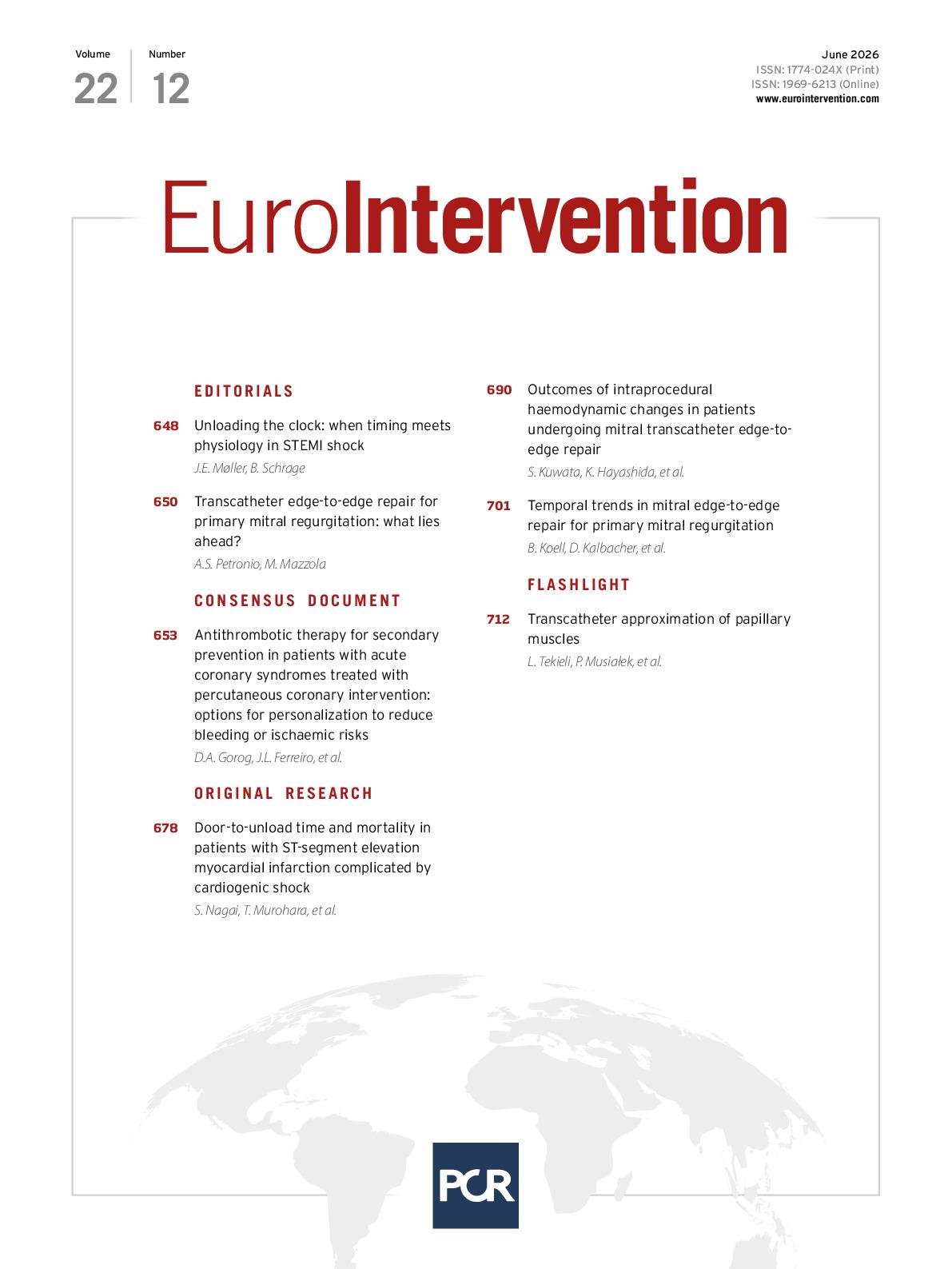
Volume 22 Number 12
Jun 15, 2026
Volume 22 Number 12
View full issue


Key metrics

Suggested by Cory
Trending articles
202.75

State-of-the-Art

10.4244/EIJ-D-21-00089 Jun 11, 2021
Intracoronary optical coherence tomography: state of the art and future directions
Ali ZA et al
free
87.2

State-of-the-Art

10.4244/EIJ-D-25-00266 Jan 19, 2026
Lesion stratification with intracoronary imaging
McGarvey M et al
free
47.45

NEW INNOVATION

10.4244/EIJ-D-15-00467 Feb 20, 2018
Design and principle of operation of the HeartMate PHP (percutaneous heart pump)
Van Mieghem NM et al
free
35.3

Original Research

10.4244/EIJ-D-25-01006 Mar 16, 2026
Clinical outcomes and haemodynamic response after blinded stress assessment of moderate aortic stenosis
Eerdekens R et al
32.2

State-of-the-Art

10.4244/EIJ-D-25-00874 Jun 1, 2026
TAVI and coronary interventions: indications, technical considerations, and clinical scenarios
Aquino Bruno H et al
free
26.25

Original Research

10.4244/EIJ-D-25-01370 May 21, 2026
Prognostic value of early haemodynamic valve deterioration after TAVI
Trimaille A et al
26.25

Original Research

10.4244/EIJ-D-25-01370 Jun 1, 2026
Prognostic value of early haemodynamic valve deterioration after TAVI
Trimaille A et al
22.2

Viewpoint

10.4244/EIJ-D-25-01066 May 4, 2026
Intracoronary imaging guidance for de novo coronary lesion treatment with drug-coated balloons
Amabile N et al
free
20.75

Flashlight

10.4244/EIJ-D-25-01014 Apr 6, 2026
Stent retriever-assisted coronary thrombectomy with continuous aspiration
Liabot Q et al
open access
19.5

Original Research

10.4244/EIJ-D-26-00032 May 15, 2026
Glucocorticoids to reduce permanent pacemaker implantation after TAVI: the GLUCO-TAVI randomised trial
Fuertes-Kenneally L et al
X

PCR
Impact factor: 9.5
2024 Journal Citation Reports®
Science Edition (Clarivate Analytics, 2025)
Online ISSN 1969-6213 - Print ISSN 1774-024X
© 2005-2026 Europa Group - All rights reserved