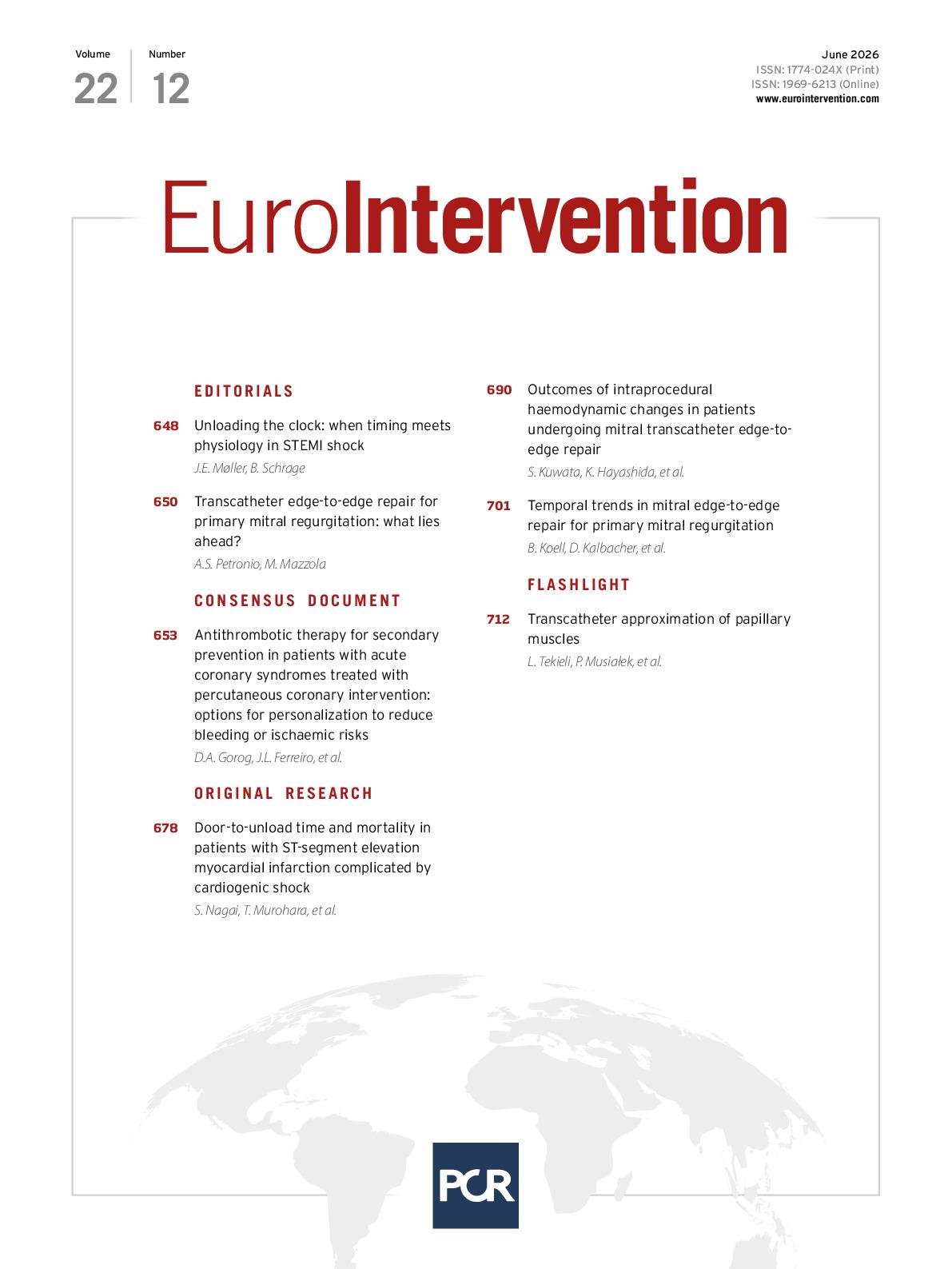
From a deep dive into the latest research on mitral transcatheter edge-to-edge repair to cardiogenic shock, this issue of EuroIntervention provides plenty to consider during these long summer days.
DAPT for secondary prevention in patients with ACS
In a European Society of Cardiology (ESC) Clinical Consensus Statement, Diana A. Gorog, Jose Luis Ferreiro and colleagues review best practices and the current evidence for personalising dual antiplatelet therapy (DAPT) for acute coronary syndrome (ACS) patients undergoing percutaneous coronary intervention. This complement to the ESC guidelines is intended to help practitioners weigh bleeding and ischaemic risks and to understand recent trial data to select the most appropriate antiplatelet strategy to optimise clinical outcomes.
Door-to-unload time in STEMI-CS
Shin Nagai, Toyoaki Murohara and colleagues query whether the duration between arrival at hospital and placement of a microaxial flow pump in patients with ST-segment elevation myocardial infarction-related cardiogenic shock (STEMI-CS) is associated with in-hospital mortality. The study stratifies this “door-to-unload” time first by duration and then by prior mechanical circulatory support – prior venoarterial extracorporeal membrane oxygenation (VA-ECMO) or intra-aortic balloon pump (IABP) placement or prior VA-ECMO and IABP. In an accompanying editorial, Jacob E. Møller and Benedikt Schrage discuss the nuances of the results.
This article is featured in this issue’s Editor’s Choice podcast.
Impact of direct left atrial pressure during M-TEER
Shingo Kuwata, Kentaro Hayashida and colleagues investigate the prognostic significance of a reduction in mean left atrial pressure (mLAP) during mitral transcatheter edge-to-edge repair (M-TEER) for mitral regurgitation (MR) patients. Their findings underline pathophysiological differences between MR aetiologies, as an intraprocedural reduction in mLAP was significantly associated with improved clinical outcomes in degenerative MR patients but not in functional MR patients.
Temporal trends in M-TEER for primary mitral regurgitation
In the PRIME-MR registry, Benedikt Koell, Daniel Kalbacher and colleagues assess the evolution of M-TEER in consecutive series of primary mitral regurgitation patients who received M-TEER. The study demonstrates advancements in procedural safety as well as sustained reductions in residual mitral regurgitation. The conversation continues in an accompanying editorial by Anna Sonia Petronio and Matteo Mazzola.