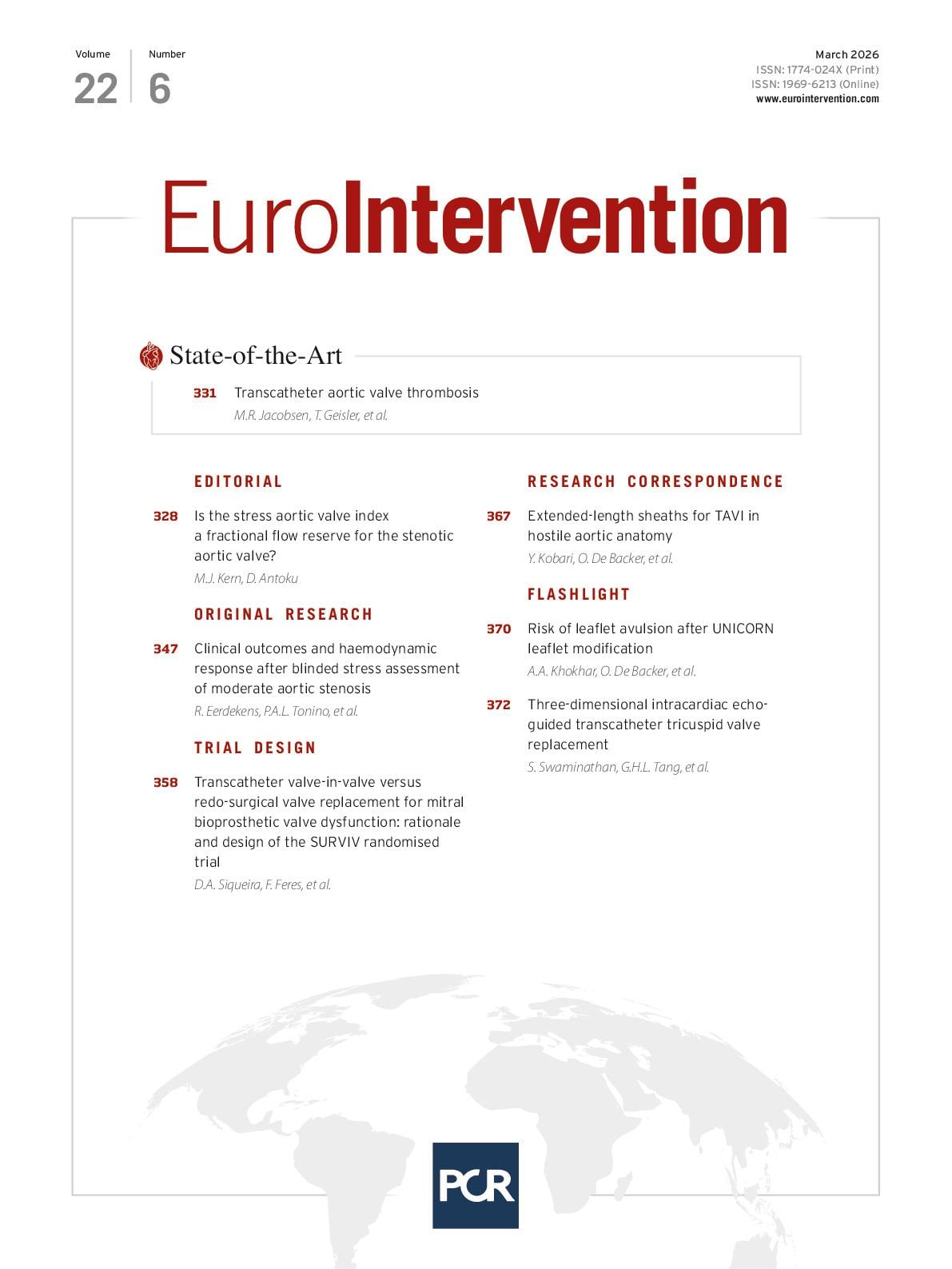
This issue of EuroIntervention takes an in-depth look at evolving treatment strategies for a range of therapeutic options – from a novel index for assessing moderate aortic stenosis to mitral valve-in-valve replacement.
TAVI thrombosis
The wide spectrum of transcatheter aortic valve implantation (TAVI) thrombosis is explored in a state-of-the-art by Mia Ravn Jacobsen, Tobias Geisler and colleagues. This review covers the current evidence and understanding of the mechanisms, treatment options, and long-term outcomes of valve thrombosis, as well as changes and improvements in antithrombotic therapies and device designs.
The SAVI-AoS study
In a pilot study, Rob Eerdekens, Pim A.L. Tonino and colleagues propose a novel stress aortic valve index aimed at identifying symptomatic moderate aortic stenosis (AS) patients who may benefit from valve intervention. By measuring patients’ stress at rest, during bicycle ergometry, and during dobutamine stress, the authors find a higher-risk subgroup – those with severe stress haemodynamics despite moderate AS – that is not found using traditional stress metrics. Morton J.Kern and Derek Antoku contribute an editorial on this article.
The SURVIV trial
Dimytri A. Siqueira, Fausto Feres and colleagues present the design and rationale of the upcoming SURVIV trial, which will assess the safety and efficacy of transseptal mitral valve-in-valve (mViV) replacement by randomising patients with severe mitral bioprosthetic valve dysfunction to either transcatheter mViV or surgical redo-mitral valve replacement. This multicentre Brazilian study’s primary endpoint is a composite of all-cause mortality or disabling stroke at 12 months procedure, with follow-up lasting 10 years.
Also in this issue
Yusuke Kobari, Ole De Backer and colleagues discuss the feasibility, safety, and technical considerations of using an extended-length introducer sheath in patients with hostile aortic anatomies undergoing transfemoral TAVI with self-expanding valves.