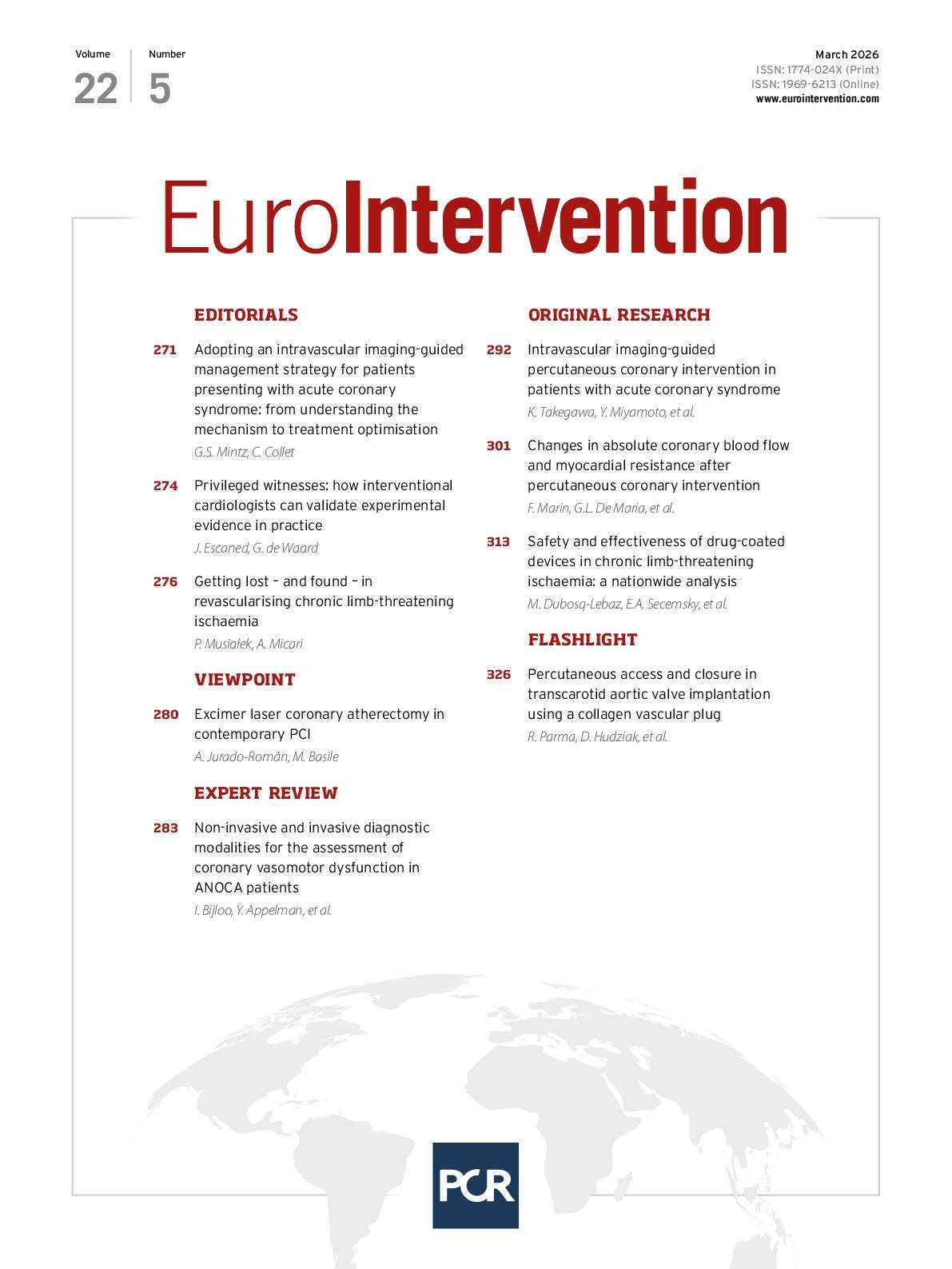
EuroIntervention continues to provide fresh insights with this new issue, featuring new research and enriching perspectives.
Non-invasive diagnosis of coronary dysfunction
Isa Bijloo, Yolande Appelman and colleagues explore and compare the invasive and non-invasive diagnostic modalities currently available for assessing coronary dysfunction in patients with angina with non-obstructive coronary artery disease. Addressing each endotype of coronary dysfunction individually, the authors review the existing diagnostic possibilities, techniques in development, and outcomes of comparative clinical studies.
Outcomes of imaging-guided PCI in ACS patients
Koki Takegawa, Yoshihiro Miyamoto and colleagues explore the benefits of intravascular imaging- versus angiography-guided percutaneous coronary intervention (PCI) and their impact on the recurrence of acute coronary syndrome (ACS). Using the national database of Japan, the authors analyse a population of first-time ACS patients undergoing PCI and discuss both the growing use of intravascular imaging in Japan as well as the lower recurrence of ACS in patients who had imaging-guided PCI. This article is accompanied by an editorial from Gary S. Mintz and Carlos Collet.
Absolute coronary flow after PCI
Federico Marin, Giovanni Luigi De Maria and colleagues investigate the immediate impact of PCI on absolute coronary flow and epicardial and myocardial resistance measured with continuous thermodilution. The pre- and post-PCI physiological assessments demonstrated a notable reduction in epicardial resistance, leading to a pronounced increase in hyperaemic flow, which can be predicted by fractional flow reserve. This article is accompanied by an editorial from Javier Escaned and Guus de Waard.
CLTI outcomes with drug-coated devices
The applicability of drug-eluting devices in femoropopliteal revascularisation is tackled by Maxime Dubosq-Lebaz, Eric A. Secemsky and colleagues, who reproduce the BASIL-3 study in a large Medicare population with chronic limb-threatening ischaemia (CLTI). The use of drug-coated balloons significantly reduced amputations, mortality, and reintervention, without increased costs. Piotr MusiaÅek and Antonio Micari continue the discussion in an accompanying editorial.
Also in this issue
Alfonso Jurado-RomÔ¡n and Mattia Basile propose an adaptation of the “5 Ss” procedural framework in excimer laser coronary atherectomy PCI.