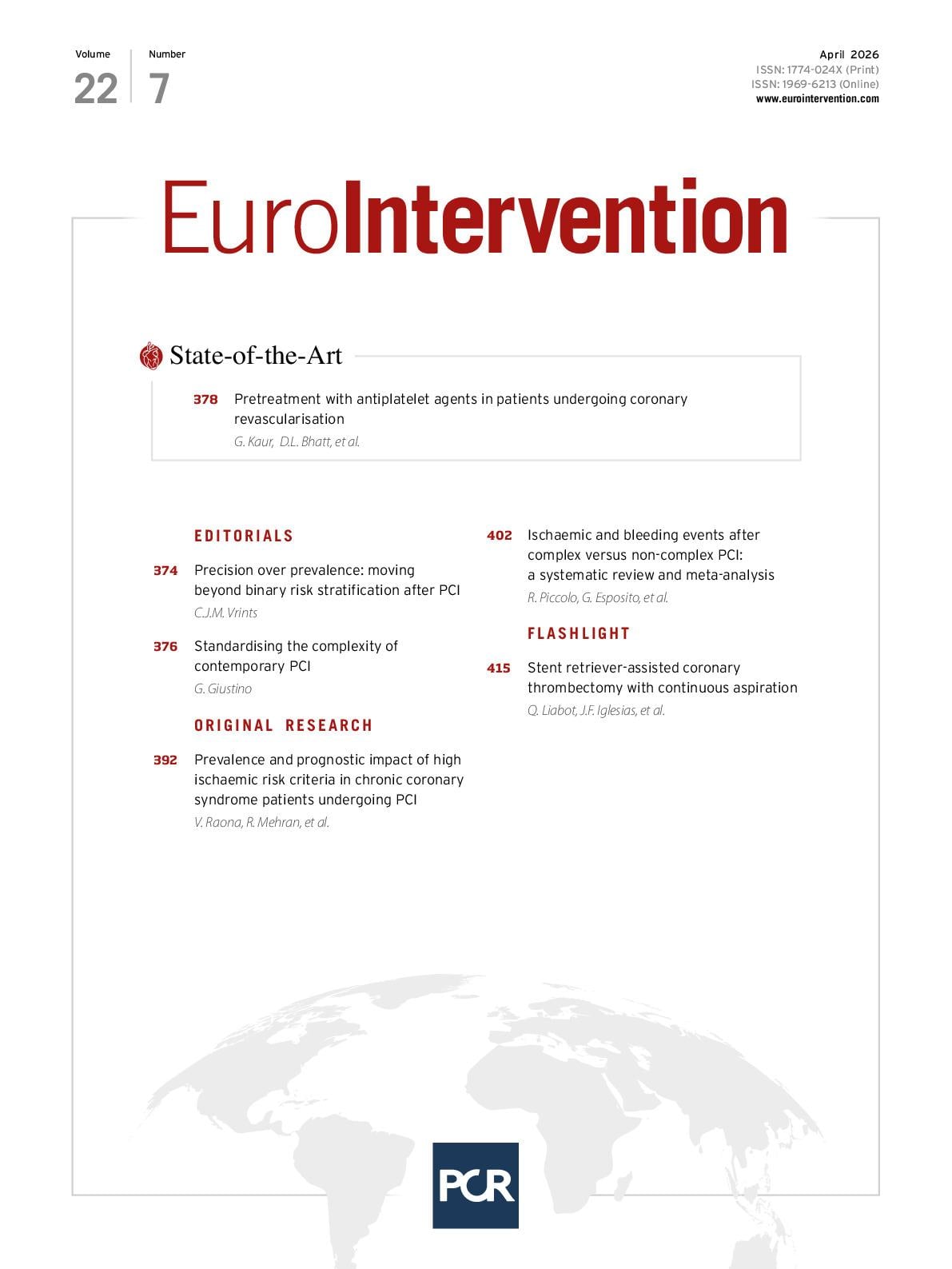
In this issue of EuroIntervention, we delve into research on pretreatment – the art of balancing ischaemic and bleeding risk, the high ischaemic risk criteria from the 2024 European Society of Cardiology (ESC) Guidelines, and complex percutaneous coronary interventions.
Antiplatelet pretreatment in coronary disease
Gurleen Kaur, Deepak L. Bhatt and colleagues present a state-of-the-art review on the current evidence on the role of pretreatment with antiplatelet agents in coronary artery disease. This summary covers patients with non-ST-segment elevation acute coronary syndromes, ST-segment elevation myocardial infarction, and chronic coronary syndromes undergoing percutaneous coronary intervention (PCI) and discusses the new data on cangrelor and other new parenteral agents.
Impact of HIR criteria in PCI
Valeria Raona, Roxana Mehran and colleagues investigate the prognostic impact of the high-ischaemic risk (HIR) criteria, as defined in the ESC 2024 Guidelines, in a real-world cohort of chronic coronary syndrome patients undergoing PCI with drug-eluting stents. Their analysis examines HIR status and adverse events, finding individual risk factors such as diabetes, chronic kidney disease, left main involvement, and greater total stent length to be most strongly associated with adverse outcomes. Christiaan J.M. Vrints contributes an editorial on this article.
This article is the subject of EuroIntervention’s new podcast, Editor’s Choice.
Prognostic impact of complex PCI
A meta-analysis by Raffaele Piccolo, Giovanni Esposito and colleagues explores the association between complex PCI and the risk of bleeding and ischaemic outcomes. Their results underline the need to tailor strategies to individuals undergoing complex PCI, as the risks of both ischaemic and bleeding events are significantly increased in this patient subset. This article is accompanied by an editorial from Gennaro Giustino.