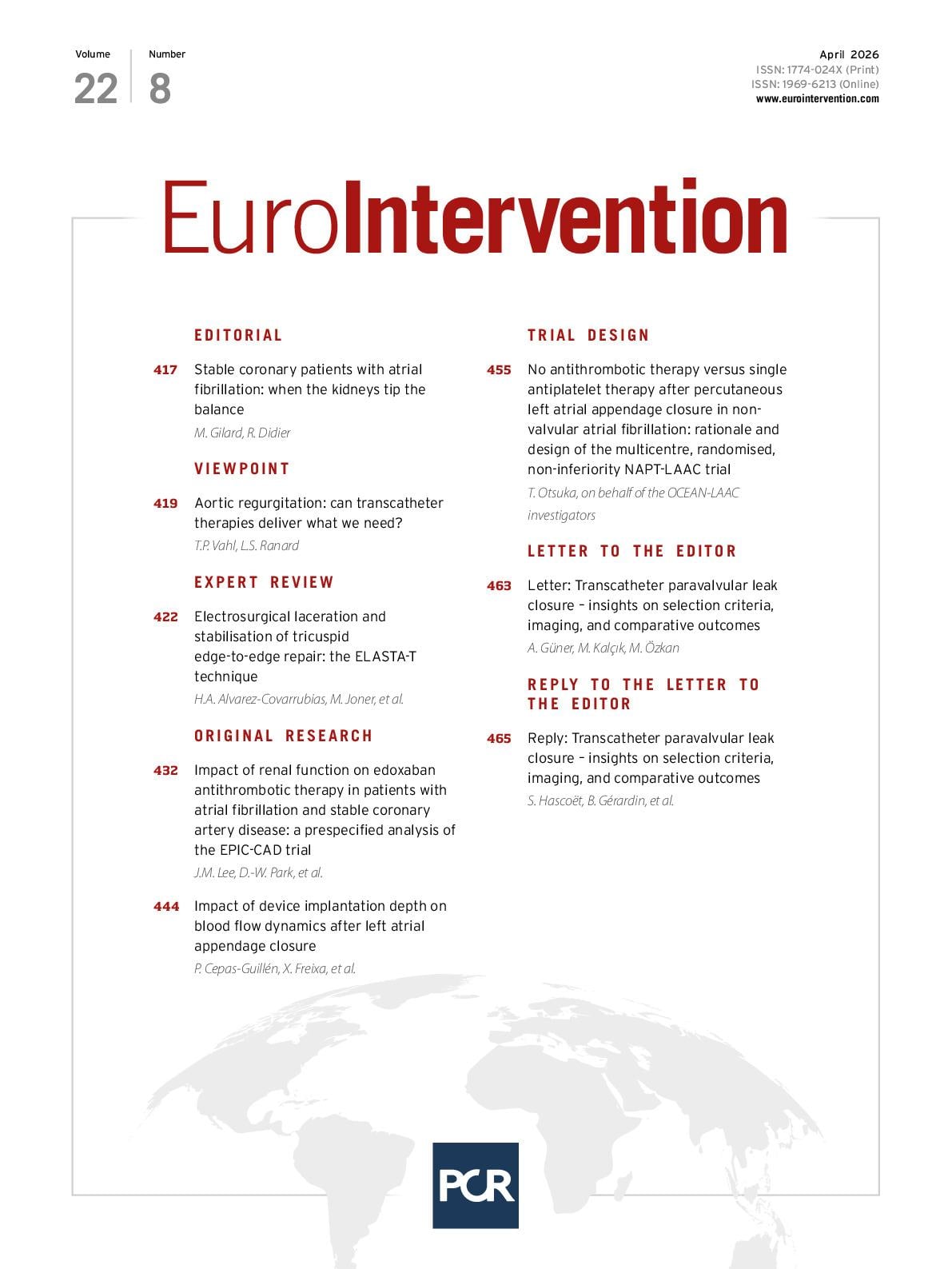
This issue of EuroIntervention shares practical insights and future perspectives on developments in interventional cardiovascular medicine to help our readers offer the best care to their patients.
ELASTA-T for TTVR
Hector A. Alvarez-Covarrubias, Michael Joner and colleagues provide a step-by-step procedural guide to performing the ELASTA-T technique. Developed to facilitate transcatheter tricuspid valve replacement (TTVR), the approach uses electrosurgical laceration and stabilisation of tricuspid transcatheter edge-to-edge repair by enabling controlled single leaflet device attachment.
This article is the subject of this issue’s Editor’s Choice podcast.
Renal function and antithrombotic use in AF-CAD
In a prespecified analysis of the EPIC-CAD study, Joong Min Lee, Duk-Woo Park and colleagues demonstrate that renal dysfunction does not impact the net clinical benefit of edoxaban monotherapy compared with dual antithrombotic therapy in patients with atrial fibrillation (AF) and stable coronary artery disease (CAD). In an accompanying editorial, Martine Gilard and Romain Didier explore the implications of their findings in real-world practice.
Device depth and flow dynamics in LAAC
Using computational flow dynamics simulations, Pedro Cepas-Guillén, Xavier Freixa and colleagues investigate whether device-related thrombus (DRT) complications after left atrial appendage closure (LAAC) are influenced by device implantation depth. Distal implantation depths were associated with abnormal flow patterns, which, in turn, were associated with DRT. With these conclusions in hand, the authors also discuss the potential of developing a risk score for DRT.
Study protocol for the NAPT-LAAC trial
Toshiaki Otsuka, Kentaro Hayashida and colleagues describe the rationale and design of the NAPT-LAAC trial. This Japanese study will examine the non-inferiority of long-term non-antithrombotic therapy with antiplatelet monotherapy following LAAC in 500 patients with non-valvular AF. Endpoints include incidence of thrombotic and bleeding composite events with a maximum of 4-year follow-up.
Also in this issue
Torsten P. Vahl and Lauren S. Ranard on the future of transcatheter therapies for aortic regurgitation