Editorial

DOI: 10.4244/EIJ-E-25-00053

The quiescent volcanoes that don't harm anymore

Francesco Prati1,2, MD; Flavio Giuseppe Biccirè1,2, MD, PhD

Cardiologists examine the coronary vessels much like geologists study volcanoes – by observing their continuous structural evolution and confronting similar questions: is the volcano a dormant Mauna Kea or an active Etna?

Plaque ulceration is a traumatic event in the course of atherosclerosis that most often progresses silently1. A long-standing question has been whether these dangerous phases of plaque destabilisation are associated with worse clinical prognosis. Several earlier studies – although not supported by robust evidence regarding the risk associated with these signs of prior plaque ulceration – have used non-culprit plaque rupture (NCPR) as a marker of high risk and investigated its prognostic significance without being able to reach definitive conclusions23.

In this issue of EuroIntervention, Zhao et al4 assess the prognostic impact of NCPR in an optical coherence tomography (OCT) study of the three major coronary vessels, for which their efforts should be commended. The authors examined, with 3-vessel OCT, a total of 930 ST-segment elevation myocardial infarction patients with 3,660 non-culprit lesions. NCPR was detected in 165 patients (18% of cases). During a median 4.1-year...

Sign in to read
the full article

Forgot your password?
No account yet?
Sign up for free!

Create my pcr account

Join us for free and access thousands of articles from EuroIntervention, as well as presentations, videos, cases from PCRonline.com
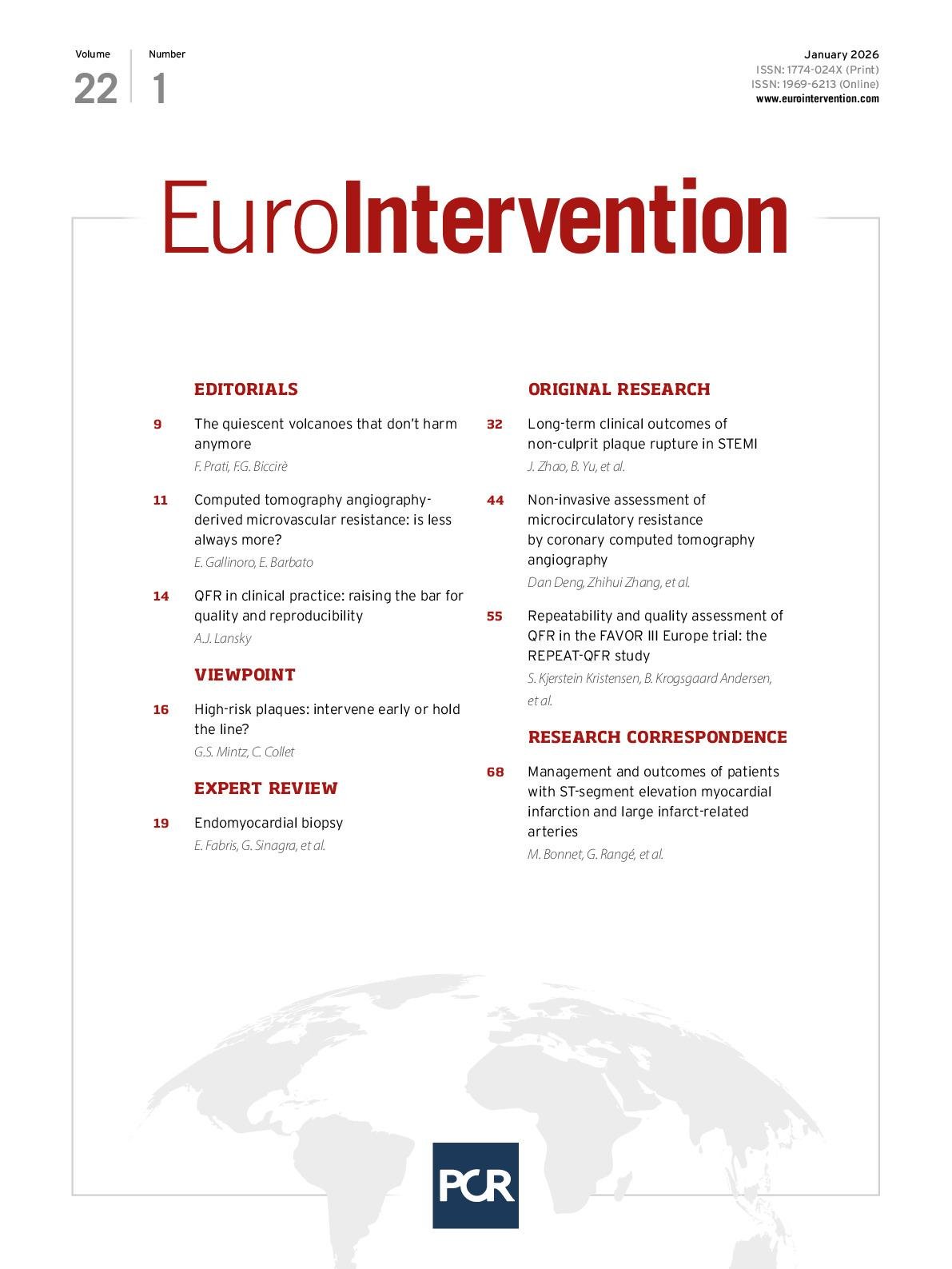
Volume 22 Number 1
Jan 5, 2026
Volume 22 Number 1
View full issue


Key metrics

Suggested by Cory

Editorial

10.4244/EIJ-E-22-00051 Jan 23, 2023
What makes a plaque rupture? A simple answer seems too much to ask for
Achenbach S
free

Viewpoint

10.4244/EIJ-D-22-00397 Oct 21, 2022
Skating on thin ice: searching for vulnerable plaques
Prati F et al
free

10.4244/EIJV15I9A138 Oct 4, 2019
Ruptured and healed atherosclerotic plaques: breaking bad?
Amabile N and Veugeois A
free

Viewpoint

10.4244/EIJ-D-25-01167 Jan 5, 2026
High-risk plaques: intervene early or hold the line?
Mintz G and Collet C
free

Editorial

10.4244/EIJ-E-25-00018 Jun 2, 2025
Using pericoronary fat attenuation to guide management after coronary interventions
Antoniades C and Chan K
free

Debate

10.4244/EIJ-E-24-00004 Mar 4, 2024
Prophylactic stenting of vulnerable plaques: pros and cons
Park D et al
free

10.4244/EIJV9I8A150 Dec 27, 2013
STEMI patients and non-culprit lesions: what to do and when?
Smits PC
free

Editorial

10.4244/EIJ-E-25-00042 Oct 6, 2025
Seeing is believing
Daemen J and Sadowski K
free
X

PCR
Impact factor: 9.5
2024 Journal Citation Reports®
Science Edition (Clarivate Analytics, 2025)
Online ISSN 1969-6213 - Print ISSN 1774-024X
© 2005-2026 Europa Group - All rights reserved