Reply to the letter to the editor

DOI: 10.4244/EIJ-D-26-00147

Reply: Transcatheter paravalvular leak closure – insights on selection criteria, imaging, and comparative outcomes

Sebastien Hascoet1, MD, PhD, FESC; Grégoire Albenque1, MD; Grzegorz Smolka2, MD; Benoît Gérardin1, MD

We thank Güner et al for their interest in our prospective multicentre Fermeture de Fuite ParaProthétique (FFPP) registry evaluating transcatheter paravalvular leak closure (PVLc)1 and for their thoughtful and constructive comments. We welcome the opportunity to clarify several methodological points raised in their correspondence.

We fully agree that PVLc management remains complex and that outcomes depend on multiple factors, including patient selection, anatomical characteristics, procedural strategy, and imaging assessment. In this context, we believe that the prospective design of the FFPP registry, its complete follow-up up to two years, and the use of clinically meaningful endpoints provide robust real-world evidence in a high-risk population undergoing transcatheter PVLc2.

Several concerns deserve clarification. First, regarding endpoint definitions, we would like to emphasise that Academic Research Consortium (ARC) criteria were explicitly acknowledged and applied in our methodology. In the FFPP registry, echocardiographic assessment of PVL severity followed the Valve Academic Research Consortium expert consensus3, as detailed in both the present manuscript and in the initial publication from the same prospective registry focusing on short-term outcomes4. Our definitions of technical and clinical...

Sign in to read
the full article

Forgot your password?
No account yet?
Sign up for free!

Create my pcr account

Join us for free and access thousands of articles from EuroIntervention, as well as presentations, videos, cases from PCRonline.com
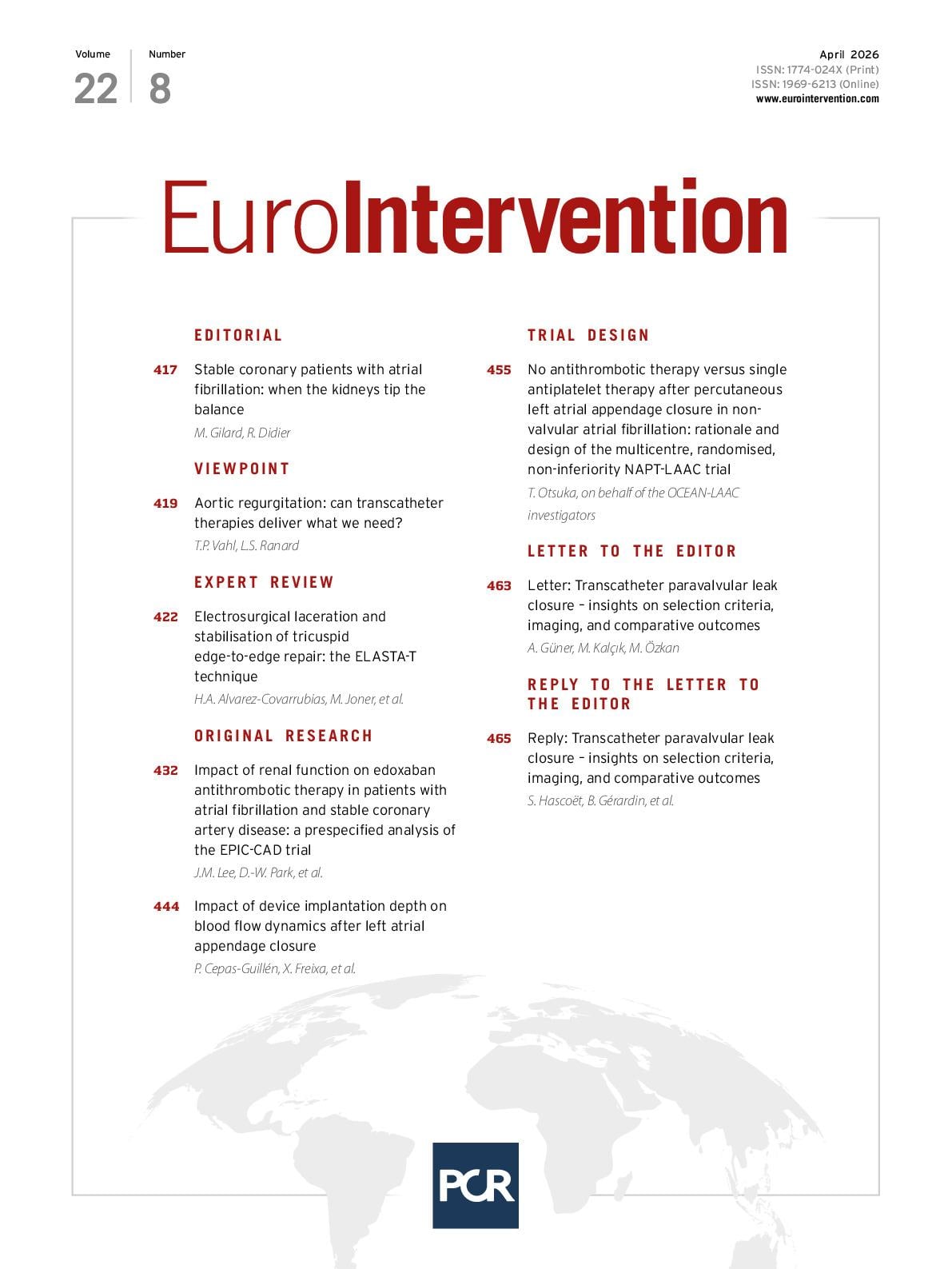
Volume 22 Number 8
Apr 20, 2026
Volume 22 Number 8
View full issue


Key metrics

Suggested by Cory

Letter to the editor

10.4244/EIJ-D-26-00101 Apr 20, 2026
Letter: Transcatheter paravalvular leak closure – insights on selection criteria, imaging, and comparative outcomes
Güner A et al
free

10.4244/EIJV17I9A121 Oct 20, 2021
Transcatheter paravalvular leak closure: catch me if you can
Pilgrim T and Okuno T
free

Clinical research

10.4244/EIJ-D-20-01206 Oct 20, 2021
Long-term outcomes of catheter-based intervention for clinically significant paravalvular leak
Perl L et al
free

Clinical research

10.4244/EIJ-D-22-01110 Aug 7, 2023
Percutaneous paravalvular leak closure after transcatheter aortic valve implantation: the international PLUGinTAVI Registry
Flores-Umanzor E et al
free

CLINICAL RESEARCH

10.4244/EIJV11I10A237 Feb 19, 2016
Early experience of percutaneous paravalvular leak closure using a novel Occlutech occluder
Goktekin O et al
free

10.4244/EIJV12SXA11 May 16, 2016
Catheter-based treatment of paravalvular leaks
Taramasso M et al
free
X

PCR
Impact factor: 9.5
2024 Journal Citation Reports®
Science Edition (Clarivate Analytics, 2025)
Online ISSN 1969-6213 - Print ISSN 1774-024X
© 2005-2026 Europa Group - All rights reserved