Although the calendar year begins in January, for EuroIntervention, the real start of the year comes in May when the interventional community comes together at EuroPCR. This 2026 edition follows that tradition.
This year is one of transition. The connection between the Journal and PCR has become even closer following the conclusion of the long-standing agreement with the European Society of Cardiology (ESC). This change represents a further step in our development, making us more agile and forward-moving, while continued collaboration with the ESC remains a natural perspective.
This year also marks the beginning of a new era of leadership at PCR, led by Bernard Prendergast. This vision, presented in this issue, reflects a moment of renewal: pragmatic, energetic, and open to opportunity.
And, as for the the Journal itself? It is growing. Submissions are increasing, as is their quality. Growth alone, however, is not our goal; what matters is what we do with it. Our role is not only to select manuscripts but to ensure that the science we publish is clear, rigorous, and accessible and that our content is relevant to ongoing scientific and clinical questions. These parameters have helped us to rethink how we present material. We are always aiming for stronger visual communication – as evidenced by our now-professionally developed Central Illustrations – as well as formats designed to make complex ideas easier to understand and use.
This progress is also reflected in how the Journal is used. EuroIntervention is increasingly cited in leading publications, not only as a source of information but also as a contributor to the scientific conversation; this is a distinction that matters. Being cited in leading publications reflects not only the impact of our work but also the stature EuroIntervention has achieved among the world’s leading journals as a trusted source.
The start of our new year also offers two new pathways for our community to engage with EuroIntervention’s content. The first you may have already encountered: a podcast series, Editor’s Choice, hosted by Aaysha Cader. Each issue of the Journal is now accompanied by an audio discussion with the authors of a key study.
The second is the expansion of the EuroIntervention Journal family with the launch of EuroIntervention Case Reports, led by Salvatore Brugaletta. This new Open Access platform in interventional cardiology complements the main journal and captures clinically relevant insights from real practice, for real practice.
Overall, EuroIntervention is entering a new phase in which we are more agile, more visible, and more confidently orientated toward the future. The challenge is not simply to grow but to ensure that this growth continues to translate into meaningful contributions for clinicians, for researchers, and ultimately, for the patients we serve.
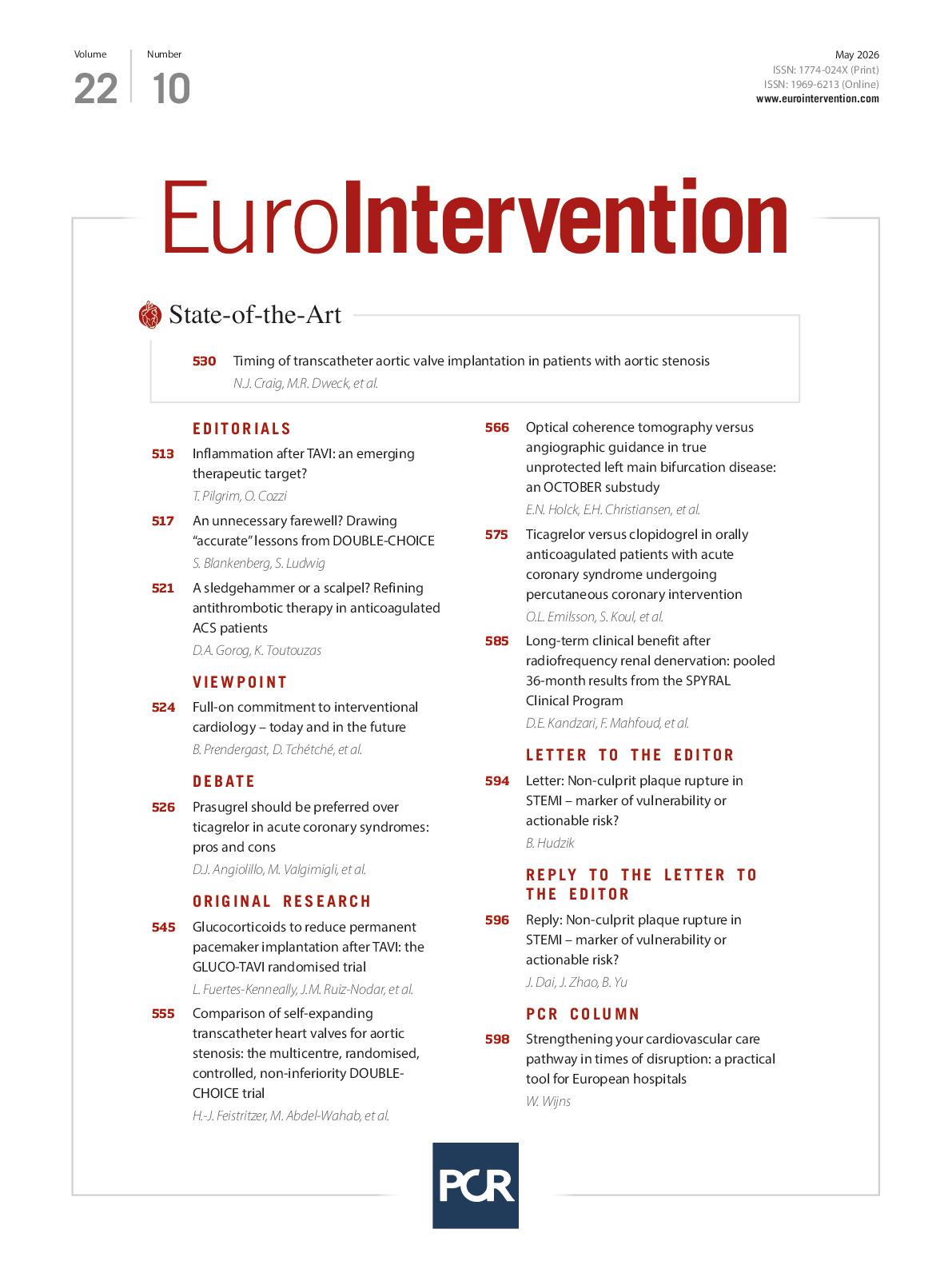
But let’s not go too far ahead for now – there is a brand new table of contents to present.
We begin with a State-of-the-Art addressing the timing of transcatheter aortic valve implantation (TAVI). Whilst the interventional path is relatively straightforward for patients with severe aortic stenosis (AS), it is less so for patients with severe asymptomatic AS or moderate symptomatic AS. Neil J. Craig, Marc R. Dweck and colleagues explain how to weigh and integrate factors such as clinical characteristics, disease progression, imaging data, and recent trial results into an effective, patient-based approach to determine the best timing for TAVI.
We then turn to a Debate on the use of prasugrel or ticagrelor for acute coronary syndromes, an unresolved subject that has split international guidelines. We have brought together experts to examine this subject in detail for you. Dominick J. Angiolillo and Adnan Kastrati offer arguments for prasugrel from a pharmacological angle and explain their interpretation of ISAR-REACT 5. Marco Frazzetto and Marco Valgimigli critique the design of ISAR-REACT 5 and other recent studies and explain why they believe the results are inconclusive.
Moving to our Original Research articles, we present an investigation into whether targeting inflammation can help prevent post-TAVI cardiac conduction disturbances by Laura Fuertes-Kenneally, Juan M. Ruiz-Nodar and colleagues. The GLUCO-TAVI pilot study evaluated the feasibility, safety, and preliminary efficacy of glucocorticoids to prevent permanent pacemaker implantation post-TAVI. A cohort of 100 patients with severe symptomatic AS were randomised to either intravenous methylprednisolone 1 hour before TAVI, followed by 5 days of oral prednisone, or standard care. The numerical reduction in PPI at 1 month post-TAVI and the acceptable safety profile suggest that larger studies may be warranted. Thomas Pilgrim and Ottavia Cozzi discuss this inflammatory hypothesis in detail in an accompanying Editorial, and this Original Research article is the subject of this issue’s Editor’s Choice podcast, hosted by Aaysha Cader.
Our second Original Research article underlines how scrutinising outcomes of the ACURATE neo2 valve improves our understanding of self-expanding valve design. Here, Hans-Josef Feistritzer, Mohamed Abdel-Wahab and colleagues present the 30-day results of the DOUBLE-CHOICE trial. After randomising 835 patients with severe symptomatic AS undergoing TAVI to either the ACURATE neo2 or an Evolut valve, the ACURATE valve was found to be non-inferior to the Evolut devices, with significantly lower rates of the primary endpoint, driven by lower permanent pacemaker implantation at 30 days. This article is accompanied by an editorial from Stefan Blankenberg and Sebastian Ludwig.
Next, Emil N. Holck, Evald H. Christiansen and colleagues investigate the feasibility of optical coherence tomography (OCT) guidance in patients undergoing percutaneous coronary intervention (PCI) for true distal left main coronary artery (LMCA) bifurcation lesions and the prognostic impact compared with angiographic guidance. This substudy of the OCTOBER trial analysed successful OCT pullbacks at three predefined timepoints, as well as the incidence of clinical outcomes in both groups. Despite proving feasibility, the authors were confronted with visibility issues around the LMCA ostium and found that OCT was not associated with significant improvement in clinical outcomes at 2 years.
An investigation by Oskar Love Emilsson, Sasha Koul and colleagues queries whether ticagrelor or clopidogrel is the optimal P2Y12 agent for ACS patients undergoing PCI with concurrent direct oral anticoagulants. This analysis from the SWEDEHEART registry examined 1-year outcomes of major cardiovascular events, all-cause mortality, myocardial infarction, stroke, stent thrombosis, and clinically relevant bleeding. Ticagrelor was associated with an increased risk of bleeding compared with clopidogrel, supporting current guideline recommendations. Diana A. Gorog and Konstantinos Toutouzas contribute an Editorial on this article.
Finally, our last Original Research article from David E. Kandzari, Felix Mahfoud and colleagues examines 36-month data from 4 clinical studies on radiofrequency renal denervation (RF-RDN) in order to evaluate the long-term safety and efficacy of RF-RDN. The pooled cohort of 2,137 patients, all treated with the Symplicity Spyral device, had significant and clinically meaningful reductions in both office and 24-hour ambulatory systolic and diastolic blood pressure that were sustained over 3 years, with few adverse events. Moreover, nearly 9 out of 10 patients across a wide demographic range experienced a clinical benefit.
As mentioned earlier, in this issue, Bernard Prendergast and the PCR Leadership Team share news of this year’s PCR-related activities, and William Wijns and Sandrine Wallace discuss the RESIL-Card project – a self-assessment tool for multidisciplinary teams looking to improve their resilience – in our new PCR column.
And now, the articles can speak for themselves.