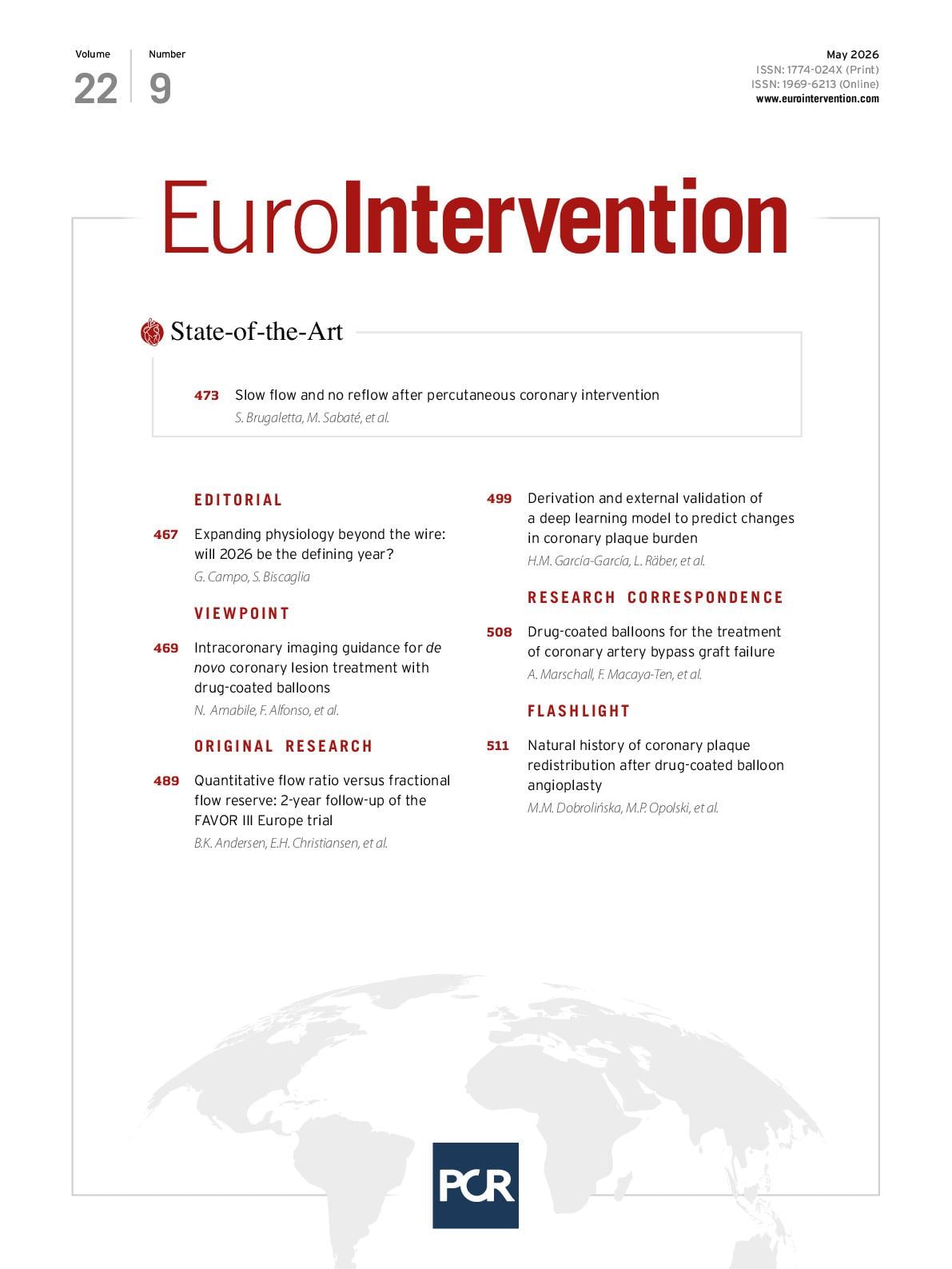
Here is a selection of thought-provoking research and insightful commentary on a wide range of subjects to keep you engaged and learning as we count down to seeing everyone at EuroPCR 2026!
Slow flow and no reflow
A State-of-the-Art by Salvatore Brugaletta, Manel Sabaté and colleagues discusses the pathophysiology of the slow-flow and no-reflow phenomena occurring in some acute ST-segment elevation myocardial infarction patients. This in-depth review also covers the currently available invasive and non-invasive diagnostic tools, as well as the pharmacological and interventional treatments that have been tested in clinical studies.
Two-year outcomes of FAVOR III Europe
Birgitte K. Andersen, Evald H. Christiansen and colleagues present the 2-year outcomes of FAVOR III Europe, which compared quantitative flow ratio (QFR) guidance with fractional flow reserve (FFR) guidance for patients undergoing revascularisation of intermediate coronary stenoses. The surprising 1-year outcomes were confined to that first year – while at 2 years, major adverse cardiac event rates were similar between QFR and FFR. Gianluca Campo and Simone Biscaglia discuss the results in an accompanying editorial.
This article is the subject of this month’s Editor’s Choice podcast.
Predicting changes in coronary plaque burden
Using baseline geometric features of lumen and vessel contours generated by intravascular ultrasound, Hector M. GarcÔa-GarcÔa, Lorenz Räber and colleagues have developed a deep learning model capable of predicting changes in plaque dynamics. By analysing the plaque burden change in adjacent frames, their model demonstrated high accuracy in predicting the progression/regression of the coronary artery disease in non-culprit vessels of patients with acute myocardial infarction.
Also in this issue
A Viewpoint on intracoronary imaging guidance with drug-coated balloons (DCB) from Nicolas Amabile, Fernando Alfonso and colleagues and a Research Correspondence from Alexander Marschall, Fernando Macaya-Ten and colleagues on DCB angioplasty for de novo and in-stent restenosis lesions in bypass grafts.