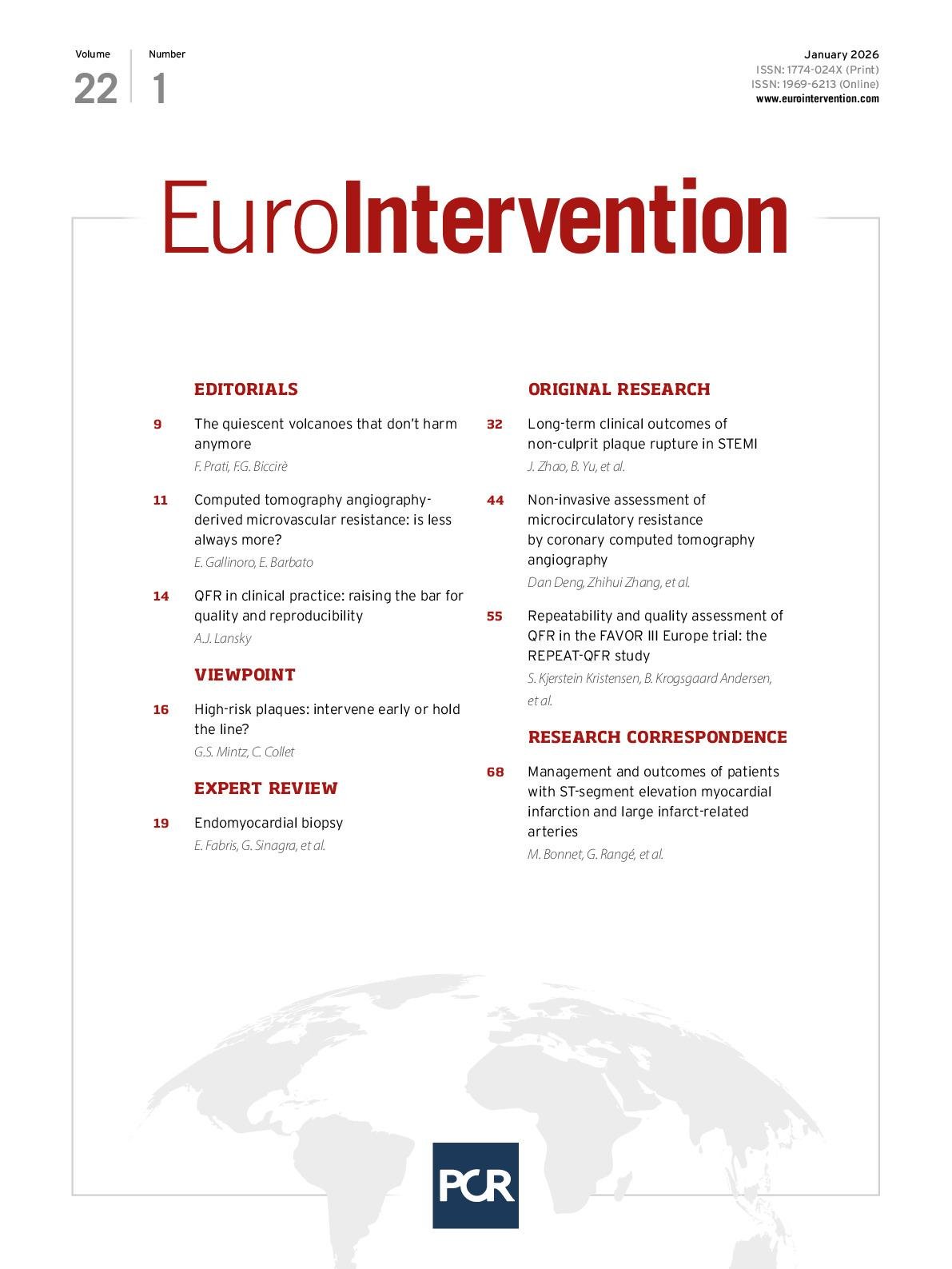
EuroIntervention wishes all our readers a happy new year for 2026. Let’s dive straight in with a selection of forward-looking articles.
Endomyocardial biopsy
Enrico Fabris, Gianfranco Sinagra and colleagues present an expert review on endomyocardial biopsy (EMB), used in the diagnosis of a wide range of cardiac disorders. The authors explore how interventional cardiologists can optimise the clinical use of EMB, covering patient selection, left versus right ventricular EMB, imaging, technical and procedural steps, as well as a selection of case studies and future perspectives.
Clinical impact of non-culprit plaque rupture
In an optical coherence tomography study of the three major epicardial coronary arteries, Jiawei Zhao, Bo Yu and colleagues investigate non-culprit plaque rupture in ST-segment elevation myocardial infarction (STEMI) patients. Although those with non-culprit plaque rupture had an elevated risk of long-term adverse results, non-ruptured thin-cap fibroatheroma was demonstrated to be the independent predictor of long-term adverse outcomes. Francesco Prati and Flavio Giuseppe Biccirè contribute an accompanying editorial.
IMRCT for non-invasive coronary microvascular disease assessment
Dan Deng, Zhihui Zhang and colleagues describe a coronary computed tomography angiography (CCTA)-based method for evaluating coronary microcirculation, called computed tomography-based index of microvascular resistance (IMRCT). The technique integrates multiphase CCTA data with retrospective electrocardiogram gating and demonstrated good correlation with invasively determined measurements at the vessel and patient levels. This article is accompanied by an editorial from Emanuele Gallinoro and Emanuele Barbato.
Reproducibility of QFR in FAVOR III Europe
With doubts about the reliability of quantitative flow ratio (QFR) sown by FAVOR III Europe, Sophie Kjerstein Kristensen, Birgitte Krogsgaard Andersen and colleagues search for the roots of the discordance in the REPEAT-QFR substudy, comparing in-procedure QFR with core lab QFR analyses. Agreement between these analytic approaches was modest with measurement variability influenced by angiographic quality, advanced coronary artery disease, and poor in-procedure QFR analysis. Alexandra J. Lansky reflects on the implications of this study in an accompanying editorial.
Also in this issue
Gary S. Mintz and Carlos Collet on high-risk plaque interventions; and Marc Bonnet, Grégoire Rangé and colleagues on the management of STEMI patients with large coronary arteries.