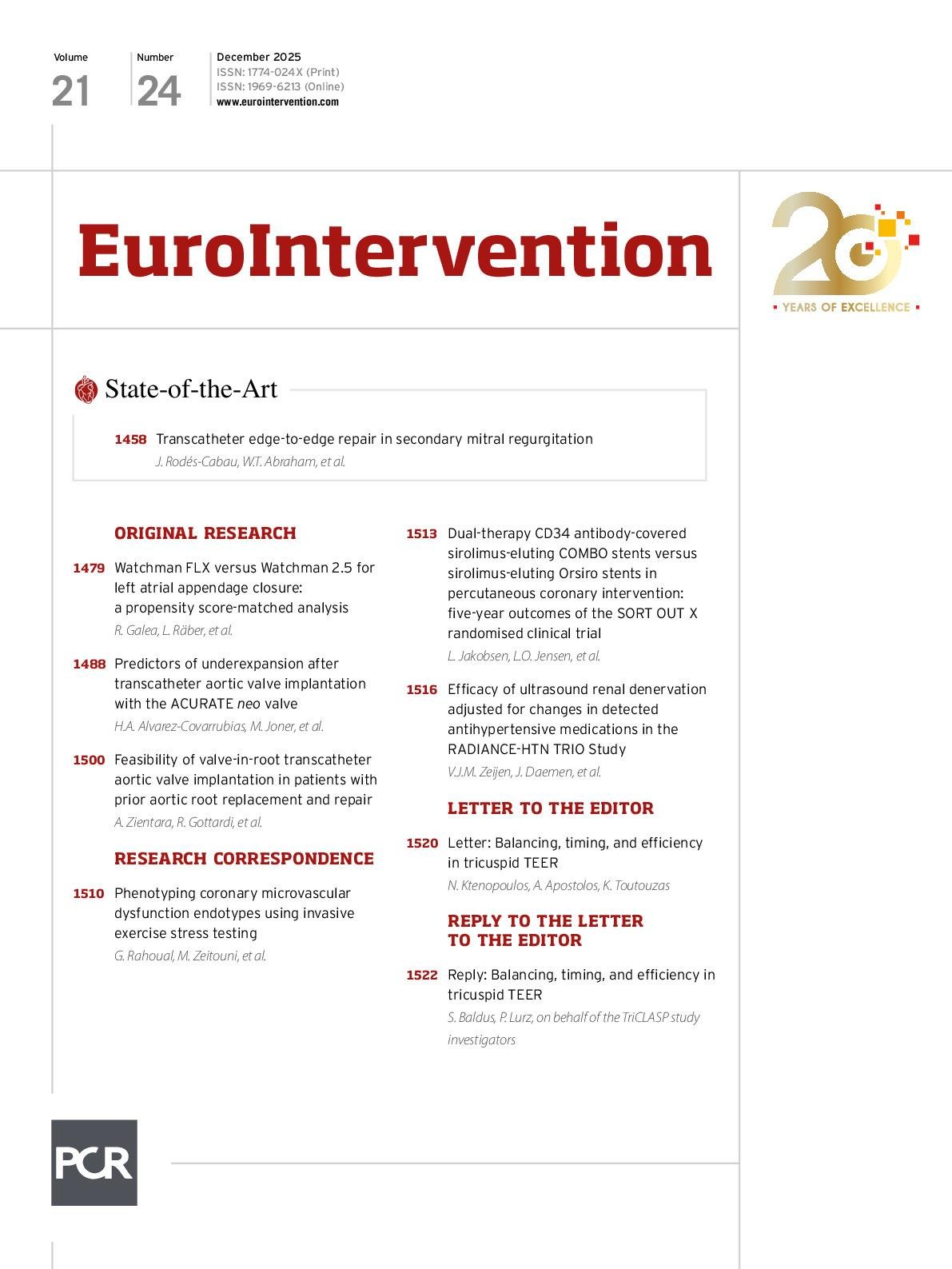
2025 is drawing to a close, and all of us at EuroIntervention wish you, our readers, the very best for the holidays and start of the new year. For our last issue of 2025, we bring you articles on the devices and therapies that have each been, in their own way, transformative to our field.
TEER in MR
Transcatheter edge-to-edge repair (TEER) for heart failure patients with secondary mitral regurgitation (SMR) is the subject of a state-of-the-art by Josep Rodés-Cabau, William T. Abraham and colleagues. With a focus on the pathophysiology and assessment of SMR, the authors discuss patient selection, current devices, and procedural outcomes as well as how landmark trials shaped patient management.
Watchman FLX vs 2.5
Roberto Galea, Lorenz Räber and colleagues compare device-related complications and clinical outcomes after left atrial appendage closure with the Watchman FLX and Watchman 2.5. After propensity score matching, the newer-generation FLX had lower rates of device-related thrombus and peridevice leakage at imaging follow-up.
Predictors of underexpansion with ACURATE neo
Hector A. Alvarez-Covarrubias, Michael Joner and colleagues investigate the procedural factors associated with underexpansion of the ACURATE neo/neo2 valves. An excessive volume of annular calcium was associated with a higher likelihood of underexpansion, whereas post-dilatation reduced the risk of underexpansion. The authors suggest that further research is needed to determine whether valve underexpansion is observed at a similar rate in other transcatheter heart valves.
Valve-in-root TAVI after aortic root operation
Patients who have undergone a Bio-Bentall procedure or valve-sparing root repair (VSRR) may need a second intervention later in life. Alicja Zientara, Roman Gottardi and colleagues examine the feasibility of valve-in-root procedures in the context of lifetime management, with discussions on the anatomical conditions – annulus area, coronary ostia height, and valve-to-coronary distance – that must be addressed in the first intervention to facilitate a second one.
Also in this issue
This issue also includes three research correspondences, the first, an examination of coronary microvascular dysfunction using invasive exercise stress testing, by Ghilas Rahoual, Michel Zeitouni and colleagues; followed by the 5-year results of SORT OUT X by Lars Jakobsen, Lisette O. Jensen and colleagues; and finally, an analysis of antihypertensive medications in the RADIANCE-HTN TRIO Study from Victor J.M. Zeijen, Joost Daemen and colleagues.