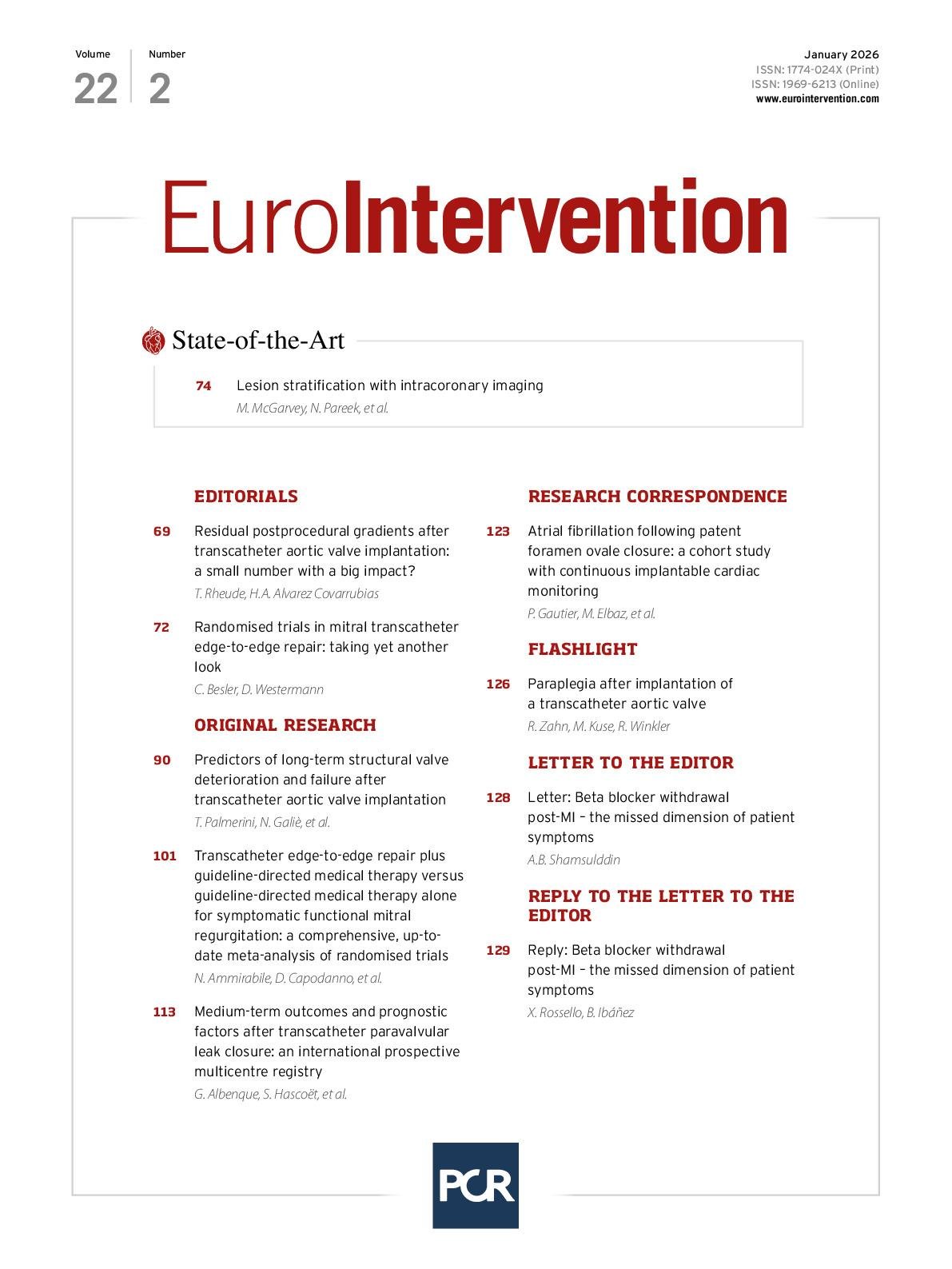
In our constantly evolving field, EuroIntervention is here to match your stride with expansive, thought- provoking research articles. This month we bring you the following:
Lesion stratification with intracoronary imaging
In a state-of-the-art, Michael McGarvey, Nilesh Pareek and colleagues discuss the expansion of intracoronary imaging in lesion stratification beyond its current applications in percutaneous coronary intervention planning and optimisation. The authors explore the potential of intracoronary imaging in refining treatment in both chronic and acute coronary syndromes, the prospects of automated image interpretation using artificial intelligence, and new developments in multimodality devices and plaque biomechanics.
Structural valve deterioration and mortality after TAVI
Tullio Palmerini, Nazzareno Galiè and colleagues find an association between early residual postprocedural gradients and the risk of structural valve deterioration (SVD) in an all-comer population of patients with severe aortic stenosis undergoing transcatheter aortic valve implantation (TAVI). Additionally, they find SVD to be associated with long-term mortality, suggesting that strategies that reduce postprocedural gradients after TAVI can optimise clinical outcomes. Tobias Rheude and Héctor Alfonso Alvarez Covarrubias contribute an editorial on these findings.
M-TEER vs GDMT
In a meta-analysis of the MITRA-FR, COAPT, and RESHAPE-HF2 trials, Nicola Ammirabile, Davide Capodanno and colleagues compare the 2-year clinical outcomes of mitral transcatheter edge-to-edge repair (M-TEER) plus guideline-directed medical therapy (GDMT) and GDMT alone in patients with symptomatic moderate-to-severe functional mitral regurgitation. A combination of M-TEER and GDMT reduced the incidence of death or hospitalisation due to heart failure and the rate of heart failure-related hospitalisation. Christian Besler and Dirk Westermann comment in an accompanying editorial.
Medium-term outcomes in transcatheter PVL closure
Grégoire Albenque, Sébastien Hascoët and colleagues analyse 2-year outcomes and predictors of mortality or surgical reintervention for patients who have undergone transcatheter paravalvular leak (PVL) closure. Transcatheter PVL closure was a durable therapeutic option so long as early clinical success was achieved, whereas mitral valve involvement, mechanical prostheses, and haemolytic anaemia were identified as predictors of worse outcomes.
AF following PFO closure using ICM
Using continuous implantable cardiac monitoring (ICM) devices, Paul Gautier, Meyer Elbaz and colleagues investigate the incidence and time-to-onset of atrial fibrillation (AF) after patent foramen ovale (PFO) closure. Patients received extensive pre- and postprocedural AF monitoring, and the rate at 30 days was high, albeit asymptomatic and paroxysmal.