Trial Design

DOI: 10.4244/EIJ-D-25-00200

FFRangio-guided versus pressure wire-guided PCI: design and rationale of the multicentre, randomised ALL-RISE trial

Björn Redfors1,2,3,4, MD, PhD; Mahesh V. Madhavan1,5, MD, MS; Ajay J. Kirtane1,5, MD, SM; William F. Fearon6,7, MD; Robert W. Yeh8, MD; David J. Cohen1,9, MD, MSc; Rasha Al-Lamee10,11, MD, MA, PhD; Allen Jeremias1,9, MD, MSc; Guy Witberg12,13, MD, MPH; Rahul P. Sharma6, MBBS; Alexandra Popma1, MD; Amir Kaki14, MD; Alejandro Froimovich15, MD, MBA; Martin B. Leon1,5, MD

Abstract

Wire-based indices of coronary physiology are the gold standard for guiding revascularisation decisions in patients with coronary artery disease and angiographically intermediate coronary stenoses. FFRangio is a novel angiography-based technology for assessing the functional significance of epicardial coronary stenoses without pressure wires or hyperaemic stimulus. The primary objective of the Advancing Cath Lab Results with FFRangio Coronary Physiology Assessment trial (ALL-RISE; ClinicalTrials.gov: NCT05893498) is to compare clinical outcomes in patients with chronic coronary syndromes or non-ST-segment elevation acute coronary syndromes undergoing coronary angiography with ≥1 coronary lesion suitable for physiological assessment. Patients will be randomised to FFRangio-guided or to pressure wire-guided treatment. The primary endpoint is the occurrence of major adverse cardiovascular events (MACE) at 1 year (a composite of all-cause death, myocardial infarction, or unplanned clinically driven revascularisation), assessed for non-inferiority of FFRangio-based versus pressure wire-based guidance. If non-inferiority is met, reflex superiority guidance will be tested. Secondary endpoints include periprocedural and early complications up to 30 days, individual components of MACE at 1 year, patient-reported health status, procedural resource utilisation and healthcare-related costs, and operator-assessed usability of the FFRangio and pressure wire systems. With a sample size of 1,924 patients, the study has 82.7% power to assess non-inferiority with a non-inferiority margin of 3.5%. The ALL-RISE trial will provide prospective clinical outcomes data on the relative safety, efficacy, and cost-effectiveness of a workflow using FFRangio as compared with pressure wire-based approaches for coronary lesion assessment among patients being considered for percutaneous coronary intervention.

Sign in to read
the full article

Forgot your password?
No account yet?
Sign up for free!

Create my pcr account

Join us for free and access thousands of articles from EuroIntervention, as well as presentations, videos, cases from PCRonline.com
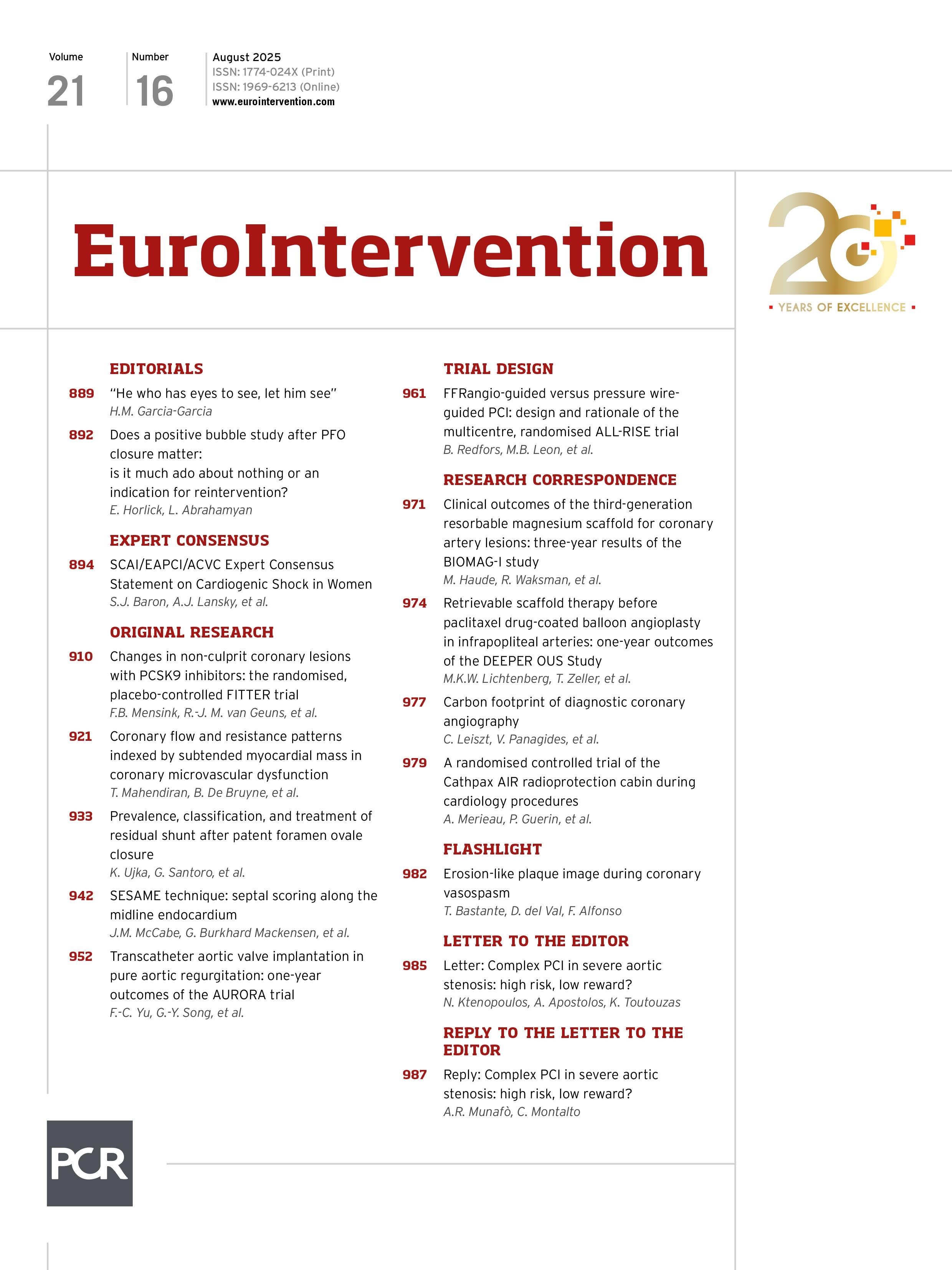
Volume 21 Number 16
Aug 18, 2025
Volume 21 Number 16
View full issue


Key metrics

Suggested by Cory

Expert consensus

10.4244/EIJ-D-24-01126 May 20, 2025
SCAI/EAPCI/ACVC Expert Consensus Statement on Cardiogenic Shock in Women
Baron S et al
open access
Trending articles
334.7

State-of-the-Art Review

10.4244/EIJ-D-21-00904 Apr 1, 2022
Antiplatelet therapy after percutaneous coronary intervention
Angiolillo D et al
free
84.05

State-of-the-Art

10.4244/EIJ-D-23-00840 Sep 2, 2024
Aortic regurgitation: from mechanisms to management
Baumbach A et al
free
45.75

State-of-the-Art

10.4244/EIJ-D-25-01346 May 4, 2026
Slow flow and no reflow after percutaneous coronary intervention
Brugaletta S et al
free
42.15

State-of-the-Art

10.4244/EIJ-D-25-00896 Apr 6, 2026
Pretreatment with antiplatelet agents in patients undergoing coronary revascularisation
Kaur G et al
free
38.2

State-of-the-Art

10.4244/EIJ-D-24-00195 Apr 7, 2025
Percutaneous coronary intervention for calcified and resistant lesions
Pesarini G et al
free
32.65

Original Research

10.4244/EIJ-D-26-00032 May 15, 2026
Glucocorticoids to reduce permanent pacemaker implantation after TAVI: the GLUCO-TAVI randomised trial
Fuertes-Kenneally L et al
32.2

State-of-the-Art

10.4244/EIJ-D-25-00874 Jun 1, 2026
TAVI and coronary interventions: indications, technical considerations, and clinical scenarios
Aquino Bruno H et al
free
X

PCR
Impact factor: 9.2
2025 Journal Citation Reports®
Science Edition (Clarivate Analytics, 2026)
Online ISSN 1969-6213 - Print ISSN 1774-024X
© 2005-2026 Europa Group - All rights reserved