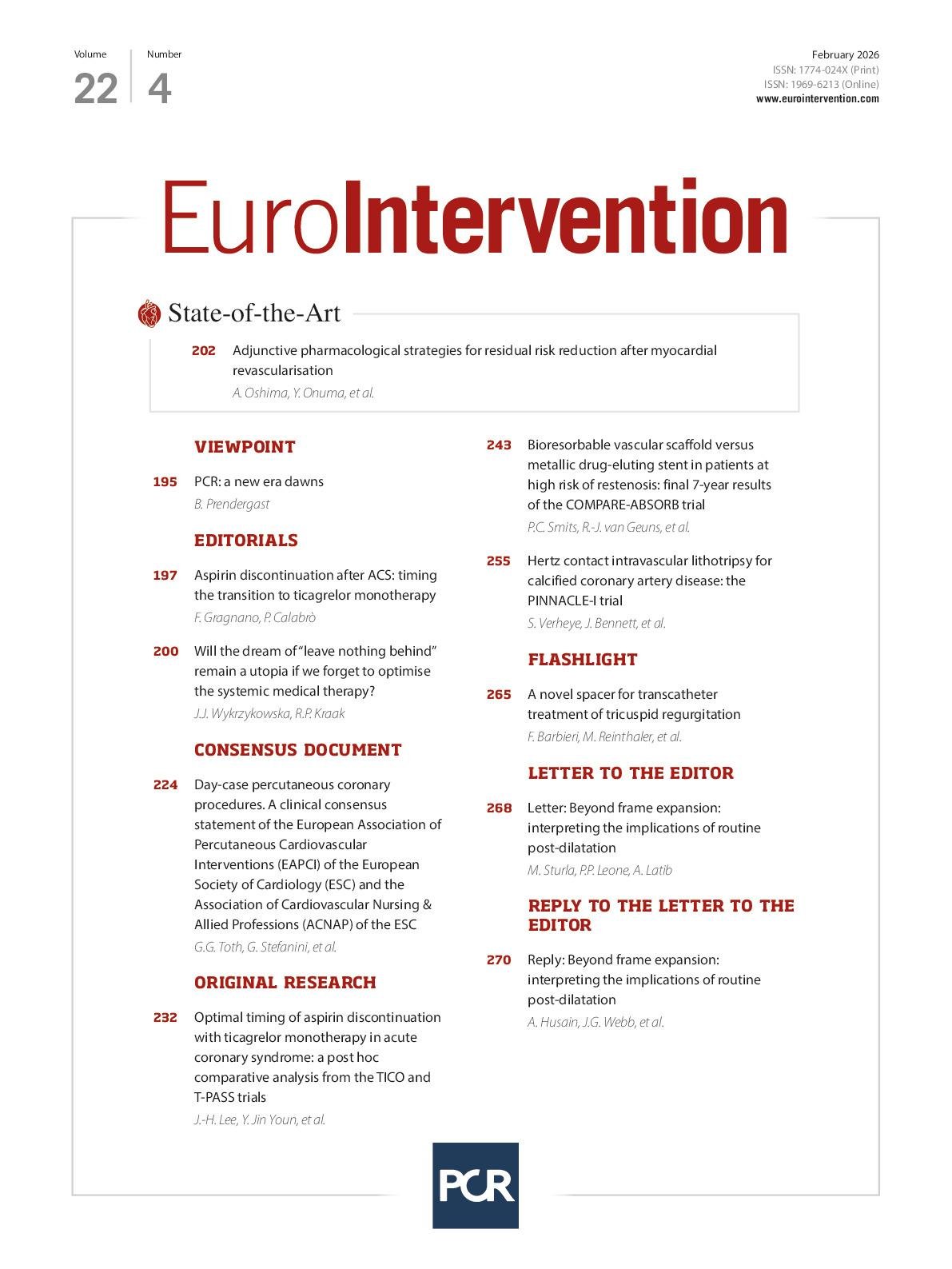
Abstract
Background: The clinical outcomes of bioresorbable vascular scaffolds (BVS) compared with everolimus-eluting stents (EES) beyond 5-year follow-up are unknown.
Aims: This study aims to investigate clinical outcomes of BVS 7 years after implantation.
Methods: The COMPARE-ABSORB trial is an investigator-initiated, prospective randomised study. Patients at high risk of restenosis were randomly assigned to receive either a BVS or an EES. A dedicated implantation technique was recommended for BVS. The primary endpoint was target lesion failure (TLF), defined as the composite of cardiac death, target vessel myocardial infarction (TVMI), or clinically indicated target lesion revascularisation (CI-TLR). The primary and co-primary objectives were non-inferiority at 1 year and superiority of BVS at 7 years after a 3-year landmark analysis.
Results: Although enrolment was stopped at 1,670 patients (80% of the intended 2,100 patients; 848 patients receiving BVS and 822 EES) because of high thrombosis and TVMI rates in the BVS arm, non-inferiority for TLF at 1 year was met. At 7-year follow-up subsequent to a 3-year landmark analysis, the TLF rate of BVS was 6.7% versus 5.9% for EES (hazard ratio [HR] 1.14, 95% confidence interval [CI]: 0.76-1.77; p=0.53); therefore, superiority was not met. Cardiac death, TVMI, and device thrombosis rates did not differ between both groups; however, CI-TLR was significantly higher in the BVS arm (4.4% vs 2.2%; HR 1.97, 95% CI: 1.08-3.60; p=0.023).
Conclusions: After complete resorption, no benefit was observed with BVS compared with EES at 7-year follow-up, despite the use of a dedicated implantation protocol for BVS. In fact, after 3 years, more target lesion revascularisations occurred with BVS than with EES.
Sign up for free!
Join us for free and access thousands of articles from EuroIntervention, as well as presentations, videos, cases from PCRonline.com