Editorial

DOI: 10.4244/EIJ-D-25-01330

Aspirin discontinuation after ACS: timing the transition to ticagrelor monotherapy

Felice Gragnano1, MD, PhD; Paolo Calabrò1, MD, PhD

The optimisation of antiplatelet therapy after acute coronary syndromes (ACS) has evolved substantially in recent years, driven by the dual need to reduce thrombotic risk while minimising bleeding12. Although 12 months of dual antiplatelet therapy (DAPT) remains the conventional strategy used in most patients, accumulating evidence indicates that aspirin can be discontinued earlier when effective P2Y12 inhibition is maintained – an approach for which the strongest evidence derives from trials of ticagrelor monotherapy after 1-3 months of DAPT3. European guidelines have adopted this evidence with a conservative interpretation, issuing a Class IIa, Level of Evidence (LoE) A recommendation for P2Y12 inhibitor monotherapy after 3-6 months of DAPT in selected ACS patients not at high ischaemic risk, without specifying a preferred agent, despite notable differences in the supporting data for each P2Y12 inhibitor1. In contrast, the American guidelines have taken a more evidence-aligned position, assigning a Class I, LoE A recommendation to abbreviated DAPT (1-3 months) followed by ticagrelor monotherapy after percutaneous coronary intervention (PCI)2. Although this recommendation more accurately reflects contemporary evidence, the optimal timing...

Sign in to read
the full article

Forgot your password?
No account yet?
Sign up for free!

Create my pcr account

Join us for free and access thousands of articles from EuroIntervention, as well as presentations, videos, cases from PCRonline.com
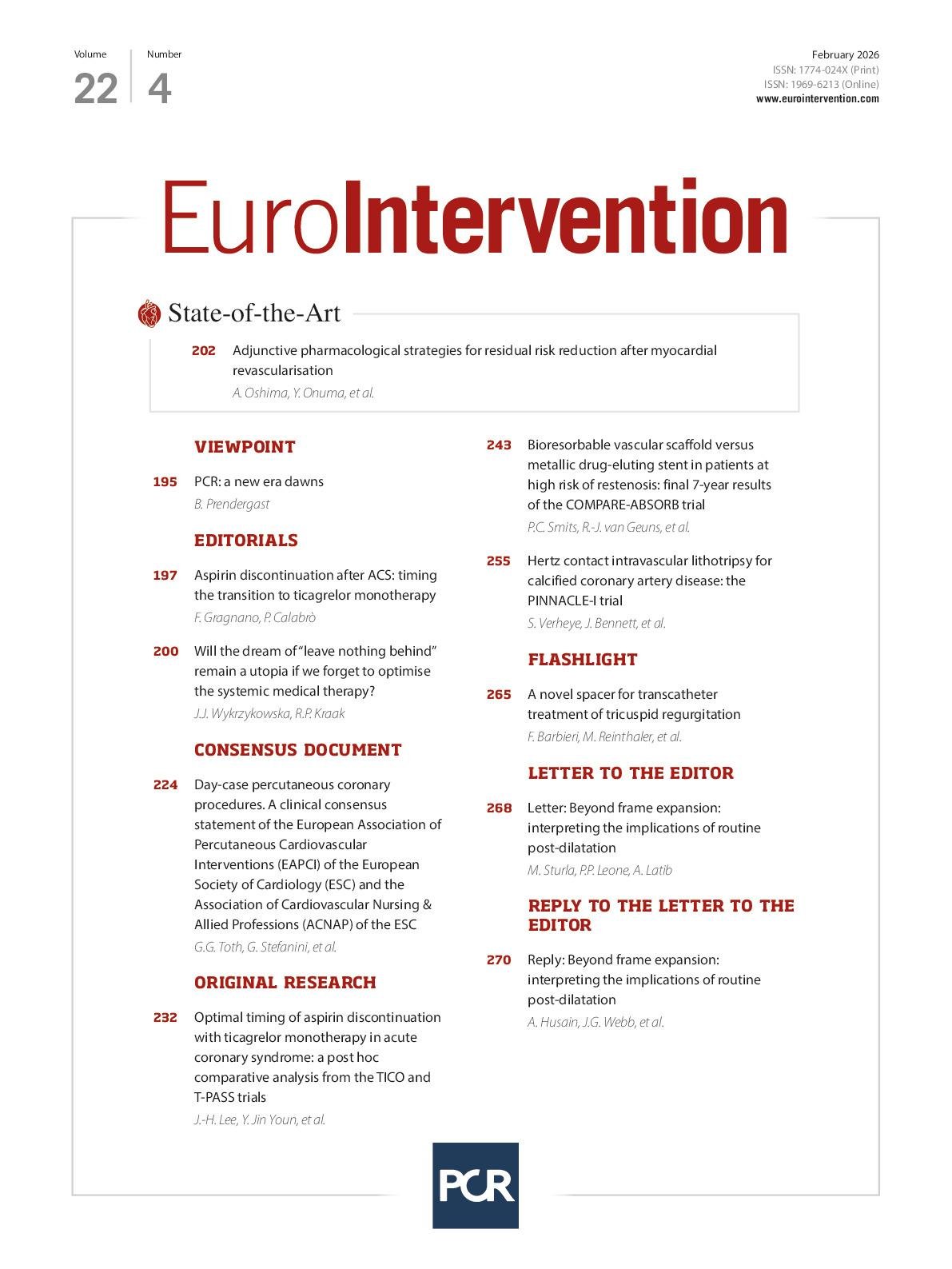
Volume 22 Number 4
Feb 16, 2026
Volume 22 Number 4
View full issue


Key metrics

Suggested by Cory

Clinical research

10.4244/EIJ-D-20-00145 Oct 23, 2020
Ticagrelor alone or conventional dual antiplatelet therapy in patients with stable or acute coronary syndromes
Franzone A et al
free
Trending articles
334.7

State-of-the-Art Review

10.4244/EIJ-D-21-00904 Apr 1, 2022
Antiplatelet therapy after percutaneous coronary intervention
Angiolillo D et al
free
84.05

State-of-the-Art

10.4244/EIJ-D-23-00840 Sep 2, 2024
Aortic regurgitation: from mechanisms to management
Baumbach A et al
free
45.75

State-of-the-Art

10.4244/EIJ-D-25-01346 May 4, 2026
Slow flow and no reflow after percutaneous coronary intervention
Brugaletta S et al
free
42.15

State-of-the-Art

10.4244/EIJ-D-25-00896 Apr 6, 2026
Pretreatment with antiplatelet agents in patients undergoing coronary revascularisation
Kaur G et al
free
38.2

State-of-the-Art

10.4244/EIJ-D-24-00195 Apr 7, 2025
Percutaneous coronary intervention for calcified and resistant lesions
Pesarini G et al
free
33.5

Original Research

10.4244/EIJ-D-26-00032 May 15, 2026
Glucocorticoids to reduce permanent pacemaker implantation after TAVI: the GLUCO-TAVI randomised trial
Fuertes-Kenneally L et al
32.2

State-of-the-Art

10.4244/EIJ-D-25-00874 Jun 1, 2026
TAVI and coronary interventions: indications, technical considerations, and clinical scenarios
Aquino Bruno H et al
free
29.2

Original Research

10.4244/EIJ-D-25-01370 May 21, 2026
Prognostic value of early haemodynamic valve deterioration after TAVI
Trimaille A et al
29.2

Original Research

10.4244/EIJ-D-25-01370 Jun 1, 2026
Prognostic value of early haemodynamic valve deterioration after TAVI
Trimaille A et al
X

PCR
Impact factor: 9.2
2025 Journal Citation Reports®
Science Edition (Clarivate Analytics, 2026)
Online ISSN 1969-6213 - Print ISSN 1774-024X
© 2005-2026 Europa Group - All rights reserved