Hypoattenuating leaflet thickening (HALT) after transcatheter aortic valve implantation (TAVI) is common. Conflicting data exist on the association between HALT and haemodynamic valve deterioration (HVD)12. Treatment with oral anticoagulation in patients with suspected HALT-related transcatheter heart valve (THV) dysfunction may be recommended. However, there is no consensus on the choice or duration of anticoagulation. While small registry data have suggested that direct oral anticoagulants (DOACs) might be equally effective as warfarin for the treatment of HALT3, others have shown that DOACs were linked to a higher ischaemic event rate than warfarin in patients with an indication for anticoagulation post-TAVI4. Here, we highlight two cases of HALT associated with HVD and the heterogeneity of response to treatment with DOACs.
An 80-year-old female underwent transfemoral TAVI with a 26 mm SAPIEN 3 Ultra (S3U) valve (Edwards Lifesciences) for severe bicuspid aortic stenosis. The immediate post-TAVI transthoracic echocardiography (TTE) showed a mean gradient (MG) of 7 mmHg. On routine 30-day TTE, an increase in the MG was noted (MG: 22 mmHg). Computed tomography (CT) revealed severe (grade 4/4) and mild (grade 1/4) HALT affecting the bioprosthetic non-coronary cusp and left coronary cusp leaflets, respectively. Although the patient remained asymptomatic, a decision was made to discontinue aspirin and start anticoagulation, with oral apixaban 5 mg bid, due to signs of HVD. Repeat TTE, after 3 months of therapy, showed a normalisation of gradients (MG: 7 mmHg) with complete resolution of HALT on CT (Figure 1, Moving image 1).
An 83-year-old male, who had undergone TAVI with a 26 mm S3U THV, presented with an elevated transaortic gradient at 12-month follow-up (MG: 7 mmHg to 30 mmHg). CT confirmed the presence of HALT (grade 3/4) affecting both the left and right coronary cusp leaflets. Treatment with oral rivaroxaban 20 mg daily monotherapy was initiated, but after 3 months, repeat TTE and CT showed persistent HALT with unchanged gradients. A decision was made to switch the anticoagulation strategy to warfarin, resulting in a significant improvement of HALT with a reduction in the transaortic gradient (MG: 20 mmHg) (Moving image 2).
The present report illustrates the pleomorphic presentations of HALT post-TAVI, which can, in some instances, be associated with HVD at any timepoint after the procedure. Treatment with DOACs or warfarin can resolve HALT5 and, potentially, restore normal THV haemodynamics. However, routine anticoagulation can be problematic, particularly in patients at high bleeding risk, and careful assessment of the risk/benefit balance is critical until more data emerge regarding the haemodynamic and prognostic implications of HALT. Here, heterogeneity of response to DOACs was observed, which might be explained by several factors, including patient characteristics (clinical, anatomical, and procedural) and different degrees of HALT severity and duration. The optimal treatment strategy for HALT-related HVD needs to be further explored.
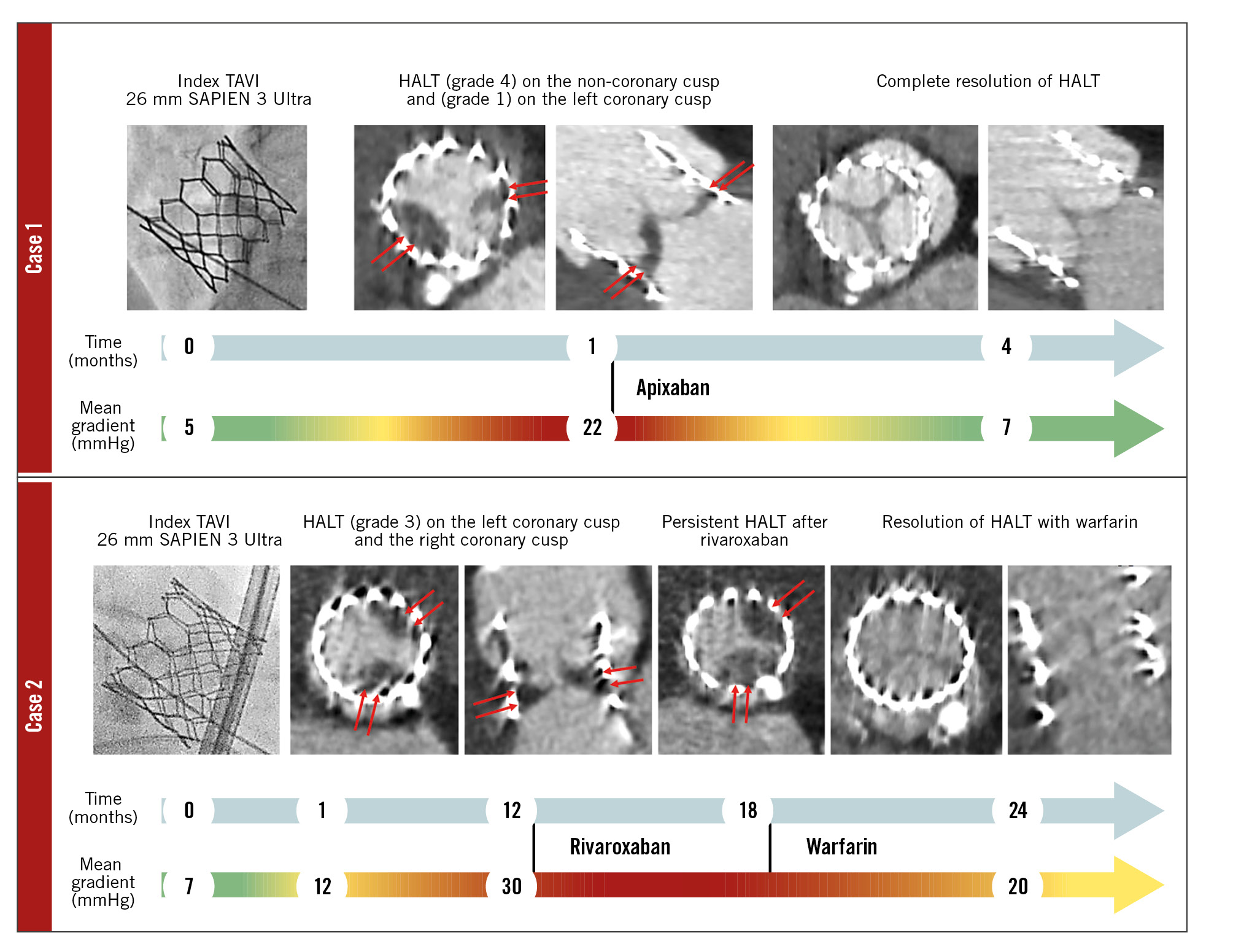
Figure 1. Heterogeneity of response to DOACs in patients with hypoattenuating leaflet thickening. Colour legend: green: normal gradient, red: elevated gradient. DOAC: direct oral anticoagulant; HALT: hypoattenuating leaflet thickening; TAVI: transcatheter aortic valve implantation
Conflict of interest statement
J.G. Webb is a consultant for Edwards Lifesciences; and receives research funding from Edwards Lifesciences, Medtronic, and Boston Scientific. J.A. Leipsic is supported by a Canadian Research Chair in Advanced Cardiopulmonary Imaging; consults for MVRx, HeartFlow Inc., and Circle Cardiovascular Imaging; and provides CT core lab services for Edwards Lifesciences, Medtronic, Neovasc, Boston Scientific, and Tendyne Holdings/Abbott, for which no direct compensation is received. D. Meier has received an institutional grant from Edwards Lifesciences. S.L. Sellers is a consultant to Edwards Lifesciences, Anteris, Excision Medical, and Medtronic; and has received research support from Medtronic, ViVitro Labs, and Edwards Lifesciences. The other authors have no relevant conflicts of interest to declare.
Supplementary data
To read the full content of this article, please download the PDF.
Moving image 1. Resolution of HALT with apixaban.
Moving image 2. Persistent HALT despite treatment with rivaroxaban and resolution of HALT after switching to warfarin.