Clinical research

DOI: 10.4244/EIJ-D-25-01328

Impact of device implantation depth on blood flow dynamics after left atrial appendage closure

Pedro Cepas-Guillén1, MD, PhD; Carlos Albors2, PhD; Jordi Mill2, PhD; Adel Aminian3, MD; Philippe Garot4, MD; Ole De Backer5, MD, PhD; Jens Erik Nielsen-Kudsk6, MD, PhD; Xavier Iriart7, MD, PhD; Manuel Barreiro-Perez8, MD, PhD; Eduardo Flores-Umanzor1, MD, PhD; Ignacio Cruz-González9, MD, PhD; Dabit Arzamendi10, MD, PhD; Marisa Avvedimento11, MD, PhD; Luis Nombela-Franco12, MD, PhD; Nina Leduc3, MD; Jérôme Horvilleur4, MD; Klaus Fuglsang Kofoed5, MD, MSc; Kasper Korsholm6, MD; Hubert Cochet7, MD; Rodrigo Estevez-Loureiro8, MD, PhD; Manal Barrouhou2, MSc; Ana Lafond9, MD, PhD; Xavi Millán10, MD, PhD; Laura Sanchis1, MD, PhD; Josep Rodés-Cabau1,11, MD, PhD; Oscar Camara2, PhD; Xavier Freixa1, MD, PhD

Abstract

Background: Device-related thrombus (DRT) remains a concern after left atrial appendage closure (LAAC), particularly when the device is deeply implanted. However, the mechanistic links between implantation depth, flow dynamics, and DRT risk are not well understood.

Aims: We therefore aimed to evaluate the impact of LAAC device implantation depth on local flow characteristics and its association with DRT using patient-specific computational fluid dynamics (CFD).

Methods: The study included 285 patients undergoing LAAC with either Amplatzer Amulet or WATCHMAN devices at 10 centres. Patient-specific CFD simulations were performed using postprocedural computed tomography and echocardiography-derived boundary conditions to assess blood flow dynamics. The primary endpoint was the comparison of CFD-derived flow indices – device surface velocity index (DSVI), endothelial cell activation potential (ECAP), and the presence of eddies/stagnated flow – between proximal and distal device implantation groups. Secondary analyses explored the relationship between these flow features and DRT.

Results: Proximal implants (57.2%) showed more favourable flow patterns: higher DSVI (0.11 m/s vs 0.09 m/s; p=0.002), lower ECAP (0.75 vs 0.90; p=0.003), and fewer recirculating zones (40.5% vs 74.6%; p<0.001). DRT incidence increased with greater implantation depth, paralleled by worsening flow indices. A composite CFD-based DRT risk score, incorporating ECAP, implantation depth, and flow complexity, demonstrated good discrimination (area under the receiver operating characteristic curve [AUC] 0.81), outperforming anatomical depth alone (AUC 0.71).

Conclusions: Deeper LAAC device implantation is associated with adverse flow profiles and a higher risk of DRT. CFD-based flow characterisation may enhance risk stratification beyond anatomical criteria alone. Further studies incorporating clinical variables are warranted to validate these methods.

Sign in to read
the full article

Forgot your password?
No account yet?
Sign up for free!

Create my pcr account

Join us for free and access thousands of articles from EuroIntervention, as well as presentations, videos, cases from PCRonline.com
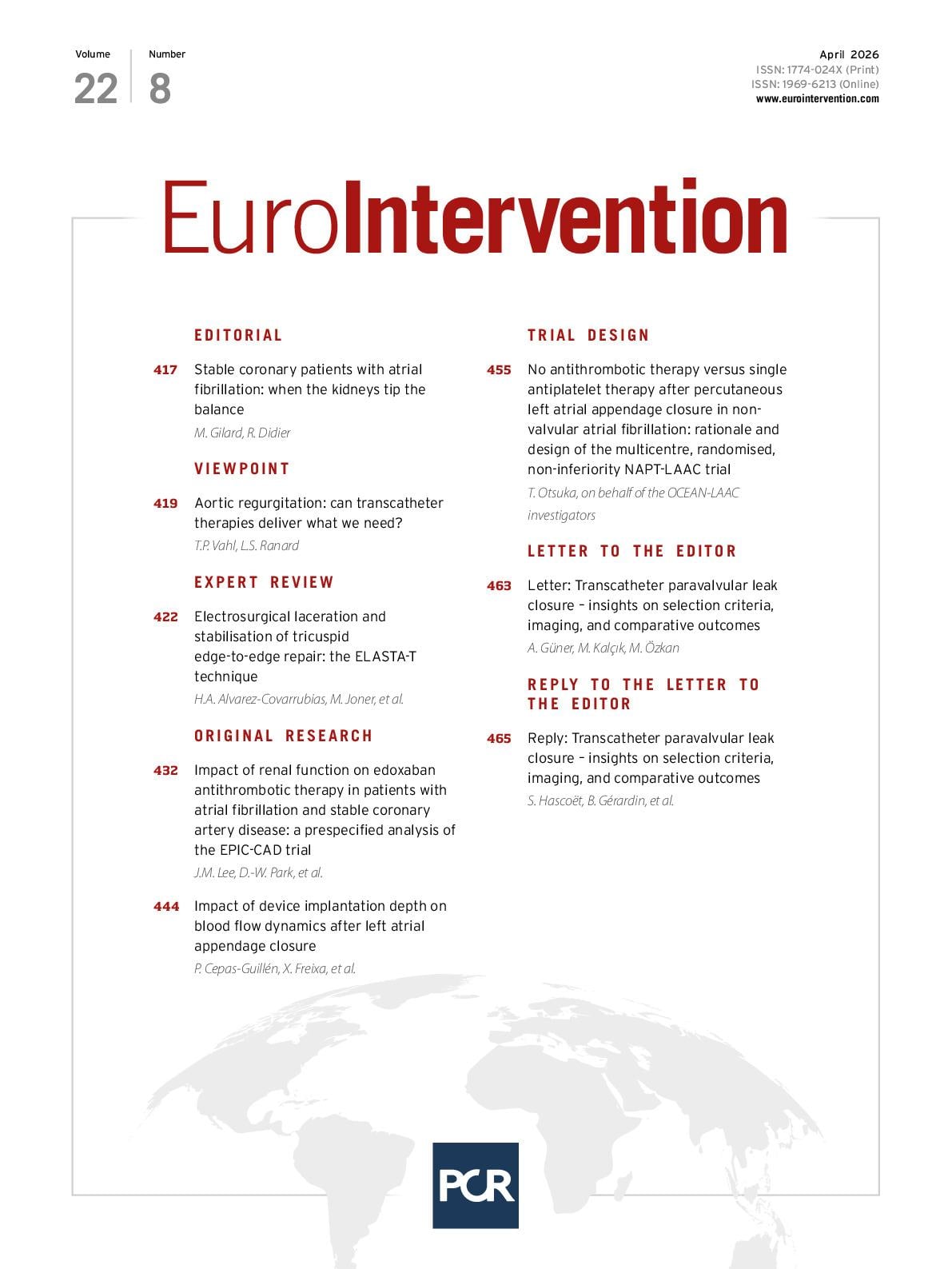
Volume 22 Number 8
Apr 20, 2026
Volume 22 Number 8
View full issue


Key metrics

Suggested by Cory

Editorial

10.4244/EIJ-E-24-00041 Aug 19, 2024
Left atrial appendage occlusion needs lifetime management not lifetime medications
Gafoor S and Panaich S
free

Expert review

10.4244/EIJ-D-21-01010 Jun 24, 2022
Device-related thrombus following left atrial appendage occlusion
Simard T et al
free

Focus article

10.4244/EIJY19M08_01 Jan 17, 2020
EHRA/EAPCI expert consensus statement on catheter-based left atrial appendage occlusion – an update
Glikson M et al
free

Original Research

10.4244/EIJ-D-25-00757 Dec 15, 2025
Watchman FLX versus Watchman 2.5 for left atrial appendage closure: a propensity score-matched analysis
Galea R et al

EXPERT REVIEW

10.4244/EIJ-D-17-00469 Nov 20, 2017
Residual leaks following percutaneous left atrial appendage occlusion: assessment and management implications
Raphael CE et al
free

Image – Interventional flashlight

10.4244/EIJ-D-18-00512 May 20, 2019
A new practical anatomical classification for left atrial appendage closure
Cressa L et al
free

State-of-the-art

10.4244/EIJ-D-22-00627 Feb 6, 2023
Left atrial appendage occlusion
Holmes D et al
free
X

PCR
Impact factor: 9.5
2024 Journal Citation Reports®
Science Edition (Clarivate Analytics, 2025)
Online ISSN 1969-6213 - Print ISSN 1774-024X
© 2005-2026 Europa Group - All rights reserved