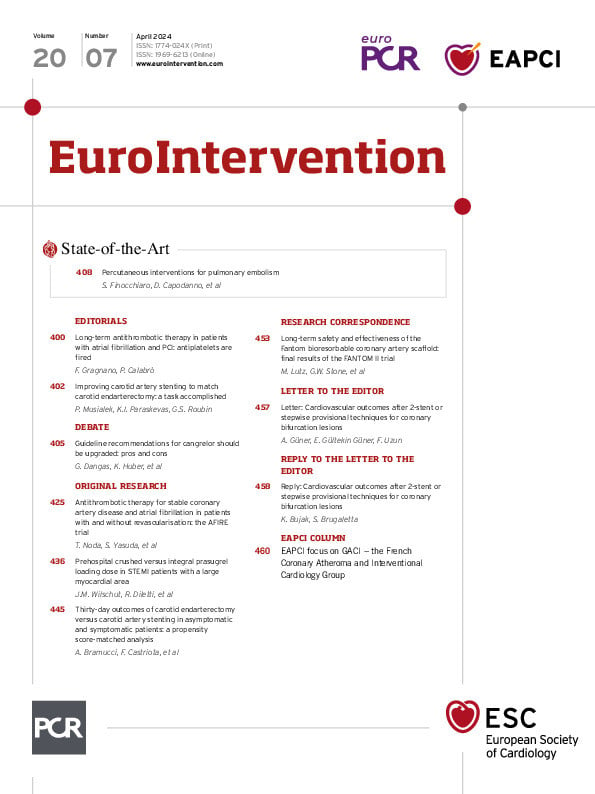
There is always a lot going on in our field – and just keeping up with the latest research can sometimes seem like a full-time job. We are here to help, and that’s why we often provide you with state-of-the-art and expert reviews as well as touching on a vast range of topics, for instance, in this issue, from outcomes in carotid artery interventions to an interesting approach to using crushed prasugrel in STEMI patients and much more. Read on, and I am sure you will find something of interest!
Percutaneous treatment of pulmonary embolism
Simone Finocchiaro, Davide Capodanno and colleagues offer a state-of-the-art review of emerging percutaneous interventional procedures for pulmonary embolism, including catheter-directed thrombolysis and mechanical thrombectomy, providing guidance on the selection of patients and the appropriate treatments.
See page e408
Efficacy of antithrombotic monotherapy according to revascularisation
Takashi Noda, Satoshi Yasuda and colleagues demonstrate that rivaroxaban monotherapy had favourable safety and efficacy outcomes over combination therapy in high thrombotic risk patients with a history of prior revascularisation in this post hoc analysis of the AFIRE trial.
See page e425
Crushed prasugrel loading dose in STEMI patients
Jeroen M. Wilschut, Roberto Diletti and colleagues investigate if patients with a large myocardial infarction benefit from prehospital administration of a crushed prasugrel loading dose. Improvements in postprocedural TIMI 3 flow after receiving the crushed loading dose led the authors to believe this may be a rapid and cost- effective strategy to improve myocardial perfusion.
See page e436
Comparison of carotid artery stenting- and carotid endarterectomy-related outcomes
Alberto Bramucci, Fausto Castriota and colleagues compare carotid endarterectomy and carotid artery stenting for the treatment of extracranial carotid artery stenosis. Carotid artery stenting has developed on both the surgical and endovascular fronts, and the authors find the 30-day outcomes for stroke, acute myocardial infarction, and death to be similar for both carotid artery stenting and carotid endarterectomy.
See page e445