EAPCI Column

DOI:

EAPCI Focus on the EAPCI Scientific Programme and Congress Committee

What is the role of the committee?

For the 2022-2024 term, my Co-Chair Professor Nicole Karam and I, along with the EAPCI Scientific Programme and Congress Committee members, have defined our goal as serving the unmet educational needs of the interventional community. This was to be achieved by providing platforms for the interventional community to share scientific achievements. We found it also very important to create bridges and links to other subspecialities and European Society of Cardiology (ESC) working groups.

How does the EAPCI Scientific Programme and Congress benefit the interventional cardiologist?

As stated in its name, the EAPCI Scientific Programme and Congress Committee has the task of designing and managing the scientific content of EAPCI events. Above all, this includes EuroPCR, PCR London Valves and EAPCI sessions at the ESC Congress. Beyond this, EAPCI has been present at several national and international congresses and meetings within Europe from Germany to Bulgaria, as well as worldwide from Egypt to China. Our Committee has developed joint sessions with several national cardiac societies, in synergy with EAPCI Young Committee. This has enhanced EAPCI visibility at national level, as well as induced new channels of cooperation.

Parallel to that, our Committee has been responsible for coordinating multiple online events and webinars, which have become available over the year, covering various topics, often in collaboration with other subspecialities.

What has been the biggest achievement of your committee?

I do not believe that we could underline one single big achievement. I would instead emphasise that the Committee kept its main objective continuously in focus and made great efforts to follow its mission. We believe the last two years' term has been a fruitful collaboration of this great team of committee members. This has resulted in development and initiation of great session proposals for the main congresses; EAPCI has started proactively collaborating with national societies all over the globe; and last but not least the webinar catalogue now contains a stunning list of programmes.

How can EAPCI members becoming involved in the work of the Scientific Programmme and Congress Committee?

EAPCI is eager to connect with national societies. This is why we have been present at numerous national meetings in collaboration with local societies. Such connections are mostly initiated by local EAPCI members, who share the idea that such networks are beneficial for both parties, but mostly for the interventional community. Of course, such events are also good platforms to extend the network and to identify future active members of the EAPCI committees.
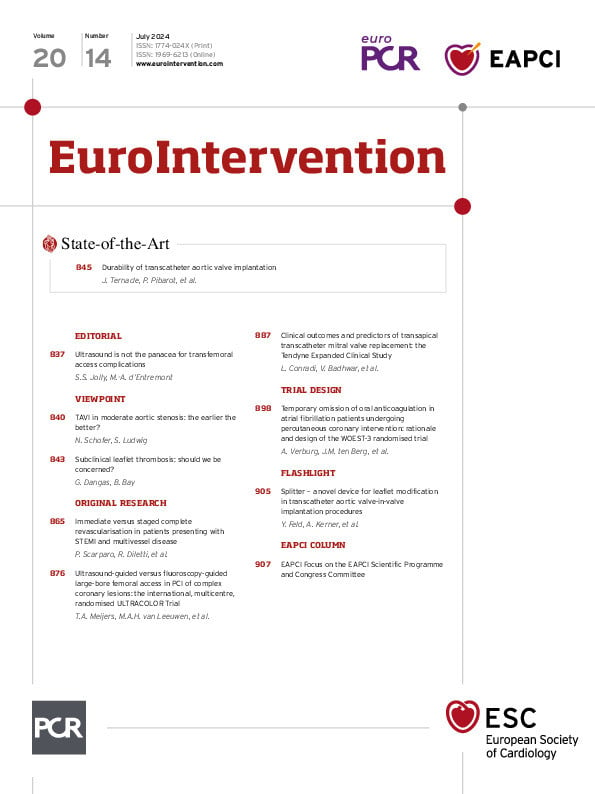
Volume 20 Number 14
Jul 15, 2024
Volume 20 Number 14
View full issue

Suggested by Cory

Editorial

10.4244/EIJ-D-26-00453 Jul 6, 2026
AnchorMan versus Watchman 2.5: a randomised comparison in left atrial appendage closure
Garot P and Nielsen-Kudsk J
free

Editorial

10.4244/EIJ-E-26-00011 Jul 6, 2026
Comparing transcatheter aortic valves: time to look beyond simplistic categorisations
Blackman D and Maznyczka A
free

Original Research

10.4244/EIJ-D-26-00158 Jul 6, 2026
Prosthesis-patient mismatch with intra-annular self-expanding valves: an analysis of the PORTICO IDE trial
Fontana G et al

Research Correspondence

10.4244/EIJ-D-26-00315 Jul 6, 2026
Validation of the VARC-HBR consensus for defining high bleeding risk in TAVI
Singh M et al

Research Correspondence

10.4244/EIJ-D-26-00271 Jul 6, 2026
Outcomes of percutaneous mechanical aspiration in left-sided infective endocarditis
Lugo-Fagundo NS et al

Flashlight

10.4244/EIJ-D-26-00128 Jul 6, 2026
Concomitant transfemoral aortic and mitral valve replacement
Lianos I et al
Trending articles
334.7

State-of-the-Art Review

10.4244/EIJ-D-21-00904 Apr 1, 2022
Antiplatelet therapy after percutaneous coronary intervention
Angiolillo D et al
free
84.05

State-of-the-Art

10.4244/EIJ-D-23-00840 Sep 2, 2024
Aortic regurgitation: from mechanisms to management
Baumbach A et al
free
45.75

State-of-the-Art

10.4244/EIJ-D-25-01346 May 4, 2026
Slow flow and no reflow after percutaneous coronary intervention
Brugaletta S et al
free
42.15

State-of-the-Art

10.4244/EIJ-D-25-00896 Apr 6, 2026
Pretreatment with antiplatelet agents in patients undergoing coronary revascularisation
Kaur G et al
free
38.2

State-of-the-Art

10.4244/EIJ-D-24-00195 Apr 7, 2025
Percutaneous coronary intervention for calcified and resistant lesions
Pesarini G et al
free
33.5

Original Research

10.4244/EIJ-D-26-00032 May 15, 2026
Glucocorticoids to reduce permanent pacemaker implantation after TAVI: the GLUCO-TAVI randomised trial
Fuertes-Kenneally L et al
32.2

State-of-the-Art

10.4244/EIJ-D-25-00874 Jun 1, 2026
TAVI and coronary interventions: indications, technical considerations, and clinical scenarios
Aquino Bruno H et al
free
29.2

Original Research

10.4244/EIJ-D-25-01370 May 21, 2026
Prognostic value of early haemodynamic valve deterioration after TAVI
Trimaille A et al
29.2

Original Research

10.4244/EIJ-D-25-01370 Jun 1, 2026
Prognostic value of early haemodynamic valve deterioration after TAVI
Trimaille A et al
X

PCR
Impact factor: 9.2
2025 Journal Citation Reports®
Science Edition (Clarivate Analytics, 2026)
Online ISSN 1969-6213 - Print ISSN 1774-024X
© 2005-2026 Europa Group - All rights reserved