When, in the past, I have been told that the figures in EuroIntervention had improved, I have been genuinely surprised; to me, they were still far from the standard I aspired to. We had certainly made progress in areas I consider essential – consistency in colours, line styles, fonts, and many seemingly minor details that may be invisible to most readers but are, in fact, critical. When figure preparation is left entirely to authors, almost anything can happen – excellent scientists are not necessarily professional graphic designers. Even when authors are visually skilled, individual styles inevitably differ, and the overall visual coherence of our electronic table of contents has never fully satisfied me.
We then introduced the position of the Visual Editor, which I believe remains uncommon among the journals to which I have submitted manuscripts over the course of my career. This role is for someone who not only has a strong sense of visual design but also understands the scientific content well enough to guide authors on decluttering, layout, and an effective visual hierarchy. However, this alone was not sufficient. Ultimately, in my view, what truly distinguishes a journal is the artwork.
I do not know whether, in two or three years, professional illustrators will still exist or whether their role will be replaced by artificial intelligence – some of these tools are, objectively, remarkable. For now, however, if the goal is to illustrate a concept and make it memorable in the way journals such as NEJM or JAMA do, a professional graphic artist remains essential. This position requires close collaboration between the Visual Editor and the authors to produce the best possible illustrations. It is a bespoke, handcrafted process that, at least for now, artificial intelligence cannot replicate in a way that meets my expectations.
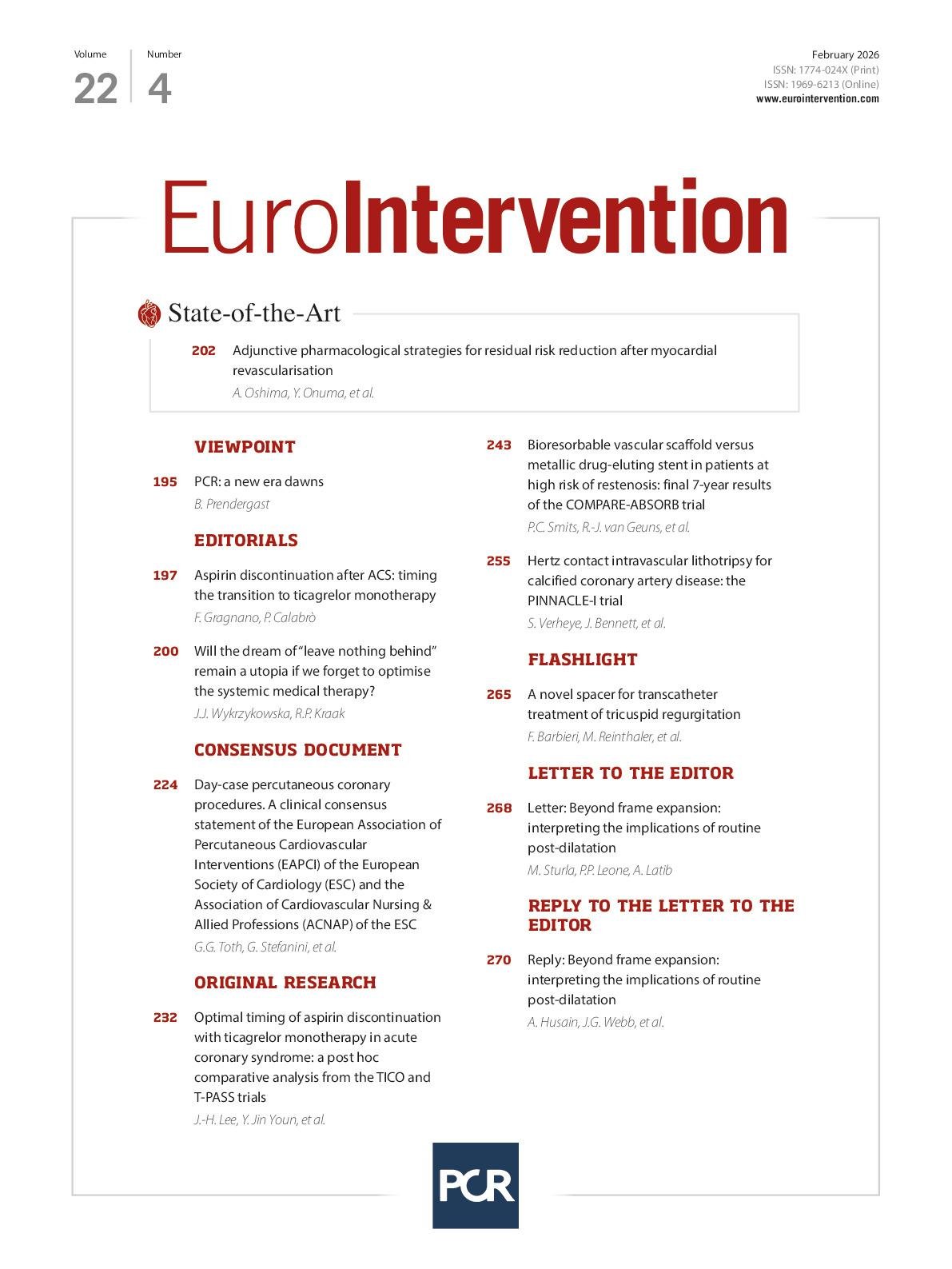
For this reason, I am pleased to announce that, starting this year, we will periodically introduce original artwork in our articles. Our intention is to further enhance our reviews and turn them into truly collectible pieces. You may have noted our first piece in an expert review on endomyocardial biopsy; the second follows in this issue with more to come over the course of the year. You will also note our new cover which brings our expanding family of journals into visual alignment as well as a new Viewpoint column by Bernard Prendergast, the Chairman of PCR.
And now, we turn to the articles:
We open this issue with a state-of-the-art from Asahi Oshima, Yoshinobu Onuma and colleagues on adjunctive pharmacological strategies for the management of atherosclerotic cardiovascular disease. This review explores the current evidence on lipid-lowering and anti-inflammatory therapies, beginning with the well-established statins, then exploring emerging therapeutic options for residual lipid and inflammatory risks.
Next, Gabor G. Toth, Giulio Stefanini and colleagues present a consensus document on day-case percutaneous coronary procedures. This clinical consensus statement from the European Association of Percutaneous Cardiovascular Interventions of the European Society of Cardiology and the Association of Cardiovascular Nursing & Allied Professions is intended as a resource for patient selection, procedural considerations, and postprocedural patient management, and provides advice as to when regular admissions may be warranted for patient safety.
In original research, we begin with the timing of aspirin discontinuation in acute coronary syndrome (ACS) patients undergoing percutaneous coronary intervention (PCI). Using patient-level data from the TICO and T-PASS trials, Jung-Hee Lee, Young Jin Youn and colleagues compare aspirin discontinuation within 1 month or at 3 months after PCI, with all patients maintained on ticagrelor monotherapy thereafter. Discontinuation within 1 month was associated with reduced net clinical adverse events, driven by a significant reduction in major bleeding without an increase in ischaemic complications. Felice Gragnano and Paolo Calabrò continue the discussion in an accompanying editorial.
Then, the final 7-year results of the COMPARE-ABSORB trial are shared by Pieter C. Smits, Robert-Jan van Geuns and colleagues. The trial compared the clinical outcomes of bioresorbable vascular scaffolds (BVS) with everolimus-eluting stents in patients at high risk for coronary restenosis and is the first to report BVS-related outcomes beyond 5 years. BVS showed no benefit in the primary endpoint of target lesion failure, despite complete resorption, and higher target lesion revascularisation rates were associated with BVS between 3 and 7 years. In an accompanying editorial, Joanna J. Wykrzykowska and Robin P. Kraak comment on where the ‘leave nothing behind’ approach stands after these surprising results.
Finally, in the PINNACLE-I study, Stefan Verheye, Johan Bennett and colleagues assess the LithiX Hertz Contact Intravascular Lithotripsy system − a novel mechanical device requiring neither an external energy source nor capital equipment. The authors evaluate the safety and performance of the system in 60 patients with moderately to severely calcified de novo lesions, with an optical coherence tomography substudy included. Effective calcium modification, optimised stent parameters, ease of use, and a positive safety profile were all demonstrated.
As always, we wish you an enjoyable reading experience.