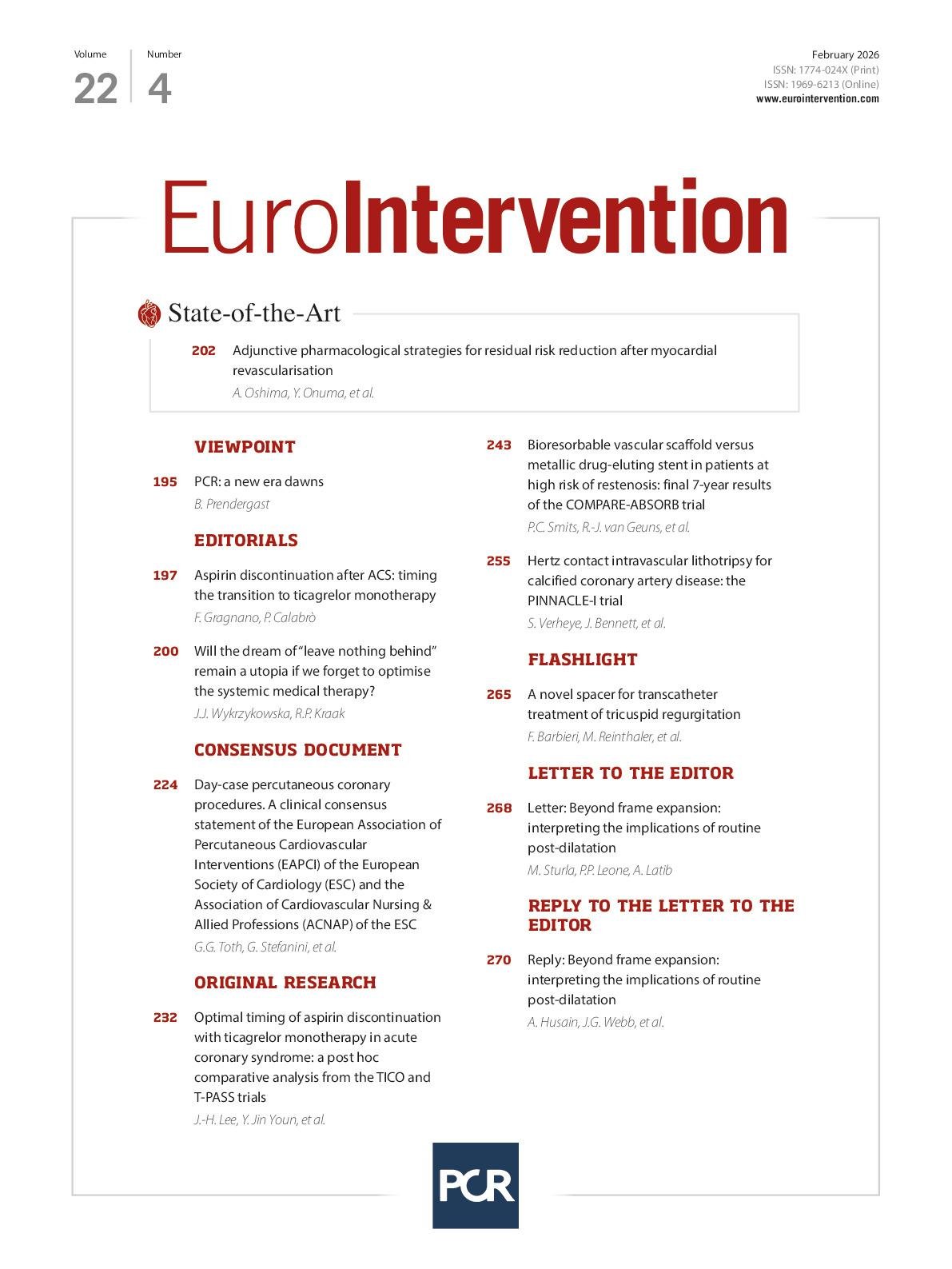
Welcome to this first print edition of EuroIntervention in 2026, and a belated Happy New Year! The midnight bells of 31 December 2025 ushered in a new era for PCR and I am grateful to you for taking the time to read this first in a series of occasional editorials that will highlight the PCR educational mission and our latest news.
Passing the flame
Of course, my first priority is to pay tribute to William Wijns and Jean Fajadet, who have led the PCR Family for over 15 years and now transition smoothly to join Jean Marco (the founder of PCR) as Honorary Chairs. Theirs will be a very difficult act to follow, and I will endeavour to maintain their high standards and zeal for excellence in conjunction with my friends and colleagues who make up the new PCR Leadership Team (Nicolas Dumonteil, Martine Gilard, Emanuele Barbato, and Didier Tchétché) and the PCR Board.
William and Jean have worked tirelessly to ensure the quality and international reach of our organisation, transforming the PCR family into one of the most formidable forces in continuing medical education worldwide. Working across continents and progressively incorporating a wide and diverse community that excels in both education and clinical practice, they have developed the PCR portfolio far beyond educational courses and seminars, embracing a new and vital role as the engine of a dynamic and interactive community of health professionals. As a consequence, PCR is the now the place where the next generation of interventional cardiologists and related specialists, nurses, and allied professionals can grow and acquire the clinical knowledge and personal skills needed both to advance their professional lives and to better serve their patients and communities.
New horizons
2025 was also the year that saw the end of PCR’s formal partnership with the European Association of Percutaneous Cardiovascular Intervention (EAPCI), a historic 20-year relationship that the PCR founders helped to create. The circumstances of this rift are complex, but change is always a positive thing if managed constructively. The worldwide interventional community is vast, with continual needs in education, innovation, and research, and we remain committed to a positive future relationship with the European Society of Cardiology (ESC) and other international organisations that will keep our speciality united and allow the next generation to prosper. Importantly, these new circumstances have also provided PCR with a welcome opportunity for self-reflection and allowed us to take stock of our historic foundations and rich experience, galvanise our commitment and dedication to a longstanding educational mission, and realign for expansion and collaboration on an international scale.
The sharing of education, science, and innovation
PCR is far more than just two annual flagship courses in Paris and London – even though these together attract over 16,000 participants year on year. Our in-depth offering also includes highly popular annual courses in Europe, Asia, Africa, the Middle East, and South America, well-established collaborations with multiple national societies worldwide, a successful rolling calendar of interactive seminars and webinars, a burgeoning educational programme specifically targeting the next generation of young interventional cardiologists and related specialists, a thriving interactive community of almost 20,000 PCR Companions, and a buzzing PCRonline website that provides 24/7 access to a library of sessions from recent courses, educational cases, and information concerning the latest innovations in our field. Each of these elements is a critical part of our identity and unites a multitude of regions, interests, and dedicated multidisciplinary professionals who share a common goal – to work together to improve medical care for all.
As you read this editorial, consider also how PCR is embedded in the domain of scientific research and innovation, focussing on the core themes of coronary intervention and valve disease, as well as the related disciplines of stroke prevention and heart failure. Whilst principally a community of active clinicians (also known as “doers”), many senior figures within the PCR family are highly respected clinical investigators as well, leading pivotal international trials, contributing to international guidelines and state-of-the-art publications, and supporting the development and clinical application of innovative devices in collaboration with industry partners. These scientific endeavours will continue to feature strongly in the programme of our courses, alongside world-leading educational content that will guide their clinical implementation. Meanwhile, EuroIntervention celebrated its 20th anniversary in 2025 and is now one of the most respected and highly cited journals in the field of cardiovascular intervention, with a continuously escalating impact factor (currently 9.5). Emerging in 2026, a daughter journal, EuroIntervention Case Reports, will focus on complications, unexpected or unusual clinical scenarios, and the clinical application of new innovations, while long-established, key reference PCR publications (including the popular PCR Textbook and the PCR Trials Book) will be continuously updated and refreshed.
Building the future
PCR is a community of like-minded individuals committed to excellence and a patient-centred approach to medicine who have come together to learn, share, and enjoy the company of their colleagues. As we look to the future, our continuing priority will be the training of the next generation of interventional cardiologists and related specialists, nurses, and allied professionals. Our high quality of medical education and reputed style of interaction and networking will continue to permeate every format and session of every course, seminar, and webinar. You only need attend a PCR event once to know that you are part of something that is unique, special, and – by design and from the outset – "By and For" the participants.
The PCR team look forward to working together with you in 2026 with the shared goals of uniting the entire interventional community and improving medical care for our patients.